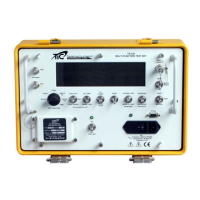
User Manual SDR-OMNI Avionics Test Set
Page 94 6 June 2023 Revision B
Table 5-12. Audio Intercom Test Screen Fields
Section in the upper portion of the screen that displays measured
parameters of the audio input signal
Determines audio filter type:
• 300 Hz – 3 kHz BP (bandpass): default: best filter for audio
• 3 kHz LP (low pass)
• 15 kHz LP (low pass)
• None
Selects display of Vp-p (peak-to-peak) or Vrms (root-mean squared)
Displays measured voltage of audio input signal in Vp-p or Vrms
Selects type of distortion to be displayed: SINAD (signal-to-noise and
distortion ration) or THD+N (total harmonic distortion + noise)
Displays SINAD or THD+N, depending on selection above
Section in the center of the screen that allows user to control Audio
Output parameters (frequency, level, and type of signal)
The output signal can be a Sine (default), Square, Triangle, or Ramp.
Note that signals that are not sine waves become increasingly distorted
at higher frequencies as the harmonics get filtered above 20 kHz
Enter an audio frequency from 20 Hz to 20 kHz
Enter a voltage level from 0 to 2.0 Vp-p
Activates the audio output
Mic Out: Mic Level
ON/OFF
Activates the SDR-OMNI headset mic when it is connected and sets its
output level.
When connected, the SDR-OMNI headset listens to the audio input
signal. The slider bar sets the volume level to the headset.


 To Next Page
 Loading...