TECHNISONIC INDUSTRIES LIMITED
www.til.ca
TAF-550 Installation & Operating Instructions TiL 96RE187 Rev D
3-15
3.5 TFM-138B OPERATING FEATURES
The TFM-138B has several important operating features which include:
1. 120 memory positions which can each be programmed with a transmit and receive
frequency with 25 or 12.5 kHz channel spacing, Tx/Rx CTCSS tones or DPL codes and a
9-character alphanumeric title.
2. 2 guard channels which can each be programmed with a Rx frequency with 25 or 12.5
kHz channel spacing, CTCSS Tx tone or DPL code and a 9-character alphanumeric title.
3. Scanning of preprogrammed memories with selective memory scanning.
4. Priority scan of memory channel 1, if desired.
5. Direct frequency entry mode.
6. Receive frequency simplex function.
7. Switchable RF output power between 1 watt and 8-10 watts.
8. Lockout of keyboard to prevent inadvertent entries.
9. Variable frequency mode to manually scan up and down in 2.5 kHz steps.
10. LED display variable dimming mode.
11. Selectable 90 second Tx time out feature.
12. Quick download of any of the 120 memory positions to the guard memories.
13. PC Memory download capability.
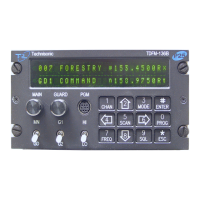
3.5.1 OPERATING INSTRUCTIONS (See Figure 3.3)
1. Switch power on by turning the main volume clockwise. The last programmed
frequencies will be displayed. The transceiver is now in normal operating mode.
2. Adjust the audio level by adjusting the main and guard volume knobs.
3. Pressing the squelch defeat button will open both receivers to confirm they work.
4. Read the display. The top line will indicate which memory is selected followed by a "+" if
the memory position is included in the scan list, an alpha-numeric message, and the
frequency of the main receiver. A small "n" before the frequency indicates 12.5 kHz
narrowband channel spacing is in effect on this memory position. In the receive mode,
the frequency is followed by an "RT" if a RX CTCSS tone or RX DPL code is
programmed, or an "RX" if no Receive tone/code is programmed. Similarity in the
transmit mode either a "TT" or "TX" is shown after the frequency. The bottom line
indicates similar information about the guard receiver.
5. Only TX CTCSS tones or TX DPL codes may be programmed for the guard receiver. At
the beginning of each line, an LED indicates open squelch.


 To Next Page