Need help?
Do you have a question about the Timex 23 and is the answer not in the manual?
Details the Timex Model 23 movement's dimensions, V-conic bearings, and two-plate construction.
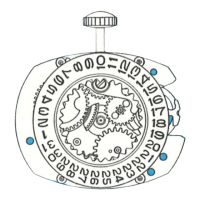
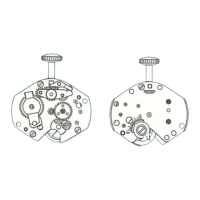
Illustrates the Timex Model 23 movement with an exploded diagram and a comprehensive parts list.
Step-by-step guide to detach the dial and hands from the movement.
Instructions for detaching the crown and stem using the set lever screw.
Procedure for carefully removing the balance assembly and its components.
Guidance on cleaning the watch movement using machines or manually.
Instructions for re-oiling the movement, including specific bearings and oils.
Steps for reinstalling the balance, adjusting the screw, and checking the hairspring.
The Timex Model 23 is a watch movement designed with a "V-conic" bearing system and a robust two-plate construction. This design approach, which utilizes full plates instead of traditional bridges, aims to enhance accuracy and ensure complete interchangeability of escapement and gear train components. This means that, unlike many watches that require selective fitting and adjustments during repair, the Model 23 is designed for straightforward component replacement, simplifying maintenance procedures.
The primary function of the Timex Model 23 movement is to power a timepiece, accurately keeping time through its intricate gear train and escapement mechanism. Its design emphasizes reliability and ease of service, making it a practical choice for watchmakers and repair technicians.
The "V-conic" bearing system is a key feature, employing two "V-conic" studs as bearings for the balance staff. One stud is driven into a screw on the movement plate, allowing for fine endshake adjustment. This precision adjustment is crucial for the optimal performance of the balance assembly, which is the heart of the watch's timekeeping accuracy. The movement's full plate design contributes to its overall stability and the consistent positioning of its internal components.
Maintenance of the Timex Model 23 movement is designed to be relatively simple, particularly for routine cleaning. For cleaning, it is only necessary to remove the minute hand, the dial, and the balance assembly. This streamlined disassembly process minimizes the risk of damaging other delicate components during cleaning. The recommended cleaning method involves placing the movement (with the dial plate down to ensure proper fluid drainage from the mainspring barrel) in a cleaning machine. It should be thoroughly swirled in cleaning fluid, followed by two sets of rinsing fluid, with the final rinse fluid being absolutely clean. After cleaning, the movement must be thoroughly dried. If a cleaning machine is unavailable, the same procedure can be performed manually by re-inserting the stem, grasping the movement firmly around the stem, and shaking it in the cleaning and rinsing fluids to ensure complete penetration throughout the mechanism. The balance assembly should always be cleaned separately in a small jar to prevent damage to its delicate hairspring. Only standard watch cleaning solutions are recommended for use.
For re-oiling, high-grade watch oils are to be used. The mainspring is permanently lubricated with a solid coating and should not be oiled during service. The "V-conic" bearings require specific lubrication, needing to be oiled at least three-quarters full before the balance is replaced.
If further dismantling beyond routine cleaning is required, such as to access the gear train, the movement plate can be removed. Reassembly should begin with the movement plate, ensuring that pivots are correctly positioned in their respective holes. An exploded view of the movement is provided in the manual to guide reassembly.
The process of removing the crown and stem involves turning the set lever screw approximately 1¼ turns. When reassembling the balance, it must be carefully tilted into the movement, inserting the movement-side pivot (hairspring side) first, followed by the dial-side pivot into the "V-conic" bearing. The balance screw should be adjusted just enough to hold the balance in place. The hairspring is then inserted into the regulator slot and hairspring wedge pin bracket by rotating the balance. Before re-pinning the hairspring, it's crucial to ensure the impulse pin is within the slot on the fork. The hairspring wedge pin must be straight and true, as any distortion can interfere with the hairspring's normal "breathing." Finally, the endshake is adjusted by applying minimal downward pressure to the balance screw, as excessive pressure can damage the balance staff points. The hairspring must also be centrally positioned within the regulator slot for optimal performance.
 General
| Brand | Timex |
|---|---|
| Model | 23 |
| Display type | Analog |
| Band material | Leather |
| Movement | Quartz |
| Water resistance | 30 meters |

 To Next Page