
 Need help?
Do you have a question about the TIS TIS258 and is the answer not in the manual?
Explanation of warning and caution safety labels and symbols.
Details the product warranty period, terms, and contact for service.
Step-by-step guide for measuring AC and DC voltage using the multimeter.
Procedure for measuring AC and DC current, including input terminal selection.
How to perform a diode test, including connecting leads and interpreting results.
Steps for testing continuity and the audible buzzer function.
Instructions for measuring electrical resistance, including range selection.
Guide for measuring temperature using the multimeter and a thermocouple.
Details ranges, resolution, accuracy, and overload protection for DC voltage.
Details ranges, resolution, accuracy, overload protection, and frequency range.
Details ranges, resolution, accuracy, and overload protection for DC current.
Details ranges, resolution, accuracy, and overload protection for AC current.
Details ranges, resolution, and accuracy for resistance measurements.
Details functions and criteria for diode and continuity tests.
Details ranges, resolution, and accuracy for temperature measurements.
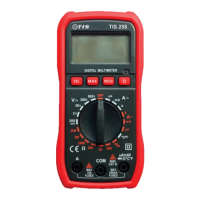
The TIS258 is a 3 1/2-digit digital multimeter designed for a wide range of electrical measurements. It offers a comprehensive set of functionalities, making it a versatile tool for both professionals and hobbyists. The device is characterized by its robust design and user-friendly interface, ensuring reliable and accurate readings across various applications.
The TIS258 multimeter is capable of measuring several electrical parameters, including AC/DC voltage, AC/DC current, resistance, and temperature. It also features diode testing and continuity indication with a buzzer. The device is equipped with a 2000-count display, providing clear and precise readings.
For voltage measurements, the TIS258 can handle both AC and DC voltages across multiple ranges, from millivolts up to 500V. This broad range allows for testing in various circuits, from low-power electronics to household electrical systems. The selection between AC and DC voltage is made easy with a dedicated "SEL" button, allowing users to switch between sine wave types as needed.
Current measurements are also supported for both AC and DC, with ranges extending from microamperes up to 10A. This capability is crucial for diagnosing current draw in circuits and ensuring proper operation of electrical components. The device provides different input terminals for current measurements: a mA input for currents less than 200mA and a 10A input for higher currents, ensuring safety and accuracy across different current levels.
Resistance measurements are available across a wide spectrum, from 200Ω to 20MΩ, enabling the testing of resistors, cables, and other components for their resistive properties. The multimeter automatically adjusts its range or prompts the user to increase the range if an "OL" (Over Limit) reading is displayed, ensuring that measurements are taken within the device's capabilities.
Beyond basic electrical parameters, the TIS258 also offers temperature measurement, with a range from -20°C to 750°C (-4°F to 1382°F). This feature is particularly useful for applications where temperature monitoring is critical, such as in HVAC systems, automotive diagnostics, or industrial processes. The temperature measurement is performed using a thermocouple, which connects to the V/ΩmA and COM input terminals.
Diode testing is another key function, allowing users to check the forward and reverse bias of diodes. This helps in identifying faulty diodes or ensuring they are functioning correctly within a circuit. The device indicates open circuit measurements as "OL" on the display.
Continuity indication is provided with an audible buzzer, which sounds when the resistance between the test leads is below 70Ω. This feature is invaluable for quickly checking for open or short circuits in wiring, fuses, and other components.
The TIS258 incorporates several user-friendly features to enhance its functionality and ease of use. These include a Data Hold button, which allows users to freeze the current reading on the display for convenient recording. A Backlight button illuminates the LCD display, making it readable in dimly lit environments. The device also has an Auto Power Off function to conserve battery life, and a Manual Range option for users who prefer to set the measurement range themselves. A MAX Hold button is also available, which captures and displays the maximum measured value during a test.
The TIS258 is designed for straightforward operation. The main control is a rotary function selector switch, which allows users to choose the desired measurement type (voltage, current, resistance, temperature, diode, or continuity). Once a function is selected, the "SEL" button can be used to toggle between AC and DC modes for voltage and current, or to select specific measurement types within a function, such as diode or continuity testing.
Connecting the test leads is intuitive. The black test lead is always inserted into the negative COM input terminal. The red test lead is then inserted into the appropriate positive input terminal based on the measurement being performed: V/ΩmA for voltage, resistance, temperature, diode, and continuity measurements, or 10A for high current measurements. This clear labeling helps prevent incorrect connections and potential damage to the device or the circuit under test.
For voltage measurements, after setting the rotary switch to the voltage position and selecting AC or DC if necessary, the test leads are connected to the conductors being tested. The voltage reading is then displayed on the LCD. It's important to note the polarity for DC voltage measurements, ensuring the red test lead is connected to the positive conductor for accurate positive voltage indication.
Current measurements require the circuit under test to be disconnected first, and then the test leads are connected in series with the circuit. This ensures that the current flows through the multimeter for an accurate reading. The appropriate input terminal (mA or 10A) must be chosen based on the expected current level.
Resistance measurements involve connecting the test leads/probes to the measuring points of the component. If an "OL" reading appears, it indicates that the resistance is outside the selected range, and the user should increase the measurement range or function.
Temperature measurements are performed by connecting a thermocouple to the V/ΩmA and COM terminals. The thermocouple is then placed on or in the vicinity of the object or room to be measured. The device requires a short stabilization period before providing a stable temperature reading.
The device's layout includes an LED indicator, which can provide visual feedback during certain operations. The clear LCD display, combined with the backlight feature, ensures that readings are easily visible in various lighting conditions.
Proper maintenance is crucial for ensuring the longevity and accuracy of the TIS258 multimeter. The device includes provisions for battery and fuse replacement, which are essential for its continued operation.
The TIS258 is powered by a 9V PP3 alkaline battery. A low battery indicator appears on the display when the battery level is insufficient, prompting the user to replace it. Operating the multimeter with a low battery can lead to inaccurate results. To replace the battery, the user must first turn off the power and disconnect the test leads from the meter. The rear battery cover can then be opened, the old battery removed, and a new 9V battery inserted, observing the correct polarity. After replacement, the battery cover should be securely fastened.
Fuse protection is integrated into the TIS258 to safeguard against overcurrents, particularly during current measurements. The device uses two types of fuses: an F200mA fuse for the mA range and an F10A fuse for the 10A range. If a fuse blows, it needs to be replaced with an identical type to ensure proper protection. The process for fuse replacement is similar to battery replacement but involves an additional step of removing the rear cover screws to access the fuses. After turning off the power and disconnecting the test leads, the battery cover and battery are removed. Then, the screws securing the rear cover are removed, allowing access to the defective fuse. The old fuse is replaced with a new, identical one, and then the rear cover, battery, and battery cover are reassembled and secured.
Safety is paramount during any maintenance procedure. The manual explicitly warns users to disconnect test leads from any voltage source before removing the back cover or accessing the battery or fuse compartments. It also emphasizes that the meter should not be operated until all covers are securely in place.
The TIS258 is designed with double insulation, indicated by a specific safety symbol, providing an additional layer of protection against electric shock. It complies with EC standards and is rated CAT III 600V, meaning it is suitable for testing and measuring circuits connected at the source of a building's low-voltage MAINS installation.
Regular inspection of the instrument and test leads for any signs of damage is recommended before each use, as damage could lead to electrical shock or inaccurate results. The device should not be used or stored in high temperature, humid, flammable, or electromagnetic environments, as these conditions can cause injury, damage to the instrument, or inaccurate readings. If the instrument is used in a manner not specified by the manufacturer, the protection provided by the instrument may be impaired. Users are also advised not to connect test leads to live systems or hazardous voltages unless explicitly stated within the manual.
Overall, the TIS258 is a reliable and feature-rich digital multimeter, designed with both functionality and user safety in mind, making it an indispensable tool for electrical testing and troubleshooting.
 General
| Diode Test | Yes |
|---|---|
| Continuity Buzzer | Yes |
| Square Wave Output | Yes |
| Power Supply | 9V Battery |
| Display | LCD |
| DC Current | 10A |
| AC Current | 10A |
| Frequency Range | 10 Hz to 10 MHz |

 To Next Page