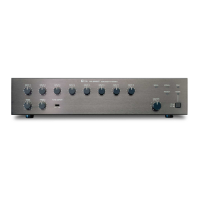
Need help?
Do you have a question about the Toa P-300D and is the answer not in the manual?
Relay circuitry disconnects load upon short-circuit or harmful DC current.
Protects against shorted/low impedance loads and overloaded power supplies.
Power output and performance specs for P-75D in mono mode.
Power output and performance specs for P-150D in mono mode.
Power output and performance specs for P-300D in mono mode.
Combines circuit breaker and power switch; reset procedure described.
Instructions for rack mounting, emphasizing ventilation with perforated panels.
Discusses fuse protection and nomograph for selecting fuse size based on speaker ratings.
Details faults, protection mechanisms, indications, actions, and restorations.
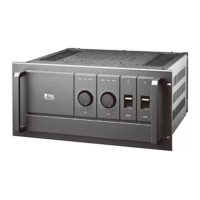
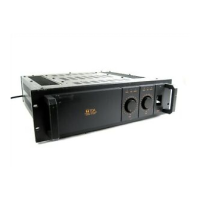
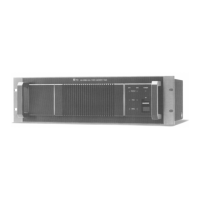
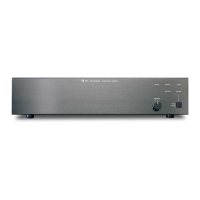
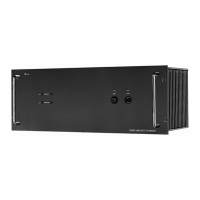
The TOA PROFESSIONAL POWER AMP series, including models P-75D, P-150D, and P-300D, are professional 2-channel (stereo) power amplifiers designed for robust performance in various audio applications. These amplifiers offer a range of power outputs, from 75 watts per channel for the P-75D to 300 watts per channel for the P-300D, into 8-ohm loads with both channels driven. When operating into 4-ohm loads, the power increases to 100 watts (P-75D), 220 watts (P-150D), and 480 watts (P-300D). For bridged mono applications, the power output is significantly boosted, delivering 200 watts (P-75D), 440 watts (P-150D), and 960 watts (P-300D) into 8-ohm loads.
A key technical specification across all models is their impressive frequency response, rated at +0dB, -0.5dB from 20Hz to 20kHz. Total harmonic distortion (THD) is kept remarkably low, less than 0.1% at nominal power outputs (8 ohms, 20Hz to 20kHz). Intermodulation distortion is also minimal, typically 0.05% using 60Hz and 7kHz frequencies mixed in a 4:1 ratio. The input sensitivity is standardized, with a +4dB (1.23V) signal producing the rated output into 8 ohms when the input attenuator is set to maximum. Input impedance is 10k-ohm (unbalanced).
The damping factor is a notable feature, indicating excellent control over speaker movement. For the P-75D, it's greater than 150 from 20Hz to 1kHz and greater than 50 from 20Hz to 20kHz. The P-150D boasts a damping factor greater than 150 (20Hz to 1kHz) and greater than 70 (20Hz to 20kHz), while the P-300D leads with greater than 260 (20Hz to 1kHz) and greater than 95 (20Hz to 20kHz). This high damping factor ensures tight, accurate bass response. Actual output impedance is very low, typically less than 0.06 ohms for the P-75D and P-150D, and less than 0.03 ohms for the P-300D, from 20Hz to 1kHz.
Hum and noise levels are exceptionally low, with all models achieving at least 109dB below rated output (20Hz - 20kHz) and 114dB below rated output (IHF-A weighted). The amplifiers exhibit fast transient response with a rise time of 10 microseconds or better and a slew rate of 10 volts per microsecond or better. Channel separation is excellent, at least 95dB at 1kHz and 85dB at 20kHz for the P-75D and P-150D, and at least 90dB at 1kHz and 75dB at 20kHz for the P-300D. Phase shift is minimal, ±15 degrees from 20Hz to 20kHz, and offset voltage is less than ±10mV DC.
In terms of usage features, these amplifiers are equipped with a range of controls and indicators for precise operation and monitoring. Calibrated input attenuators, with 22 detented steps in 2dB increments from 0dB to -34dB (and further steps to infinity), allow for accurate input sensitivity adjustment. A magnetic circuit breaker serves as both the primary mains overload protection and the on/off switch, offering predictable operation independent of temperature. High pass filter switches provide a switchable 15Hz, 12dB/octave filter to prevent damage from subsonic frequencies. A mono/stereo mode switch allows for quick conversion between dual-channel and single-channel (bridged) operation.
Input connectors include both male and female XLR connectors wired in parallel, along with two tip-sleeve (standard) phone jacks per channel, all configured for unbalanced input. An 8-pin octal socket is provided for an optional matching transformer module (PU-101T) to convert unbalanced inputs to balanced operation, or for user-defined options. Output connections are made via barrier strip terminals on the P-75D and P-150D, and standard 5-way binding posts (3/4" spacing) on the P-300D, accommodating banana plugs or direct wired connections. A ground terminal strip allows for isolating chassis ground from signal ground, which can help prevent ground loop hums.
The front panel features several LED indicators: green LEDs for signal presence (glowing when signal level exceeds -30dB), red LEDs for peak output (indicating clipping), and red LEDs for protection (illuminating for short circuits, DC drift, turn-on delay, or thermal warning). A green LED indicates power ON.
Protection features are comprehensive. Short-circuit protection circuitry uses relays to disconnect the load in the presence of a short circuit or harmful DC current. A 3-second turn-on delay eliminates annoying clicks and pops, and the speakers are disconnected instantly upon shut-off. Current limiter circuitry protects against shorted and low impedance loads, as well as overloaded power supplies and input overload. Thermal warning is indicated by flashing protection LEDs when heat sink temperature exceeds 105°C.
Maintenance and construction are designed for durability and ease of service. All models feature a rugged front panel made of 3mm (1/8") thick cast-aluminum, reinforced with another 3mm (1/8") thick steel, capable of withstanding rough use. Sturdy carrying handles protect front panel controls and facilitate handling. Internally, each channel is built with modular, plug-in boards on a sub-chassis, allowing for quick removal, replacement, or repair. The P-300D is designed in a true dual-mono configuration with two completely separate amplifiers, sharing only a common chassis and AC cord, even featuring separate circuit breaker AC switches. The P-75D and P-150D also utilize a dual-mono configuration but share a single power transformer and circuit breaker.
For installation, the amplifiers are mountable in a standard 19-inch rack. Proper ventilation is crucial, with recommendations to insert 1-unit-sized perforated panels between units and at the bottom and top of the rack. Input and output cables should be separated to prevent oscillation. For road use, additional rear support brackets are recommended to maintain strength during transportation. In mono operation, the total speaker impedance should not be lower than 8 ohms. The manual also provides a nomograph for selecting fuse sizes based on loudspeaker ratings and a fault protection table detailing indications, actions, and restoration procedures for various issues like excessive current, short circuits, temperature rise, and DC drift.


 To Next Page
 General