8
Attenuation Control
Attenuation ControlAttenuation Control
Attenuation Control
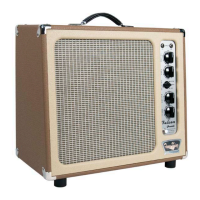
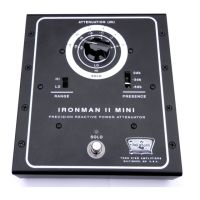
The Falcon contains a built-in Ironman precision attenuator. The attenuator allows you
to reduce the volume level of the amplifier while allowing its output tubes to operate at
full output power, for natural power tube overdrive and distortion. This attenuator
uses transformer coupling and a precision tuned reactive load to best preserve the
natural tone and feel of the amp, even at very low volume. This is the same general
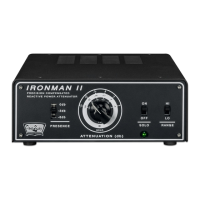
approach used in the highly regarded Ironman standalone attenuator.
There are many different approaches that can be used to generate overdriven and
distorted tones as a low volume. For example, master volume circuits, or a power
reduction scheme such as London Power Scaling have both been used successfully on
various amp models of other brands. However, for the more vintage sounding tones
that the Falcon is designed to achieve, a good quality attenuator such as the built-in
Ironman is the best way to preserve tone and feel at very low volume, because it allows
the output stage to operate the same way at any level of attenuation.
The attenuation control determines the amount of power sent to the speaker, but does
not affect the operation of the output stage of the amplifier itself. The attenuator
absorbs and dissipates any excess power generated by the output tubes that is not sent
to the speaker.
The attenuator is internally connected between the amplifier output and the speaker
jack – the same way an external attenuator would be connected. However, the input of
the attenuator is not accessible, so you cannot use the built-in Ironman attenuator to
attenuate the output of some other amplifier.
Notes on using the attenuator
Notes on using the attenuatorNotes on using the attenuator
Notes on using the attenuator
In the 0db position, the attenuator is completely bypassed, and the speaker is
connected directly to the output transformer secondary, with no additional circuitry
touching the signal path.
Although the Ironman attenuator does an excellent job of reducing output power
without changing the tone of the amp’s circuitry, there are other variables in play at
lower volume which do result in some apparent tone change. Here are a few factors
that you should be aware of -
Speaker breakup and compression is a big part of the tone and feel of the amp when
played at high volume. At low power settings, the speaker responds differently, and
does not break up and compress as it does at high power.
The ear’s natural response curve varies at different volume levels, which changes the
way you perceive sounds at different volume levels. Quieter sounds tend to give the
impression of having less bass content.
At lower volume, there is a tendency to hit the guitar strings harder and play more
aggressively than you would if the amp were tuned up very loud. It may take some time
to get used to maintaining your playing style at reduced volume.


 To Next Page