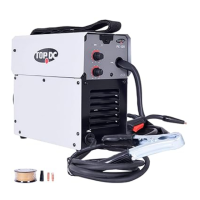
1
VITAL SAFETY INFORMATION
1. General Safety Rules
1) Work Area Safety
a. Take a suitable work area, must be clean and well bright. Cluttered or dark areas
could cause accidents.
b. Do not operate machines in explosive atmospheres, such as the presence of
flammable liquids, gases or dust. Welding sparks may ignite the dust or fumes.
c. Keep children and bystanders away while operating a machine. Distractions can
make you lose all the control.
2) Electrical Safety
a. Avoid
body contact with grounded surfaces such as pipes, radiators, ranges and
r
efrigerators. There is an increased risk of electric shock if your body is grounded.
b. Do not expose machines to rain or wet conditions. Water entering a machine will
increase the risk of electric shock.
c. Do not abuse the Power Cord. Never use the Cord for pulling or unplugging the
machine. Keep Cord away from heat, oil, sharp edges or moving parts. Damaged or
entangled Cords increase the risk of electric shock.
d. Whe
n operating a machine outdoors, use an extension cord suitable for outdoor use.
Us
e of a cord suitable for outdoor use reduces the risk of electric shock.
3) Personal Safety
a. Stay alert, watch what you are doing and use common sense when operating a
machine. Do not use a machine while you are tired or under the influence of drugs,
alcohol or medication. A moment of inattention while operating machines may result in
serious personal injury.
b. Use safety equipment. Always wear eye protec
tion. S
afety equipment such as arc
shaded, impact safety full face shield, dust mask or respirator, heavy-duty work gloves,
non-skid safety shoes, or hearing protection used for appropriate conditions will reduce
personal injuries. Do not wear loose fitting things, like rings, scarves, etc., which is high
risk of being trapped or burnt.
c. Avoid accidental starting. Ensure the Power Switch is in the off-position before
plugging in. Plugging in machines that have the Swi
tch on invites accidents.
d.
Do not overreach. Keep proper footing and balance at all time. This enables better
control of the machine in unexpected situations.
4) Machine Use and Care
a. Use the correct machine for your application. The correct machine will do the job
better and safer at the rate for which it was designed.
b. Do not use the machine if the Power Switch does not turn it on and off. Any
machine that cannot be controlled with the Switch is dangerous and must be repaired.
c. Disc
onnect the Power Cord from the power source before making any adjustments,
changing accessories, or storing machines. Such preventive safety measures reduce
the risk of starting the machine accidentally.
d. Store idle machines out of the reach of children and do not allow persons unfamiliar
with the machine or these instructions to operate the machine. Machines are
dangerous in the hands of untrained users.
e. Maintain machines. Check for misalignment or binding of moving parts, breakage of
parts and any other condition that may affect the machine’s operation. If damaged,
have the machine repaired before use. Many accidents are caused by poorly
maintained machines.


 To Next Page
 Loading...