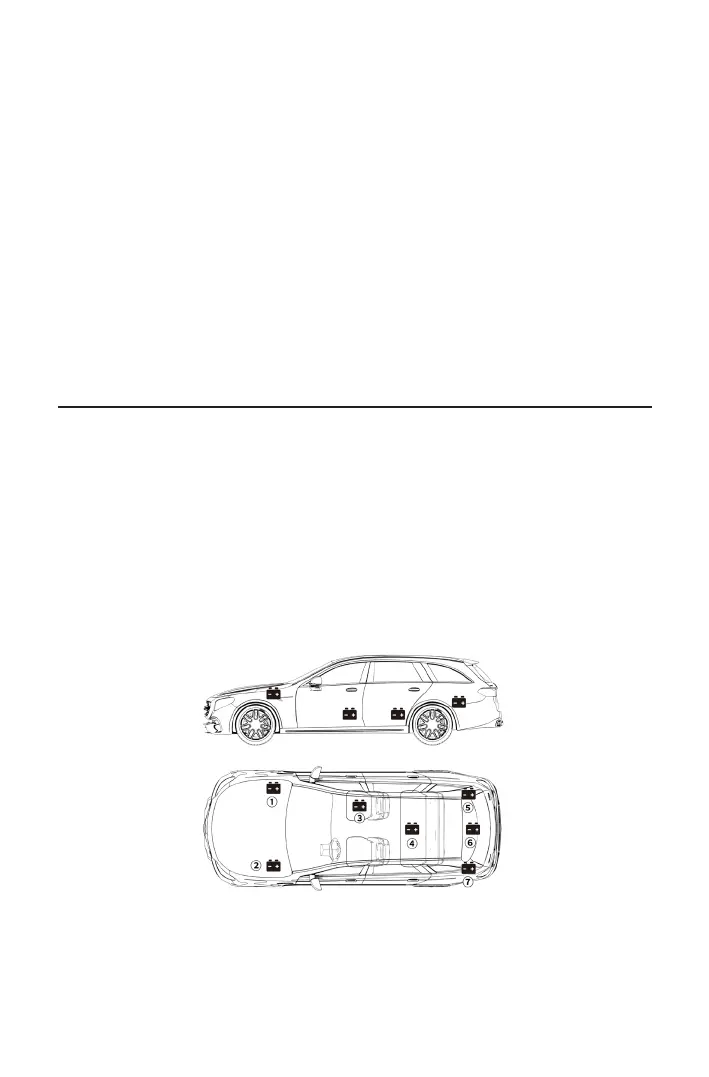
1) Most models hold the battery in the engine bay, under the hood, in one of the front
corners. See battery location
①
and
②
in Figure 3.3.1.
2) To balance uneven weight distribution, some manufacturers hold the engine in
the trunk. See battery location
⑤
,
⑥
, and
⑦
in Figure 3.3.1. In this case, the battery
may have a plastic cover that should be removed prior to any testing.
3) For some models, the battery might be stored underneath the rear seat. See
battery location
④
in Figure 3.3.1.
4) For other vehicles, the battery can be located underneath the passenger seat. See
battery location
③
in Figure 3.3.1
Figure 3.3.1
1) Reserve Capacity: 80Ah
The Reserve Capacity is a time measurement that explains how long a fully-
charged battery can deliver a 25 amps current in an 80°F environment before the
battery is discharged and drops to 10.5V.
2) Battery Type: AGM
3) Voltage: 12V
When fully charged, automotive batteries should measure at 12.6V. However, this
measurement should be from 13.7 to 14.7V when the engine is running. If the
battery tester reads less than this standard, it means that the battery's resting
voltage is weak. In this case, typically, the battery needs to be charged or replaced.
4) CCA: 650A (SAE)
The CCA rating refers to how many amps a 12V battery can deliver at 0°F in 30
seconds while maintaining at 7.2V at least. This means that the higher the CCA
rating is, the easier the engine can be cranked in cold temperatures.
3.3 Where Is the Battery of a Car Located?
EN I 9


 To Next Page