6
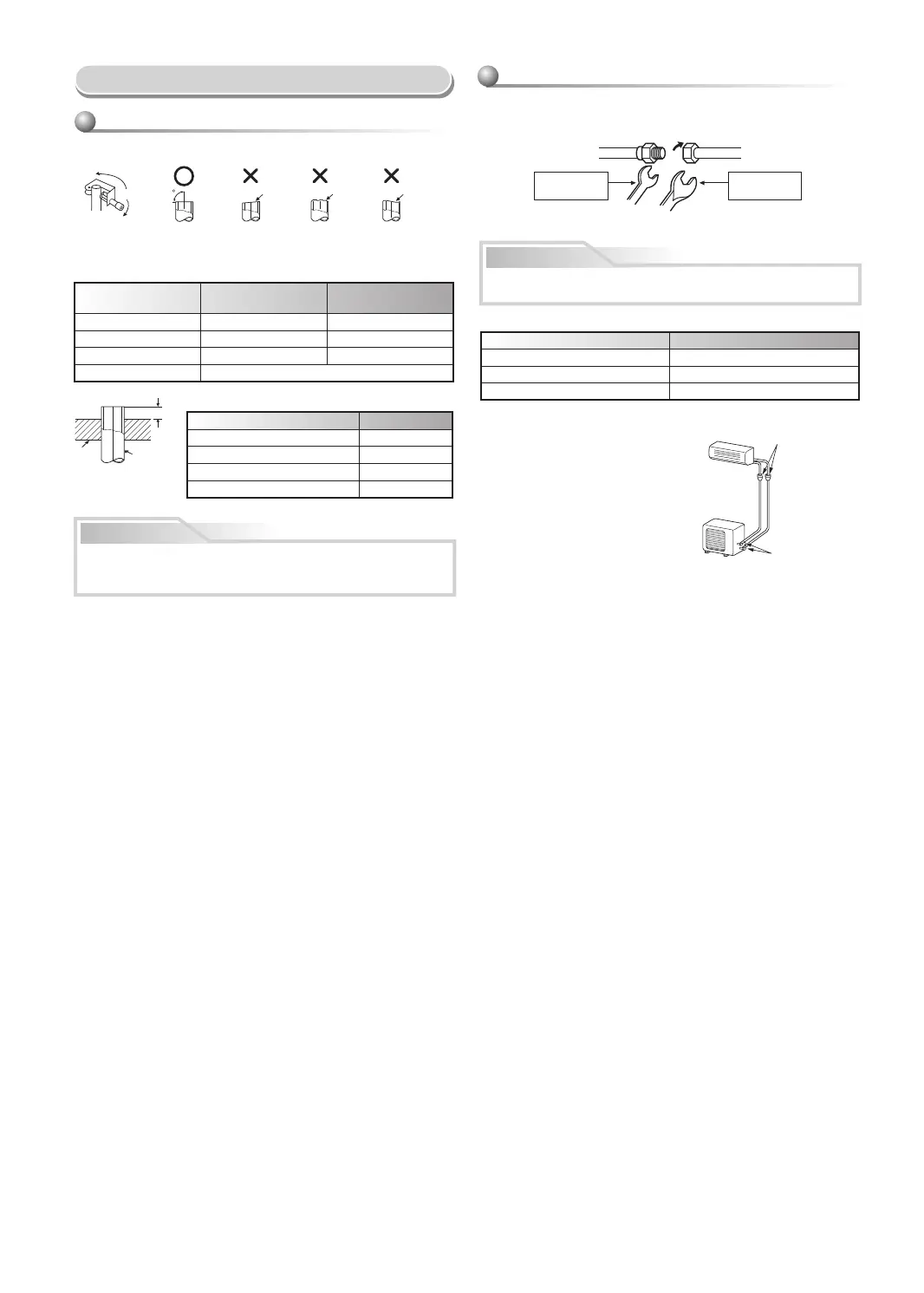
Flare nut
Half union
Externally
threaded side
Internally
threaded side
Use a wrench to secure. Use a torque wrench to tighten.
CAUTION
Align the centers of the connecting pipes and tighten the fl are nut as far as
possible with your fi ngers. Then tighten the nut with a spanner and torque
wrench as shown in the fi gure.
Tightening connection
Do not apply excess torque. Otherwise, the nut may crack depending on
the conditions.
(Unit : N·m)
Outer dia. of copper pipe Tightening torque
Ø6.35 mm 14 to 18 (1.4 to 1.8 kgf·m)
Ø9.52 mm 30 to 42 (3.0 to 4.2 kgf·m)
Ø12.70 mm 50 to 62 (5.0 to 6.2 kgf·m)
Flare at
indoor unit side
Flare at
outdoor unit side
• Tightening torque of fl are pipe connections
The operating pressure of R32 is
higher than that of R22 (approx.
1.6 times). It is therefore necessary
to fi rmly tighten the fl are pipe
connecting sections (which connect
the indoor and outdoor units) up to the
specifi ed tightening torque. Incorrect
connections may cause not only a
gas leakage, but also damage to the
refrigeration cycle.
Refrigerant Piping Connection
Flaring
1. Cut the pipe with a pipe cutter.
90
Obliquity Roughness Warp
2. Insert a fl are nut into the pipe and fl are the pipe.
• Projection margin in fl aring : A (Unit : mm)
RIDGID (clutch type)
Outer dia.
of copper pipe
R32 tool used
Conventional tool
used
Ø6.35 0 to 0.5 1.0 to 1.5
Ø9.52 0 to 0.5 1.0 to 1.5
Ø12.70 0 to 0.5 1.0 to 1.5
Pipes thickness 0.8 mm or more
IMPERIAL (wing nut type)
Outer dia. of copper pipe R32
Ø6.35 1.5 to 2.0
Ø9.52 1.5 to 2.0
Ø12.70 2.0 to 2.5
Pipes thickness 0.8 mm or more
A
Die
Pipe
• Do not scratch the inner surface of the fl ared part when removing burrs.
• Flare processing under the condition of scratches on the inner surface
of fare processing part will cause refrigerant gas leak.
CAUTION





 To Next Page