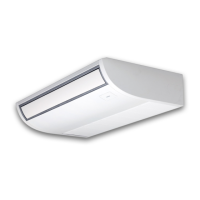
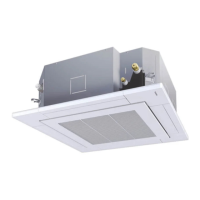
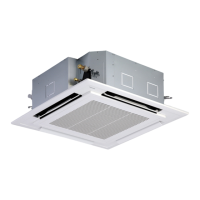
This document serves as an owner's manual for Toshiba Air Conditioners (Split Type), specifically for indoor units of the ceiling type. The models covered include RAV-HM401CTP-E, RAV-HM561CTP-E, RAV-HM801CTP-E, RAV-HM901CTP-E, RAV-HM1101CTP-E, RAV-HM1401CTP-E, and RAV-HM1601CTP-E, intended for commercial use. The air conditioner utilizes R32 refrigerant, which is an HFC (R32) that does not deplete the ozone layer.
The manual emphasizes safety precautions, stating that the manufacturer assumes no liability for damage caused by not observing the manual's descriptions. It is crucial to read the Owner's Manual carefully before operating the air conditioner, as it contains important information for daily use. Installation, maintenance, repair, and removal of the air conditioner must be performed by a qualified installer or service person. These individuals are trained and knowledgeable in the specific operations, electrical work, refrigerant handling, piping, and working at heights related to Toshiba Carrier Corporation air conditioners. Unqualified persons performing these tasks risk fire, electric shock, injury, water leakage, noise, and vibration.
The manual highlights various safety warnings and cautions. A "WARNING" indicates that failure to adhere to directions could result in serious bodily harm or loss of life, while "CAUTION" suggests potential for slight injury or property damage. Specific warnings include the risk of fire due to flammable R32 refrigerant if it leaks and contacts fire or heating parts. Users are instructed to read the owner's manual carefully before operation, and service personnel must read both the owner's and installation manuals.
General safety advice includes not using refrigerants other than those specified, as this could generate abnormally high pressure in the refrigeration cycle, leading to product failure or explosion. The placement of the outdoor unit should consider noise disturbance, especially near neighbors. The appliance is intended for expert or trained users in commercial settings.
For transportation and storage, users should wear protective gear like toe caps and gloves. When transporting, avoid holding the packing carton bands to prevent injury if they break. Precautions on packing cartons for stacking must be followed to prevent collapse. If any part of the product is broken during transport, the dealer should be contacted. The air conditioner must be transported in a stable condition.
Installation guidelines stress that only qualified personnel should perform electrical work to prevent electric shocks or leaks. After installation, the installer should explain circuit breaker positions. In case of trouble, the circuit breaker should be set to OFF, and a service person contacted. If installed in a small room, measures must be taken to prevent refrigerant concentration from exceeding limits, as high concentrations can cause oxygen deficiency. The unit should not be installed near combustible gases, as leaks could cause fire. Only company-specified products should be used for parts to avoid fire, electric shock, or water leakage. Correct earthing is essential.
During operation, the intake grille of the indoor unit or service panel of the outdoor unit should only be opened by qualified personnel after setting the circuit breaker to OFF to prevent electric shock from internal parts. High-voltage areas and rotating parts are inside the air conditioner, posing risks of electric shock or entrapment. Therefore, service panels should not be removed by users. Cleaning the indoor unit filter or performing other jobs at heights over 50 cm should be done by qualified personnel to avoid falls and injury. The aluminum fins of the outdoor unit should not be touched to prevent injury. Climbing or placing objects on the outdoor unit is prohibited. Combustion appliances should not be placed where they are directly exposed to the air conditioner's wind, as this can cause imperfect combustion. When using the air conditioner with a combustion appliance, the room must be sufficiently ventilated to prevent oxygen shortage. Prolonged direct exposure to cool air or excessive cooling should be avoided to prevent health issues. Fingers or sticks should not be inserted into the air intake or discharge to prevent injury from the high-speed fan.
If the air conditioner is not cooling or heating properly due to refrigerant leakage, the shop where it was purchased should be consulted. Repairs involving additional refrigerant charging must be confirmed with a qualified service person. Before cleaning, the air conditioner must be stopped, and the breaker turned off to prevent injury from the rotating fan.
Repairs should only be handled by qualified service personnel. If an error display appears, a burning smell is detected, abnormal sounds are heard, or the unit fails to cool/heat or leaks water, the circuit breaker should be set to OFF, and a service person contacted. The power should be marked "out of service" to prevent accidental activation. Continuing to use a faulty unit can escalate mechanical problems or cause electric shocks. If the fan grille is damaged, the outdoor unit should not be approached; the circuit breaker should be set to OFF, and a service person called for repairs. The circuit breaker should remain OFF until repairs are complete. If there is a risk of the indoor unit falling, it should not be approached; the circuit breaker should be set to OFF, and a qualified installer or service person contacted to refit it. Similarly, if the outdoor unit is at risk of toppling, the circuit breaker should be OFF, and qualified personnel should be contacted.
Customizing the unit is prohibited, as it may lead to fire, electric shock, or other issues. Relocation must be performed by a qualified installer or service person to prevent electric shocks and/or fire.
Installation cautions include ensuring proper drainage with the drain hose to prevent flooding. The air conditioner must be connected to an exclusive power supply of the rated voltage to prevent breakdowns or fire. The outdoor unit must be fixed on its base to prevent falling.
Operation cautions advise against using the air conditioner for special purposes like preserving food, precision instruments, art objects, breeding animals, cars, or vessels. Switches should not be touched with wet fingers to avoid electric shock. If the air conditioner will not be used for a long time, the main switch or circuit breaker should be turned off. To ensure optimal performance, the unit should be operated within the specified temperature range; otherwise, malfunctions or water leakage may occur. Liquids should not be spilled on the remote controller. The air conditioner should not be washed, as this may result in electric shock.
Regular checks are recommended, as prolonged use can lead to deterioration of parts and potential malfunction or poor drainage. The unit should be checked and maintained by the dealer periodically. For environmental conservation and efficient operation, regular cleaning and maintenance of both indoor and outdoor units are strongly recommended, ideally once every 3 months for units operated 8 hours or more daily. This includes checking for rust and scratches on the outdoor unit. Improper cleaning can damage plastic parts, cause insulation failure, and lead to malfunctions, water leakage, electric shock, smoke emission, or fire. Water containers should not be placed on the unit to prevent water intrusion and electric shock. Pressure washers should not be used to clean air conditioners.
The manual also provides information on transportation, handling, and storage of the carton, with symbols indicating "Keep dry," "Fragile," "Do not drop," "Do not lay down," "Stacking height," "Do not walk on this carton," "This side up," and "Handle with care." A "Caution" symbol warns of injury possibility if handling packing bands incorrectly. A "Stacking notice" advises laying a 10mm thick plywood over the pallet if cardboard boxes protrude when stacking.
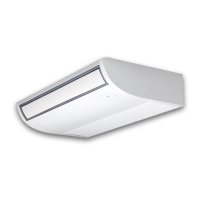
The indoor unit components include horizontal louvers/vertical grilles for air discharge, an air intake grille, an earth screw inside the electrical box, and an air filter. The outdoor unit (design varies) includes air intake, a panel with an earth screw, valves, and electric parts, air discharge, a piping panel, fixing legs, a wiring hole, and refrigerant pipe discharge.
The wired remote controller (RBC-ASCU1*) features an ON/OFF button, a setting button for temperature, fan speed, and wind direction, a timer off button, and a menu button for selecting running mode, fan speed, and wind direction. The LCD backlight illuminates for 15 seconds when a button is pressed. The display includes icons for normal operation, operation mode, fan speed, wind direction, running mode, central control, setting, repair, test run, temperature setting, wind direction, louver position, louver locking, fan speed, timer off, pre-heat, remote controller sensor, notice, and no function. "SETTING" flickering indicates that operation will not be accepted.
To operate, press the ON/OFF button to start. Select the running mode (Auto, Heat, Dry, Cool, Fan) using the menu button, then adjust the temperature (18.0°C to 29.0°C) with the set button. Fan speed can also be selected. The 8°C operation feature allows the air conditioner to control heating temperature to about 8°C for object pre-heating, requiring specific settings via the wired remote controller. This mode is canceled if the operation is stopped, another mode is selected, or temperature/operation mode is changed by other controllers.
Timer operation allows setting an OFF timer from 0.5 to 24 hours. Wind direction can be adjusted for both vertical and horizontal airflow. For vertical airflow, the louver can be set to six steps or auto-swing. Horizontal airflow is adjusted by pointing the vertical louvers inside the horizontal louver.
Maintenance involves cleaning the air filters when indicated on the remote controller. Clogged filters can reduce cooling and heating performance. Cleaning the air filter and other parts involves dangerous work at heights and should only be done by a qualified installer or service person. Buttons should not be pushed with wet hands to avoid electric shock. If the unit will not be used for a long time, perform fan operation for a few hours to dry the inside, stop the air conditioner, turn off the circuit breaker, and clean/reinstall the air filters. Before the cooling season, the drain pan should be cleaned by a dealer to prevent clogging and potential overflow.
Troubleshooting guidance advises stopping the unit, turning off the circuit breaker, and contacting the dealer if unusual issues persist. Error codes displayed on the remote controller LCD should be reported. The troubleshooting history can be viewed by long-pressing the timer off button for more than 10 seconds. This history records up to 4 events, displaying the check code and the faulted indoor unit number.
Operational performance notes include checking earth wire and air filter installation, and turning on the circuit breaker at least 12 hours before initial operation. A 3-minute protection function prevents immediate restarts after power-on. In case of power failure, the unit stops and requires manual restart. Defrosting operation automatically occurs during heating if the outdoor unit frosts, temporarily stopping fans. Heating capacity relies on the heat pump system; in very cold conditions, supplementary heating may be needed. Protective devices stop operation if the unit is overloaded, indicated by blinking lights on the remote controller. If activated, the circuit breaker should be turned off, and a checkup performed. Clogging of air intake/discharge or strong winds can affect cooling. Clogged air filters or intake/discharge can affect heating. During the air-conditioning season, the circuit breaker should remain on, and the ON/OFF key on the remote controller used for control.
Attention to snowfall and freeze on the outdoor unit is important in snowy areas, as snow or ice can cover the unit, causing machine failure or poor warming. Drain hoses must be clear in cold areas to prevent freezing and potential machine failure. The air conditioner operates within specific outdoor and room temperature ranges for cooling and heating; operating outside these conditions may trigger safety protection.
Installation locations should avoid proximity to TVs, stereos, radios, high-frequency appliances, or areas with iron/metal dust, humidity, oil, steam, soot, corrosive gas, salt, or sulfureous gas. It should not be installed in vessels, mobile cranes, or acidic/alkaline atmospheres. Obstacles that disturb discharge air should be avoided. The unit should not be used for special purposes like preserving food or breeding animals. It should not be installed over objects that must not get wet, near doors/windows with humid outside air, or where special sprays are frequently used.
Noise and vibration precautions include installing the unit on a solid, stable foundation to prevent resonance. Consideration should be given to neighbors regarding noise from the outdoor unit. Some sound may be audible from other indoor units even if they are not operating.


 To Next Page


 General