
 Need help?
Do you have a question about the TP-Link TL-SG1210PP and is the answer not in the manual?
Indicates the PoE power provision status: On, Flashing, or Off.
Shows the total power supply status for PoE: On, Flashing, or Off.
Extends PoE power supply distance up to 250m at 10 Mbps.
Automatically reboots PoE devices when abnormal status is detected.
Allows specific ports to transmit data with higher priority.
Prevents specific ports from transmitting data with other downlink ports.
Troubleshooting steps for when the Power LED is not lit.
Checks to perform when the Link/Act LED is not lit for a connected device.
Explanation of why PoE ports might not be supplying power to devices.
Precautions to take before using the PoE Auto Recovery feature.
Details on network standards, interface types, and media.
Information on the switching capacity for different models.
Specifications for power input and PoE budget for each model.
Operating and storage conditions, and physical mounting details.
Guidelines for safe handling and operation of the device.
Statement of compliance with EU essential requirements and directives.
Statement of compliance with UK essential requirements and regulations.
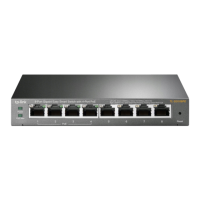
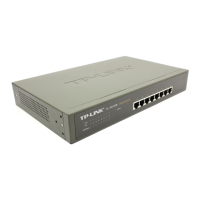
This document describes the TP-Link Unmanaged Desktop PoE+/PoE++ Switch, a network device designed to simplify network expansion and power delivery to compatible devices.
The TP-Link Unmanaged Desktop PoE+/PoE++ Switch serves as a central hub for connecting multiple network devices, facilitating data transmission between them. Its primary function is to provide Power over Ethernet (PoE) capabilities, allowing it to deliver both data and electrical power to PoE-compatible devices such as IP cameras, wireless access points (APs), and IP phones over a single Ethernet cable. This eliminates the need for separate power adapters for these devices, simplifying installation and reducing cable clutter.
The switch operates as an unmanaged device, meaning it requires no configuration or software setup. Users can simply plug in their network cables and devices, and the switch will automatically handle data forwarding. This plug-and-play functionality makes it ideal for small office/home office (SOHO) environments or users who prefer a straightforward networking solution.
The switch supports various Ethernet speeds, including 10 Mbps, 100 Mbps, and 1000 Mbps (Gigabit Ethernet), ensuring compatibility with a wide range of network devices and providing high-speed data transfer for demanding applications. It also incorporates MDI/MDIX auto-negotiation, which automatically detects and adjusts for straight-through or crossover cables, further simplifying connectivity.
The TP-Link Unmanaged Desktop PoE+/PoE++ Switch offers several features designed to enhance its usability and adaptability in different network scenarios:
PoE/PoE++ Support: The switch provides PoE (Power over Ethernet) and PoE++ capabilities on a subset of its ports, enabling it to power compatible devices directly through the Ethernet cable. This is a significant advantage for deploying devices in locations where power outlets are scarce or inconvenient. The PoE budget varies by model, indicating the total power available for connected PoE devices. The switch intelligently manages power distribution, prioritizing ports with lower numbers if the total power consumption exceeds the budget, ensuring critical devices remain powered.
Extend Mode: This feature allows users to extend the reach of PoE power and data transmission beyond the standard 100-meter limit. When Extend Mode is enabled, the switch can deliver power and data up to 250 meters, albeit at a reduced speed of 10 Mbps. This is particularly useful for deploying devices like IP cameras in remote locations without needing additional range extenders or power sources. The Extend Mode typically applies to a specific group of ports, as indicated in the switch's documentation.
Recovery Mode (PoE Auto Recovery): The Recovery feature automatically detects the working status of connected PoE Powered Devices (PDs). If a PD is found to be operating abnormally (e.g., unresponsive), the switch will automatically reboot that specific PD. This helps to restore functionality without manual intervention, improving network reliability and reducing downtime. Users can choose to enable or disable this feature based on their needs.
Priority Mode: For models that support it, Priority Mode allows users to assign higher priority to data transmission on specific ports. When enabled, data from these prioritized ports will be transmitted with preference over data from other ports. This is beneficial for applications that require consistent bandwidth and low latency, such as video streaming or VoIP calls, ensuring their performance is not compromised by other network traffic.
Isolation Mode: This feature enhances network security and performance by isolating specific downlink ports from each other. When Isolation Mode is active, devices connected to these isolated ports can only communicate with the uplink ports, not with other isolated downlink ports. This prevents potential broadcast storms or unauthorized access between devices on the same switch, making it suitable for scenarios where client isolation is desired.
LED Indicators: The switch is equipped with various LED indicators that provide real-time status information. These include:
Wall-Mountable Design: The switch is designed to be wall-mountable, offering flexibility in placement and helping to save desk space. This allows for a cleaner and more organized installation, especially in environments with limited surface area.
As an unmanaged switch, the TP-Link Unmanaged Desktop PoE+/PoE++ Switch requires minimal maintenance. However, there are a few considerations to ensure its optimal performance and longevity:
Troubleshooting with LEDs: The LED indicators are the primary tool for diagnosing issues. By observing the Power, Link/Act, and PoE Status LEDs, users can quickly identify problems such as no power, no link, or PoE faults. For example, a flashing PoE Status LED might indicate that the total power budget is being exceeded, prompting the user to check the power consumption of connected devices.
Cable Management: While not a direct feature of the switch, proper cable management is crucial for maintaining network performance and preventing physical damage. Ensuring that Ethernet cables are securely plugged in and not excessively bent or strained helps prevent intermittent connections or data loss. The switch's support for MDI/MDIX auto-negotiation simplifies cable selection, reducing the chance of incorrect wiring.
Environmental Considerations: The switch is designed to operate within specific temperature and humidity ranges. Ensuring that the switch is placed in an environment that meets these specifications (e.g., avoiding extreme heat, cold, or high humidity) will contribute to its long-term reliability.
PoE Auto Recovery Management: While beneficial, the PoE Auto Recovery feature should be managed carefully. Before upgrading firmware on a connected PoE device, it is recommended to disable Auto Recovery to prevent unintended reboots during the update process, which could potentially damage the device. Similarly, for devices that enter a low-power "sleep mode" and do not send data packets for extended periods, disabling Auto Recovery might be advisable to prevent unnecessary reboots.
Firmware Updates (Not Applicable for Unmanaged Switches): As an unmanaged switch, there is typically no user-upgradable firmware. The device operates with its factory-set software, eliminating the need for maintenance related to software updates.
In summary, the TP-Link Unmanaged Desktop PoE+/PoE++ Switch is a user-friendly and efficient solution for expanding network connectivity and powering PoE-compatible devices. Its plug-and-play nature, combined with features like Extend Mode, Recovery Mode, and clear LED indicators, makes it a reliable choice for various networking needs with minimal maintenance requirements.
 General
| Combo SFP ports quantity | 1 |
|---|---|
| Installed SFP modules quantity | 0 |
| Basic switching RJ-45 Ethernet ports type | Gigabit Ethernet (10/100/1000) |
| Basic switching RJ-45 Ethernet ports quantity | 10 |
| Power source | DC/PoE |
| Input current | 2.43 A |
| Input voltage | 53.5 V |
| AC input voltage | 90 - 220 V |
| AC input frequency | 50 Hz |
| Power supply included | Yes |
| Power consumption (max) | 144.1 W |
| Heat dissipation | 482.17 BTU/h |
| Storage temperature (T-T) | -40 - 70 °C |
| Operating temperature (T-T) | 0 - 40 °C |
| Storage relative humidity (H-H) | 5 - 90 % |
| Operating relative humidity (H-H) | 10 - 90 % |
| 10G support | No |
| Networking standards | IEEE 802.3af, IEEE 802.3at, IEEE 802.3i, IEEE 802.3u, IEEE 802.3x, IEEE 802.3z |
| Cable types supported | Cat3, Cat4, Cat5, Cat5e |
| Copper ethernet cabling technology | 10BASE-T, 100BASE-TX |
| Forwarding rate | 14.88 Mpps |
| MAC address table | 4000 entries |
| Switch type | Unmanaged |
| Switch layer | - |
| Certification | FCC, CE, RoHS |
| Product color | Black |
| Housing material | Steel |
| Total Power over Ethernet (PoE) budget | 123 W |
| Power over Ethernet plus (PoE+) ports quantity | 2 |
| Power over Ethernet 4PPoE (PoE++) ports quantity | 6 |
| Harmonized System (HS) code | 85176990 |
| Package type | Box |
| Cables included | AC |
 Weight and Dimensions
| Depth | 126 mm |
|---|---|
| Width | 209 mm |
| Height | 26 mm |


 To Next Page