EasyManua.ls Logo

Tractel Tirak Series - User Manual

Tractel Tirak Series
28 pages
Print Icon
To Next Page IconTo Next Page
Loading...
1
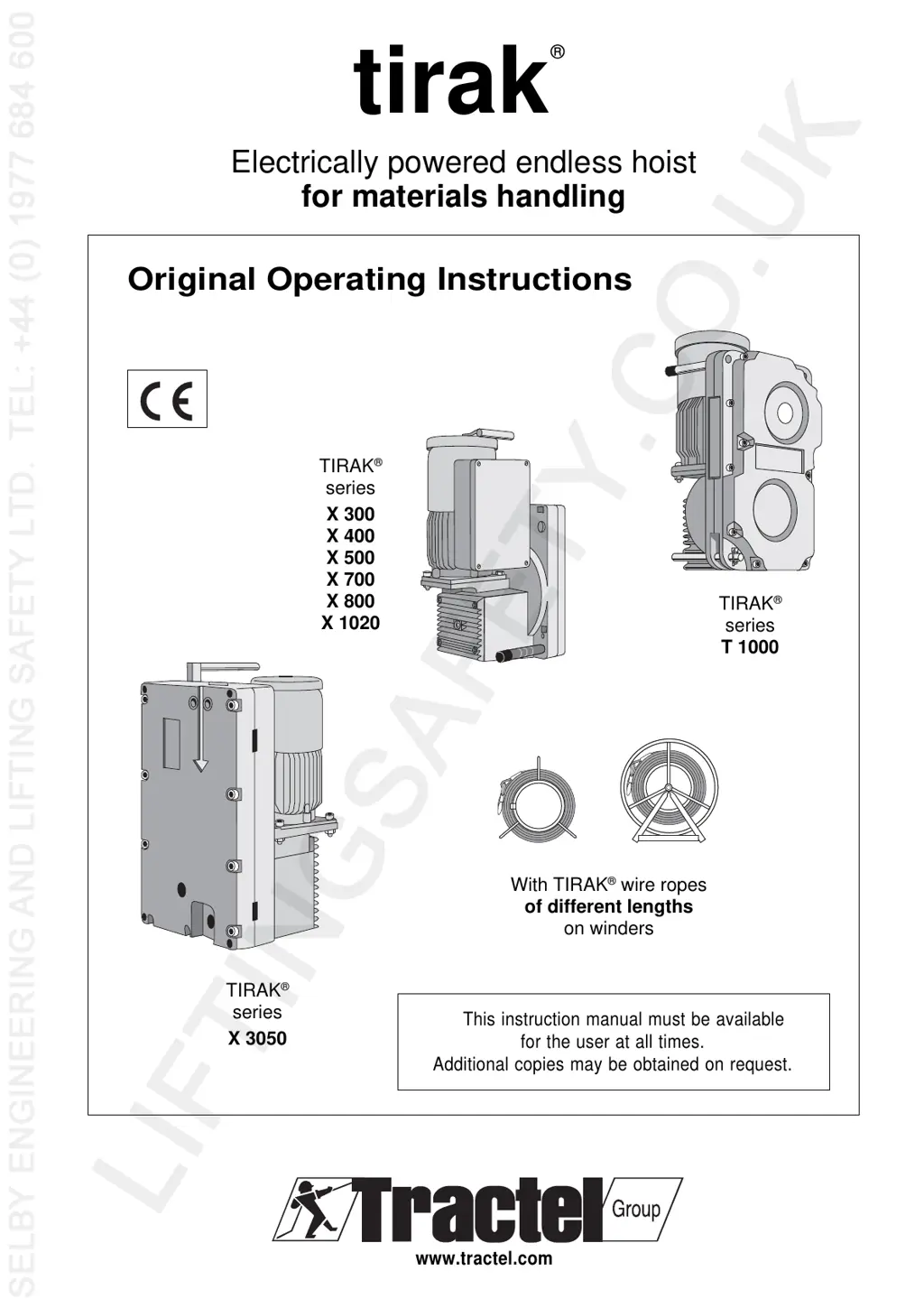
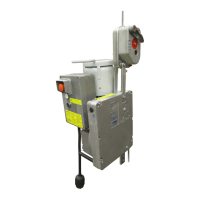
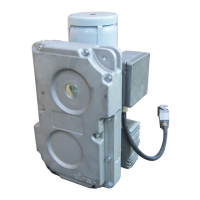
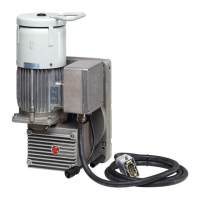
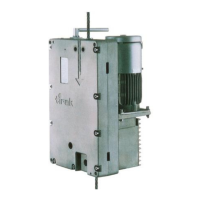
Electrically powered endless hoist
for materials handling
TIRAK
®
series
T 1000
tirak
®
TIRAK
®
series
X 300
X 400
X 500
X 700
X 800
X 1020
TIRAK
®
series
X 3050
Original Operating Instructions
This instruction manual must be available
for the user at all times.
Additional copies may be obtained on request.
With TIRAK
®
wire ropes
of different lengths
on winders
www.tractel.com

Questions and Answers

  • R
    Robert WagnerAug 6, 2025
    Why doesn't my Tractel Tirak Industrial Equipment hoist move at all?
    • Y
      ycardenasAug 7, 2025
      If your Tractel Industrial Equipment hoist doesn’t move at all, there could be several reasons. First, check if the control is switched off or if there's an interrupted power supply. For 3-phase motors, ensure that the phases are correctly connected. Also, inspect the connection between the power supply and the hoist control for any defects. Make sure that the EMERGENCY-STOP button is released. If it is a 3-phase motor, turn the phase inverter of the central control plug by 180 degrees. Check the lead and control cable, fuses, and connections or wiring of central control and terminal boxes, and repair if necessary.
  • P
    Patrick HolderAug 13, 2025
    What to do if the wire rope is not moving on my Tractel Tirak?
    • T
      Tracey EllisonAug 14, 2025
      If the wire rope on your Tractel Industrial Equipment is not moving even when the motor starts, it could be stuck in the TIRAK® hoist, be defective, or obstructed at the rope exit. Support the load, cut the wire rope on both sides of the TIRAK®, and repair the TIRAK®. If available, use a substitute TIRAK® or TIRFOR® to take the load. Remove the temporary support and defective wire rope once the load is fully supported. Another cause could be that the load is caught on an obstacle or tied down. In this case, carefully release the load and check the wire rope, slings, and load-carrying device for safety.
  • K
    Kyle GallowayAug 28, 2025
    What to do if my Tractel Tirak load can't be lowered?
    • R
      Rebecca RoblesAug 28, 2025
      If the load on your Tractel Industrial Equipment cannot be lowered but can be lifted, it might be obstructed. Carefully lift the load, manually if necessary, and remove the obstacle. Ensure that the rope, slings, and other load fixings are safe. Another potential cause is an error in the DOWN control circuit. In this case, perform an emergency descent by inserting and pulling upwards on the brake release lever. Check the connections, wiring, and contactors, replacing them if necessary.
  • K
    Kimberly MitchellNov 20, 2025
    Why does my Tractel Tirak Industrial Equipment lift descend but not lift?
    • C
      Charles AllenNov 21, 2025
      If your Tractel Industrial Equipment hoist does not lift or pull but descends, it could be due to several reasons. The load might be caught on an obstacle, so carefully lower the load and remove the obstruction, checking the rope and slings for safety. Overload is another possibility; check the load and reduce it or use multiple sheave blocks if necessary. Ensure the wire rope hasn't completely run out; if it has, reinstall it and prevent it from happening again by using a longer wire rope. Also, check for a missing phase by inspecting the fuses and leads. There might be an error in the UP control circuit, so inspect the connections, wiring, and contactors, replacing them if needed. Finally, a lack of motor power due to a defective starting capacitor or centrifugal switch could be the caus...

Summary

1. Safety Advice

2. Exclusion Of Non-Intended Use

3. Machine Description

3.1 Purpose

Defines the purpose of TIRAK® hoists for lifting, pulling, and moving loads.

3.2 Working Principle

Explains how TIRAK® hoists operate in any position with unlimited pulling length.

3.3 Allowed TIRAK Wire Rope For Materials Handling

Specifies the mandatory TIRAK® wire ropes for safe and trouble-free operation.

3.4 Noise Emission

Provides noise emission levels for different TIRAK® series models.

3.5 Main Components And Operating Controls

3.6 Technical Data

3.7 Increasing The Capacity

3.8 Anchoring Examples

3.9 Safety Devices

3.9.1 Primary Brake

Describes the electromagnetic brake that engages automatically when the button is released or power fails.

3.9.2 Emergency Stop

Explains the function and reset procedure of the emergency stop button.

3.9.3 Phase Control Relay

Details the relay that stops operation if motor phases are reversed.

3.9.4 Load Limiting Device

Covers the device that stops lifting movement at 1.25 times carrying capacity.

3.9.5 Manual Operation

Refers to procedures for emergency descent and manual lifting.

3.10 Residual Risks

4. Setting Up

4.1 Required Equipment

Lists essential equipment needed for setting up TIRAK® hoists, including capacity, rope, and cables.

4.2 Anchoring The TIRAK Hoist

Details methods and devices for securely anchoring the TIRAK® hoist.

4.2.1 Anchoring Devices And Dimensions

4.2.2 Anchoring Of The TIRAK Hoist

4.3 Wire Rope Exit

4.3.1 Slack Wire Rope

Instructs on ensuring the wire rope exit is unobstructed and how to manage slack rope.

4.3.2 Use Of Wire Rope Winders

Discusses the use of wire rope winders for storing the loose end of the wire rope.

4.4 Electrical Connections

4.5 Electrical Controls

4.6 Wire Rope Installation

4.6.1 Preparing The Wire Ropes

Guides on using correct TIRAK® ropes, checking diameter, length, and condition.

4.6.2 Wire Rope Installation

5. Operation

5.1 Checks Before Starting

Outlines pre-operation checks for anchoring, controls, and load safety.

5.2 Weekly Check Of Wire Rope And Cable

Emphasizes the importance of weekly inspection for wire ropes and cables for damage.

5.3 Operation

Details standard operation procedures for the hoist.

5.3.1 Stop; Emergency Stop

5.3.2 Service Operation

5.4 Securing Moving Loads

5.5 Manual Operation

5.5.1 Emergency Descent

Details manual emergency descent in case of power failure using the brake release lever.

5.5.2 Manual Lifting

Explains manual lifting with the brake open, using the hand wheel.

6. Troubleshooting

7. Out Of Operation

7.1 Temporary Stoppage

Provides instructions for safely disconnecting power during temporary shutdowns.

7.2 End Of Operation

Outlines procedures for final shutdown, cleaning, and storage.

8. Maintenance

8.1 Maintenance

Details general maintenance requirements for the hoist, wire ropes, and motor.

8.1.1 Hoist

8.1.2 Wire Ropes

8.1.3 Motor, Brake, And Gear Box

8.2 Checks

8.2.1 Essential Checks

Covers general checks before and during operation for hoist, equipment, and damage.

8.2.2 Safety Inspection

Specifies the required safety inspection intervals and responsibilities for competent persons.

8.3 Repair

9. Spare Parts

9.1 Hoist

Lists information required when ordering spare hoist parts.

9.2 Motor And Brake

Details information needed for ordering spare motor and brake parts.

9.3 Electric Controls

Specifies quoting the wiring diagram number for electric control spare parts.

9.4 Nameplates And Labels

Reminds users to ensure nameplates and labels are present and legible.

Suitable Accessories

Wire Rope Guiding Spring

Describes a spring to divert slack wire rope and prevent damage.

Limit Switch

Explains the function of a limit switch for cutting off lifting/pulling movement.

Suspension On Beam Trolleys

Details trolleys for lateral movement and hoists with rope guiding/reeling devices.

TIRAK As Mobile Winch

TIRAK Hoists For Man Riding Applications

Series XS 300 P For Silo Inspection

Access Solutions From The TRACTEL Group

Suspended Platforms, Working Cage & Seat

Presents mobile platforms and seats for assembly, inspection, and repairs at height.

Building Maintenance And Inspection Installations

Offers creative solutions for building maintenance and inspection, involving team planning.

Moveable Stairs And Work Gantries

Describes solutions for cleaning, inspecting, and repairing windows, facades, and glass roofs.

The TRACTEL Group Safety Package

TRAVSAFE - Horizontal Travelling Lifeline System

Introduces a horizontal system for working at heights with risk of falling.

Fall Arrest Equipment For Personal Protection

Lists various safety equipment for personal fall protection, approved under European Standards.

Tractel Tirak Series Specifications

General IconGeneral
BrandTractel
ModelTirak Series
CategoryIndustrial Equipment
LanguageEnglish

Related product manuals