
 Need help?
Do you have a question about the Trane Technologies 4TWL5024N1000A and is the answer not in the manual?
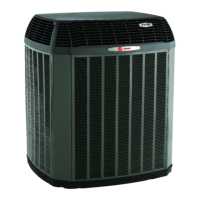
Overview of Trane's Side Discharge Heat Pump models.
Recommendation for epoxy coated models for coastal applications.
Warnings regarding hazardous voltage and grounding requirements.
Precautions for handling refrigerant, oil, and service valves.
Safety considerations for brazing and ensuring leak-free connections.
Cautions about hot surfaces and chemical exposure (Prop 65).
Table detailing unit dimensions and weight for various models.
Specifies maximum refrigerant line length and vertical rise.
Optimal placement and clearance requirements for airflow.
Precautions for units installed in cold climates with snow.
Guidelines for installing units near saltwater environments.
Steps for checking damage and removing the unit from its pallet.
Criteria for installing a proper support pad for the unit.
Table of rated line sizes and service valve connection sizes.
Information on factory charge and determining line length.
Guidelines for insulating refrigerant lines for performance.
Precautions for routing line sets to prevent noise and damage.
Methods for isolating refrigerant lines from joists, rafters, and walls.
Techniques for isolating line sets within wall cavities.
Methods for sealing and isolating lines through walls and avoiding ductwork.
Step-by-step instructions for preparing and brazing lines.
Brazing instructions for service valves and filter driers.
Procedure for pressurizing and checking lines for leaks.
Steps for evacuating the indoor coil and lines to 350 microns.
Procedure for safely opening the gas service valve.
Procedure for safely opening the liquid service valve.
Maximum wire lengths for low voltage connections by gauge.
Wiring diagrams for thermostat and air handler connections.
Diagram showing thermostat, indoor, and outdoor unit connections.
Guidelines for high voltage power supply and safety precautions.
Requirements for installing a high voltage disconnect switch.
Steps for setting the thermostat and applying power.
Procedure for waiting if crankcase heater is used below 70°F.
Recommended subcooling method for cooling above 55°F ambient.
Ensuring system stabilization for accurate charge measurements.
Guidelines for measuring temperatures for charging.
Worksheet for calculating subcooling corrections based on line length.
Chart to determine liquid gage pressure based on liquid temperature and subcooling.
Subcooling correction tables for 2.0 and 2.5 ton models.
Subcooling correction tables for 3.0 ton models.
Subcooling correction tables for 3.5 and 4.0 ton models.
Steps to stabilize the system and remove gauges.
Measuring liquid line temperature and pressure for proper charge.
Using pressure curves to verify system performance.
Procedure for adding or recovering refrigerant for correct charge.
Recording system pressures and temperatures after charging.
List of common items to confirm before final operation.
Troubleshooting steps for a compressor that does not start.
Troubleshooting steps when the compressor won't run but contactor is closed.
 General
| Cooling Capacity | 24, 000 BTU/h |
|---|---|
| Voltage | 208/230 V |
| Refrigerant | R-410A |
| Stages | Single Stage |
| Phase | Single Phase |


 To Next Page