8 88-A5HP5001-1B-EN
Section 8. Refrigerant Line Leak Check
8.1 Check For Leaks
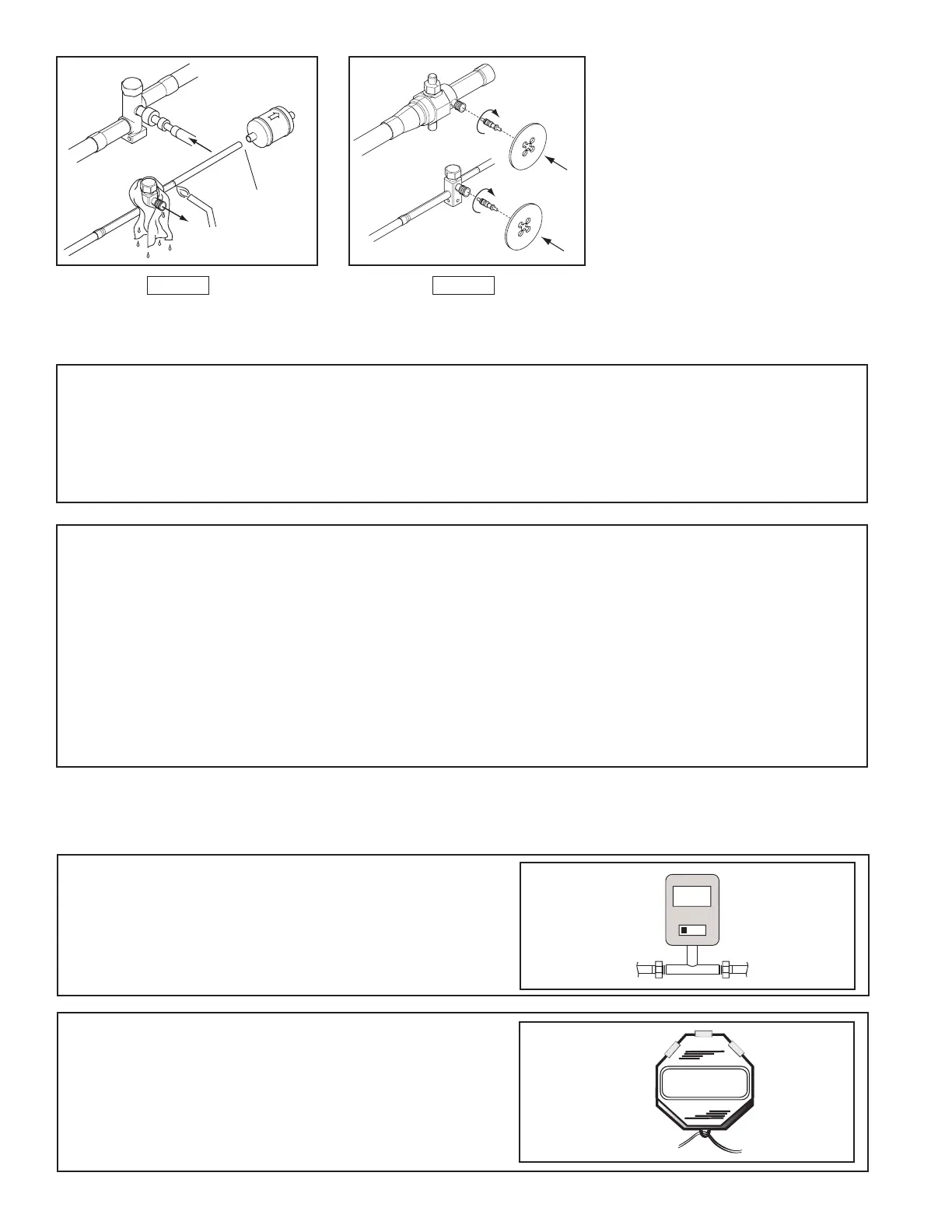
STEP 4 STEP 5
Important: The outdoor unit should not be tested higher than 450 psig for servicing or component replacement.
The indoor unit and linesets should be tested to the max pressure specied on the outdoor or indoor unit name-
plate. The service valves should be closed when pressure testing the evaporator coil and linesets to separate the
outdoor unit from the indoor unit.
STEP 1 (Final Pressure Check) - Isolate the outdoor unit from the evaporator coil and linesets using the service
valves. Pressurize the evaporator coil and linesets to the max pressure specified on the outdoor or indoor unit
nameplate for a minimum of 60 minutes. Do not add additional refrigerant or test gas after reaching the evaporator
coil specified pressure. The system should show no loss of pressure once pressurized. Once the pressure test is
complete follow the steps for evacuation.
*OPTIONAL (Preliminary Pressure Check) - Pressurize the refrigerant lines and evaporator coil to 150 PSIG
using dry nitrogen. Check for leaks by using a soapy solution or bubbles at each brazed location. Remove pres-
sure and repair any leaks before continuing.
STEP 2 - Observe the micron gauge. Evacuation
is complete, if the micron gauge does not rise
above 500 microns in one (1) minute and 1500
microns in ten (10) minutes.
STEP 3 - Once evacuation is complete, blank off
the vacuum pump and micron gauge, and close
the valve on the manifold gauge set.
1 MIN.
Important: Do not open the service valves until
the refrigerant lines and indoor coil leak check
and evacuation are complete.
STEP 1 - Evacuate until the micron gauge reads
no higher than 350 microns, then close off the
valve to the vacuum pump.
0350
Microns
ON
OFF
Section 9. Evacuation and Servicing
9.1 Evacuate the Refrigerant Lines and Indoor Coil
After completion of eld piping for split systems, the eld pipework shall be pressure tested with nitrogen and then
vacuum tested prior to refrigerant charging.
Important: Under no circumstances shall potential sources of ignition be used in the searching for or detection of
refrigerant leaks.
Important: The following leak detection methods are deemed acceptable for all refrigerant systems:
• Electronic leak detectors calibrated for R-454B (with a sensitivity of 5 grams/year).






 To Next Page