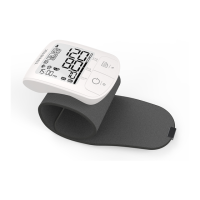
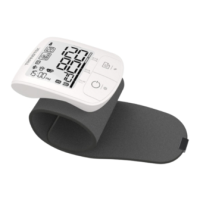
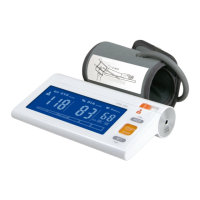
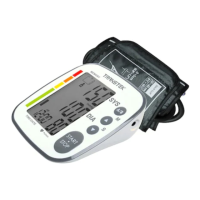
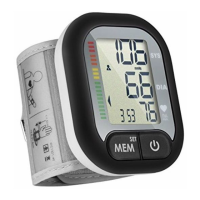
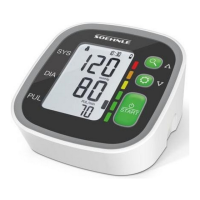
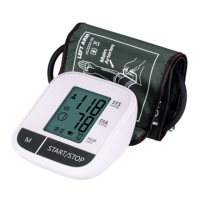
The Pro Cellular Blood Pressure Monitor TMB-2092-G is an arm-type digital monitor designed for measuring blood pressure and heartbeat rate in adults. It utilizes the Oscillometric Measuring method to detect blood pressure. Before each measurement, the unit establishes a "zero pressure" equivalent to the atmospheric pressure, then inflates the arm cuff. During inflation, it detects pressure oscillations generated by beat-to-beat pulsatile, which are used to determine systolic and diastolic pressure, as well as pulse rate. The device is intended for use with arm circumferences ranging from 22 to 42 cm (or 22 to 45 cm).
Function Description:
The TMB-2092-G monitor offers a one-click operation for ease of use. It features a large 4.5-inch LCD display that shows systolic and diastolic blood pressure readings, pulse rate, and various symbols and warning messages. The device supports real-time data transmission via 4G, allowing for remote care and access to measurements anytime, anywhere. An AC adapter is available (though not included) for power, in addition to battery operation.
Usage Features:
The monitor can be used in two primary measurement modes: Single Measurement Mode and Triple Measurement Mode.
Single Measurement Mode:
To start a measurement in Single Measurement Mode, ensure the "TRIPLE MODE" button is in the "OFF" position. When the monitor is off, press the "START/STOP" button to turn it on. The device will automatically complete the entire measurement process. After the measurement, data transmission begins, indicated by a symbol on the LCD. If transmission is successful, the symbol disappears, and "OK" is displayed. The device will power off automatically within several seconds if the "START/STOP" button is not pressed to turn it off. If data transmission fails or a server connection error occurs, a specific symbol will appear on the LCD. Similarly, if there is no cellular coverage or connection error, another symbol will be displayed.
Triple Measurement Mode:
To use Triple Measurement Mode, ensure the "TRIPLE MODE" button is in the "ON" position. When the monitor is off, press the "START/STOP" button to turn it on, and it will automatically complete the measurement. After the first measurement, the readings are not displayed; instead, the device waits 60 seconds before starting the second measurement. This process repeats for the third measurement. Once all three measurements are complete, the LCD displays the average of the three readings. If a measurement fails during the process, the device will report an error and repeat the current measurement. If an error occurs twice in a row, the Triple Measurement Mode will automatically quit. Users can press the "START/STOP" button at any time to stop the measurement.
Applying the Cuff:
For accurate readings, proper cuff application is crucial. First, remove all jewelry from the left arm. If a doctor has diagnosed poor circulation in the left arm, use the right arm. Roll or push up the sleeve to expose the skin, ensuring it's not too tight. Hold the arm with the palm facing up and tie the cuff on the upper arm, aligning the air tube toward the center of the arm. The bottom edge of the cuff should be 1 inch (2-3 cm) above the inside elbow, and the cuff should be wrapped securely, snug but not too tight, allowing one finger to be inserted between the cuff and the arm. Sit upright in a comfortable chair with the back against the backrest, feet flat, and legs uncrossed. Place the arm resting comfortably on a flat table, ensuring the cuff is at the same level as the heart's right atrium. Take 5-6 deep breaths before starting the measurement.
Tips for Accurate Measurement:
To ensure accurate readings, take measurements in a silent room, rest for 5 minutes beforehand, remain relaxed and still, and avoid talking during the measurement. For meaningful comparisons, measure under similar conditions, ideally at the same time each day, on the same arm, or as directed by a physician. Measurements may be inaccurate if taken within 1 hour after dinner or drinking, immediately after tea, coffee, or smoking, within 20 minutes after taking a bath, while moving fingers or talking, in a very cold environment, or when needing to urinate.
Measurement Reminder:
The device is equipped with a Measurement Reminder function, which can be enabled or disabled via Customer Support. Up to five groups of measurement reminders can be set (disabled by default). When enabled, a blue LED on the device button will light up as a breathing light at the scheduled time to remind the user to measure. This breathing light will be canceled after startup or 30 minutes of inactivity. If the user does not take a measurement according to the reminder, the reminder icon will not be displayed during the next measurement.
The manual explains systolic and diastolic pressure, and provides the standard blood pressure classification from the American Heart Association (AHA). It also addresses common questions such as why blood pressure fluctuates throughout the day, why readings might differ between home and hospital, and whether results are the same when measuring on the right arm. The device is intended for adults and is not suitable for neonates, infants, or children. Its effectiveness has not been established in pregnant patients, including those with pre-eclampsia.
The device is intended for indoor use and is portable but not for use during patient transport or continuous monitoring in medical emergencies or operations. It is designed for non-invasive arterial blood pressure measurement on the arm only. Users with implanted electrical devices, common arrhythmias, peripheral arterial disease, or those undergoing intravascular therapy should consult a medical professional before use. The device should not be used for diagnosis or treatment of any health problem or disease, and users should not change medications without a physician's advice. It is crucial to report any unexpected operation or events to the manufacturer.
Cautions during use include:
- Avoiding kinking, folding, stretching, compressing, or deforming the cuff tube during measurement.
- Not applying the cuff to an arm with an intravenous drip or blood transfusion.
- Avoiding frequent measurements that could disrupt blood circulation.
- Not applying the cuff to delicate or damaged skin, and checking the cuff site frequently for irritation.
- Not placing the cuff on an arm undergoing medical treatment (e.g., intra-vascular access, A-V shunt).
- Not placing the cuff on the same arm after a mastectomy.
- Not wrapping the cuff on the same arm as another monitoring device.
- Ensuring the device operation does not cause prolonged impairment of patient blood circulation.
- Immediately loosening and removing the cuff if it remains fully inflated during measurement due to a fault, as prolonged high pressure can cause bruising and discolored skin.
- Not using the device with high-frequency (HF) surgical equipment or in environments with flammable anesthetics or oxygen/nitrous oxide mixtures.
- Avoiding strong electromagnetic fields, wireless communication equipment, and electrical fast transient/burst signals to prevent measurement errors. A minimum distance of 1 foot (30 cm) should be maintained from wireless devices.
- Using the device only in the environment specified in the user manual.
- Allowing up to 30 minutes for the device to warm up/cool down to operating temperature.
- Properly managing cuff tube lengths to avoid strangulation.
- Not touching the battery/adapter output and the user simultaneously.
- Using only accessories approved by the manufacturer.
- Pressing the Power button immediately to release air from the cuff if discomfort or pain occurs during measurement.
- No calibration is required within two years of reliable service.
- Not attempting to repair the unit; only authorized service centers should perform repairs.
- Performance checks are recommended after repair, maintenance, and every two years.
- Not using the device while under maintenance or being serviced.
Maintenance Features:
To ensure the best performance and longevity of the device, store it, the cuff, and the adapter in a clean, dry place, protected from extreme moisture, heat, lint, dust, and direct sunlight. Avoid placing heavy objects on it. Ensure the rubber tube of the cuff is not squeezed, stretched, or kinked during storage. Keep the device, cuff, and batteries away from children to prevent choking or strangulation risks. Clean both the device and cuff with a soft, dry cloth; if necessary, use a dampened cloth and natural detergent. Do not use alcohol, benzene, or other harsh chemicals. The cuff should not be washed in a washing machine or dishwasher. The typical service life of the cuff is 10,000 times, though it may vary based on washing frequency, skin condition, and storage. Dispose of accessories, detachable parts, and the device according to local guidelines.



 To Next Page
 General