FUEL BOTTLE
Fuel is usually purchased by the gallon or quart, so a smaller
bottle with a dispensing tube is required to fill the fuel tank. The
fuel tank has a capacity of 120cc. The fuel bottle should be
capped to prevent the fuel from evaporating and becoming conta-
minated with debris or moisture. The alcohol and nitro contents of
the fuel will evaporate, thus upsetting the fuel balance and spoil-
ing the fuel. Do not use old or dirty fuel!
7.2v BATTERY PACK AND CHARGER
The EZ-Start electric starter requires a 7.2 volt rechargeable
nicad battery pack to operate. The battery pack straps to the bot-
tom of the EZ-Start control box with the supplied tie wraps. The
battery pack can be recharged with a simple overnight “wall charger”,
a peak-detecting charger (most expensive), or a 15-minute quick
charger. These chargers are all available from your hobby dealer.
RADIO SYSTEM INSTALLATION
{Model 3504 only}
The model 3504 Nitro Vee is fully assembled without the radio
system. Refer to the exploded view diagrams for details on
installing other manufacturers’ radio systems
THE RADIO SYSTEM (Model 3510)
TWO-CHANNEL RADIO SYSTEM - The radio system in your model
consists of the RECEIVER, the TRANSMITTER, the steering
SERVO, the ELECTRONIC SPEED CONTROL, and the CRYSTALS.
It has two channels, one to operate the throttle, and one to operate
the steering. (Unassembled kits do not include the radio system.)
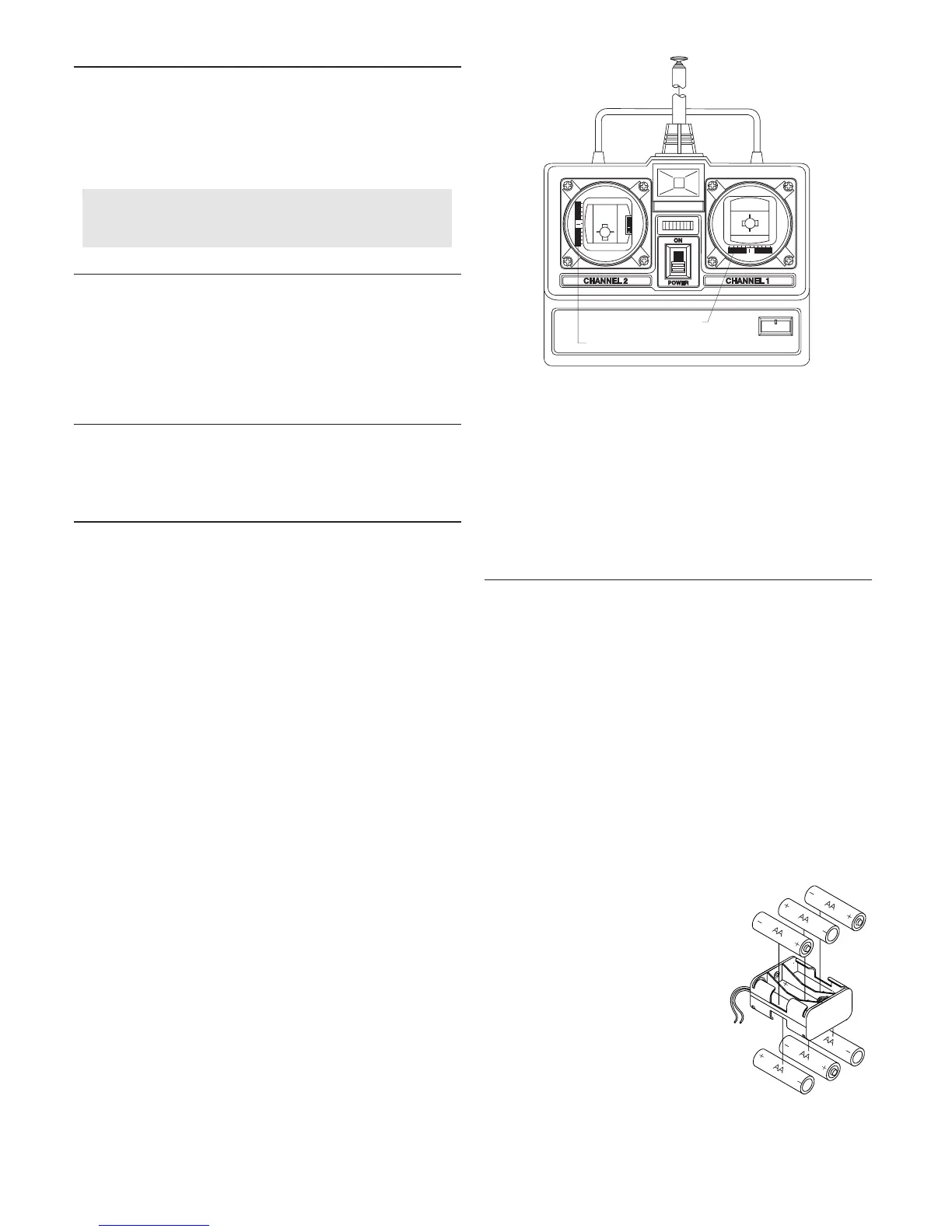
TRANSMITTER - The TRANSMITTER is the hand-held radio unit
which sends throttle and steering instructions to the model.
RECEIVER - The RECEIVER is the radio unit inside the model
which receives signals from the TRANSMITTER, and relays them
to the SERVOS.
SERVO - The SERVO is the small motor unit in the model which
operates the steering mechanism.
FREQUENCY BAND - The FREQUENCY band is the radio
frequency that the transmitter uses to send signals to the model.
The FREQUENCY BAND for radio control vehicles is 27 MHZ
(mega-hertz).
CHANNEL - The 27 MHZ FREQUENCY BAND is divided into 6
CHANNELS so that up to six boats can be operated simultaneously.
These CHANNELS are referred to by their number and flag color.
The chart below lists the channels and their flag colors.
CRYSTAL (X-TAL) - The CRYSTAL is the plug-in device that
determines which channel (1-6) that the RADIO SYSTEM will
operate on. For Each CHANNEL, there are two CRYSTALS; one
for the RECEIVER and one for the TRANSMITTER. Of those two
CRYSTALS the one marked with the lower number (.455 MHZ
lower) must be inserted in the RECEIVER.
NICAD (Ni-Cd) - These terms stand for rechargeable, nickel cad-
mium batteries. These batteries are the most economical and
can be recharged up to 500 times.
NEUTRAL POSITION - The NEUTRAL POSITION is the standing
position that the SERVO seeks when the TRANSMITTER
controls are at neutral.
TRIM - TRIM is the fine-tuning adjustment of the NEUTRAL
POSITION of the SERVOS. This adjustment is made by moving the
throttle and steering trim sliders on the face of the TRANSMITTER.
PREPARING TO RUN
• INSTALLING TRANSMITTER BATTERIES
Yo ur transmitter uses 8 “AA” size batteries. They should be alkaline
dry cells or nicad rechargeable batteries. The battery compartment
is located in the back of the transmitter. To remove the battery
door, push down and slide in the direction of the arrow. Be sure
that the switch is turned off before installing the batteries. Insert
the batteries into the battery compartment, making careful note of
the polarity. Now, slide the battery door back in place.
• OPENING THE TOP COVER
The top cover is held in place by inserting the front tab into the
slot and fastening the back of the cover to the Velcro™ strips
near the transom. Removing the top cover provides access to the
battery compartment and radio system. For engine tuning
access, the driver figures may also be removed separately.
• INSTALLING THE RECEIVER BATTERIES
Install 6 “AA” alkaline batteries into the bat-
tery holder in your model. Tape or rubber-
band the batteries into the holder to pre-
vent them from falling out during rough
running. Stretch a rubber balloon over
the battery holder to prevent fuel and
water contamination. Install the battery
holder into the boat and secure it with
the nylon tie wrap. Position the tie wrap
so that its end will not interfere with the
top cover. Make sure the battery holder
is secure in the model and will not come
loose. These batteries power both the radio
system and the Return-To-Shore system.
DO NOT ATTEMPT TO OPERATE YOUR NITRO VEE
WITH WEAK BATTERIES OR IT COULD RUN OUT OF
RANGE RESULTING IN LOSS OF CONTROL.
CAUTION:
KEEP THE FUEL CONTAINERS CAPPED AT ALL TIMES
WHEN NOT IN USE. THE FUEL CAN SPOIL VERY QUICKLY.
3


 To Next Page
 Loading...