7
THE FIRST TANK OF FUEL
Once the engine is started, drive the boat slowly at first to warm
the engine. Ease in and out of the throttle slowly. Vary your
speed between low and medium throttle until about half of the
first tank of fuel is used. Do not run at full speed during the first
tank of fuel. Do not rev the engine when the boat is out of the
water. High, no-load RPMs can damage the engine.
The baseline setting of the high-speed mixture screw will vary
slightly with each engine. To know if your engine is set correctly for
break in, look for the following performance characteristics (on a
warm engine):
• The engine will accelerate sluggishly from a standing start and
may even try to stall if the throttle is applied too quickly.
• Blue-white smoke will be emitted from the exhaust.
• When the model is accelerating at full throttle, the engine will
never “clean out.” When an engine “cleans out”, the speed and
rpms will increase suddenly and dramatically, as if the engine
has gone into “second gear.” Also the amount of smoke emitted
from the exhaust will decrease. “Cleaning out” is a desirable
characteristic once the engine is broken-in; however, during the
first two tanks, it should be avoided.
Halfway through the first tank of fuel, bring the boat in and lean
the fuel mixture by turning the high speed needle clockwise 15
0
.
As the engine reaches normal operating temperature, it will speed
up and performance will improve. This occurs because the fuel
mixture is becoming leaner with the increased temperature. You
may need to richen the fuel mixture very slightly so that the engine
continues to run as described above.
When the first tank is used, bring the model in, shut off the engine,
and allow it to cool for 7-10 minutes before continuing.
THE SECOND TANK OF FUEL
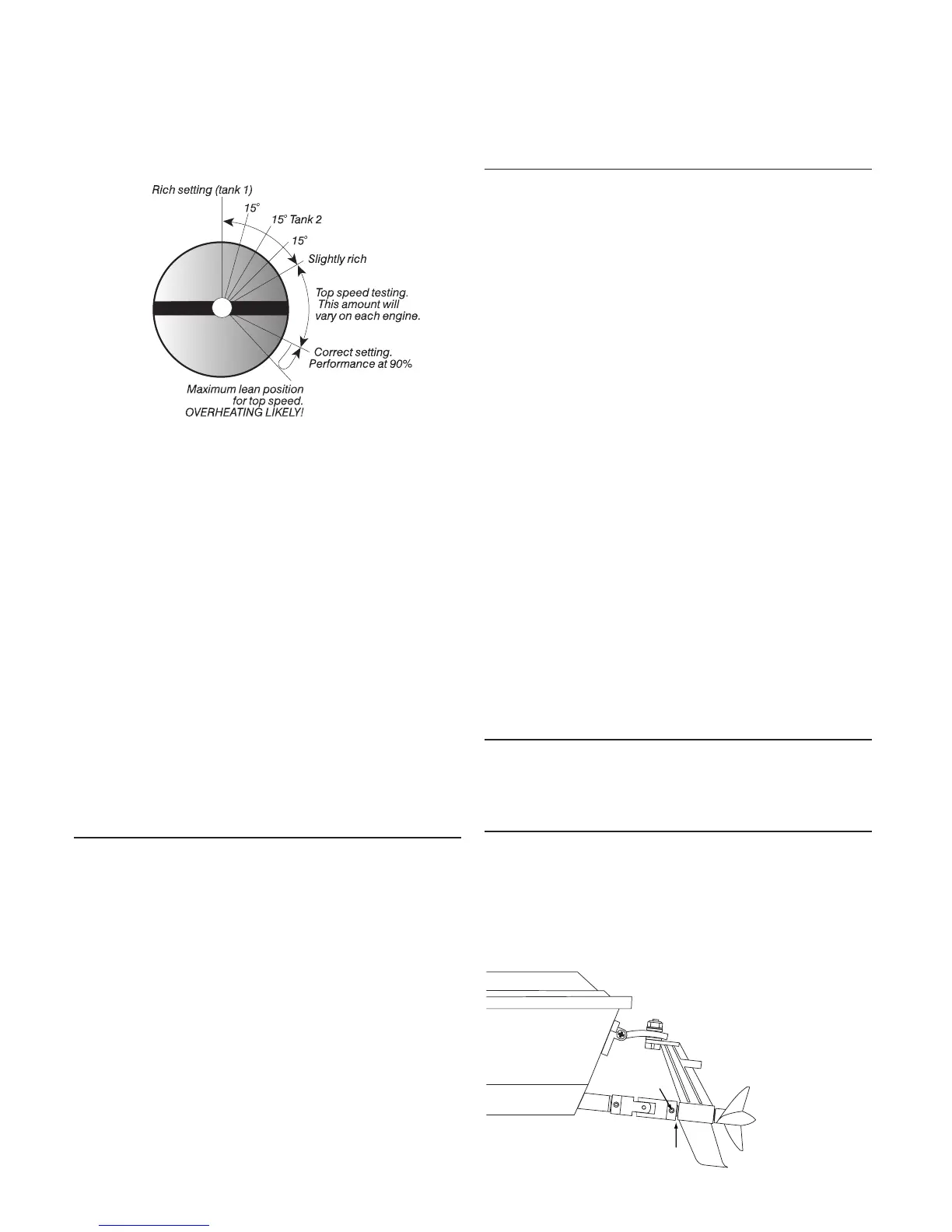
Tu rn the high-speed mixture screw clockwise 15
0
and run through
half of the second tank of fuel.
Halfway through the second tank, bring the model in and lean
the fuel mixture another 15
0
(see illustration).
During break in, watch closely for any signs of overheating.
These include:
• Steam or smoke emanating from the engine surfaces
• Lagging during acceleration (as if running out of fuel)
• Popping or clattering sound when decelerating (detonation)
• Idle speed will surge or possibly diminish to the point of stalling.
IF THE ENGINE STALLS WHILE YOU ARE DRIVING, BECAUSE
OF AN OVERHEATING CONDITION, SEVERE DAMAGE HAS
PROBABLY ALREADY OCCURRED. OVERHEATING IS
CAUSED BY THE FOLLOWING OPERATIONAL ERRORS:
• HIGH SPEED MIXTURE IS SET TOO LEAN
• EXCESSIVE NITRO IN THE FUEL
• INCORRECT OIL CONTENT IN THE FUEL
• POOR QUALITY FUEL
• EXCESSIVE LOADS PLACED UPON THE ENGINE (caused by
a bound drivetrain)
YOUR ENGINE WILL BE SHORT-LIVED IF ANY OF THE ABOVE
CONDITIONS ARE ALLOWED TO PERSIST.
TUNING FOR POWER
After the second tank of fuel, the internal engine parts should
be broken-in.You can now begin adjusting the fuel mixture to max-
imize performance for your normal driving needs.
The engine should never be run at more than 90-95% of its
maximum performance capacity. As you continue to lean the fuel
mixture, the engine will run faster, up to a point. When the engine
is set too lean, it will seem to run strong at first, but will bog, hesi-
tate, or stall when running at speed. The engine will also rapidly
overheat when the setting is too lean.
At the optimum setting, the engine will have a strong-sounding,
high-pitched whine at full speed; and there will be a thin trail of
whitish smoke emitted from the exhaust. If there is no smoke, the
fuel mixture must be richened to ensure that the engine is getting
enough oil/fuel for adequate lubrication.
Find an area that will allow the engine to run at full throttle. Run
the model two or three passes at full throttle and note the top
speed and acceleration. Turn the high-speed mixture screw clock-
wise 15
0
and retest the model, again noting the performance.
Continue to lean the mixture and retest the model until the Nitro
Vee bogs and starves for fuel at full throttle. When this occurs,
reduce the throttle immediately to medium speed and the boat
should regain its speed. Retrieve the boat, turn the high-speed
mixture screw counter-clockwise (richer), and re-test. Continue to
richen the mixture until the boat no longer hesitates and stalls at
full throttle. At that point, turn the mixture screw counterclockwise
10 to 15
0
. This is the optimum setting that the engine should be
run.
If the boat takes an excessive amount of time to come on plane
but full-throttle (top speed) performance is good, the fuel mixture
might need to be slightly leaner. (Note: A damaged prop will also
cause this same symptom. Check it before leaning the mixture.)
SETTING THE IDLE SPEED
The idle speed may be set too high now that the engine mixture is
tuned. Turn the idle screw out (counter-clockwise) until the engine
will idle slowly and the propeller is not spinning.
ADJUSTMENTS
• ADJUSTING THE OUTDRIVE SHAFT END PLAY
There should be a slight amount of shaft endplay in the out-
drive housing. To adjust the endplay loosen the grubscrew on the
U-joint yoke (see drawing). Pull the propeller shaft until there is
no more than 1mm of distance at arrow 2 in the drawing.
Retighten the grub screw.


 To Next Page
 Loading...