• INSTALLING THE EZ-START BATTERY
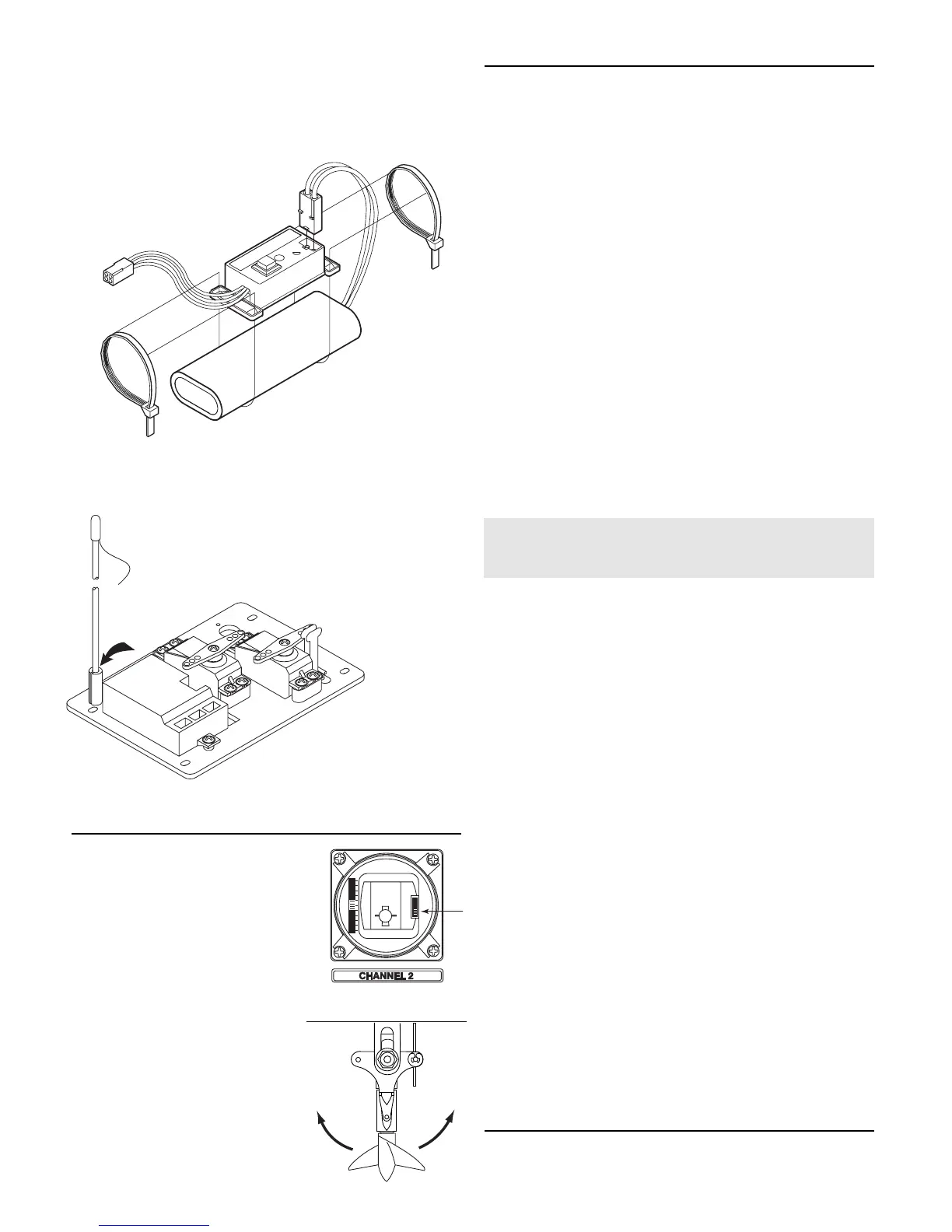
Use tie wraps to secure a fully-charged 7.2 volt battery back
to the EZ-Start control box. Plug the battery connector into the
face of the control box. The plug will only go in one way
• ANTENNA SETUP
Locate the 12” plastic antenna tube and the rubber
antenna tip that came with your boat. Now, locate the
black antenna wire which comes out of the receiver
inside the boat. Thread the antenna wire through the
antenna tube and then install the tube into the slotted
post on the radio tray (drawing). Fold the excess
antenna wire over the top
of the antenna tube
and install the vinyl
antenna tip. Do not
shorten the
length of the
receiver’s
antenna.
On top of the transmitter,
insert the chrome telescopic
antenna into the hole in the top of the
transmitter and screw it down until it
stops. Do not overtighten.
TRANSMITTER CONTROLS
• THROTTLE NEUTRAL ADJUST:
The throttle neutral adjust, is located on
the right of the throttle stick (channel 2). It
controls the amount of desired forward
and reverse travel of the throttle stick. It
should stay in the down position as
shown in the drawing (arrow). If you
change this adjustment, your transmitter
throttle trim will have to be reset.
• THROTTLE TRIM/ STEERING TRIM:
Adjust the throttle trim control so that
the RTS motor in the Nitro Vee does not
run after the switch is turned on. Adjust
the steering trim so that the Nitro Vee will
drive straight without veering to the left or
right.
RADIO SYSTEM ADJUSTMENT
Your radio system was pre-adjusted before it left the factory how-
ever, the adjustment should be checked prior to running the Nitro
Vee. These instructions are for Traxxas radio systems only. If you
installed your own radio, refer to your radio system’s instructions.
1) Before you ever turn your radio system on, you must “clear”
your frequency. Clearing your frequency means checking to be
sure that no one else in the area is operating on the same
channel as you. There are six different channels numbered 1
through 6. Each of the six channels is represented by a color.
Look at the crystal on the face of the transmitter to determine
which of the channels your Nitro Vee is operating on.
2) Always turn the transmitter on first, before you turn on the
receiver in the boat. If you do not, the boat could run out of
control. Slide the transmitter switch to the “on” position. The red
light should be on and not flashing. A flashing red light indicates
weak transmitter batteries. Weak batteries will cause the range
of your model to be limited, and you could lose control.
CAUTION: When nicad batteries begin to lose their charge, they
will fade much faster than alkaline dry cells. Stop immediately
at the first sign of weak nicad batteries.We recommend that
only alkaline batteries be used inside the boat.
3) Push the switch inside the boat to the “on” position. The steering
servo should jump and move to its idle (neutral) position. Keep
fingers and obstacles away from the propeller.
NEVER TURN THE TRANSMITTER OFF WHILE THE
ENGINE IS RUNNING. THE MODEL COULD RUN OUT
OF CONTROL.
4) Operate the steering control on the transmitter (channel 1).
Check for rapid operation of the steering servo and that none of
the steering mechanism is loose or binding. If the servo oper-
ates slowly, check for weak batteries. Slide the “steering trim”
control on the transmitter to adjust the servo so that the outdrive
and propeller are pointing straight back. Check to be sure that
the outdrive does not turn more in one direction than in the
other. If it does, then refer to the section “Centering Your
Servos.”
5) There is an adjustment to the right of the throttle lever (channel 2).
Make sure it is in the down position as shown in the drawing.
6) Operate the throttle lever on the transmitter to ensure that the
throttle servo is operating properly. When the servo is in the
neutral position, the carburetor should be in its idle position
(you will adjust the engine idle speed later). When the throttle
lever is pushed completely forward, the carburetor should be in
the fully open position. When the throttle lever is pulled all the
way back, the carburetor should close to idle and the switch for
the R.T.S. motor will be engaged. (CAUTION: The R.T.S. motor
will run during this test so be sure that your fingers are clear of
the propeller and drive mechanisms). Check to be sure that
none of the cooling and exhaust hoses interfere with the throt-
tle or gear mechanisms.
7) The radio system should be range-tested before each session
of running. With the radio system on, have a friend carry the
boat away from you a distance equal to the maximum range you
plan to operate the the boat. Make sure your friend holds the
boat carefully to avoid contact with the propeller. At distance,
once again test for complete radio control. Never attempt to run
the boat if the radio appears to be malfunctioning in any way.
VISUAL INSPECTION
Form the habit of visually inspecting the mechanical integrity of
the Nitro Vee before each run.
4


 To Next Page
 Loading...