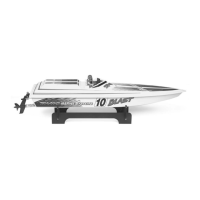
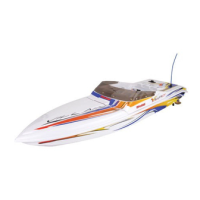
Clean the boat as thoroughly as possible and allow it to dry fully.
Clean and oil the bushings in the drivetrain and remove all batter-
ies. Store unused fuel in a tightly-capped container, away from
direct sunlight.
TROUBLESHOOTING:
GLOW PLUG PROBLEMS
The glow plug in your model engine is a consumable item
which must be replaced periodically to maintain peak perfor-
mance and starting ease. Most often, any starting problems or
erratic performance can be traced back to the glow plug. The glow
plug should also be suspected if the engine’s acceleration and
high-speed performance suddenly become flat.
Glow plugs will be damaged by running the fuel mixture too
lean, applying more than 1.5 volts to the plug, or by running out of
fuel while the engine is running at high RPMs.
A leaking glow plug can cause many problems with engine per-
formance, especially if the engine is not running well at speed.
While the engine is running, look for bubbles at the base of the
glow plug. Loosen the glow plug and then re-tighten. If the problem
persists, remove the glow plug and inspect the copper gasket for
nicks and scratches.
Whenever the glow plug is in question, simply replace it with a
new one to see if it solves your problem. Replacement glow plugs
are available from your hobby shop or Traxxas. From the factory,
your engine was equipped with a standard long-reach reach plug
(Traxxas part #3230). Do not use glow plugs with idle bars.
Always use the new gasket which comes with the glow plug.
FUEL PROBLEMS
You must use fuel which contains castor and synthetic oil.
Your engine will consume more fuel than you might expect. It will
run approximately 15 minutes on a tank of fuel. Run time will vary
greatly depending upon the mixture setting and the driving style.
Tr y not to let the fuel level drop below
1
/
4
of a tank. When the fuel
level is low, the engine will begin to draw air in with the fuel as the
fuel sloshes away from the fuel pickup point in the bottom of the
tank. The air in the line causes erratic performance and radical
leaning of the fuel mixture. In this case, the engine will lean out,
stall, and the glow plug may be damaged.
COOLING PROBLEMS
Engine overheating in the Nitro Vee is not likely to occur
because of the constant supply of cooling water. Problems can
exist if the Nitro Vee is not driven correctly, the cooling water pick-
up becomes blocked, or the fuel mixture is set too lean. The symp-
tom of an overheating engine is a noticeable drop in performance,
similar to that which occurs when the mixture becomes lean. If you
suspect overheating, drive the boat past you and check for water
flow from the outlet at the rear of the boat. If water is flowing, then
the cooling system is functioning normally. Remember that the
cooling system only functions when the boat is being driven on
plane. Therefore, do not allow the boat to idle in or out of the water
for more than a minute with no cooling water flow.
If the cooling water is not flowing, check for blockage in the
hoses and fittings. Remove the hoses and blow through them to
make sure they are clear. It is possible for corrosion and debris to
build up inside the head over time. Remove the top cover and
clean out any corrosion.
If the cooling water is flowing and the engine still exhibits symptoms
of overheating then richen the fuel mixture
1
/
4
of a turn and retest.
If the fuel meets all of the requirements, the mixture is set rich, the
head is receiving adequate water-flow, and the engine continues to
overheat, then the drivetrain may be bound. Look for dirty bushings
or any other moving part which may have tightened. Check that
moss and fishing line have not become entangled in the propeller.
WATER DAMAGE
If the Nitro Vee flips and fills with water, it must have IMMEDI-
ATE ATTENTION. If the water is allowed to remain in the engine
and radio system, they could be destroyed with rust and corrosion.
WATER IN THE ENGINE
1. Hold the boat nose up to drain all of the water from the hull and
exhaust system.
2. Look in the air intake of the carburetor for any debris or foreign
matter that may have entered the engine.
3. Remove the glow plug and gasket. Drain the water from the
cylinder and look for debris on top of the piston. If any debris is
visible, do not pull on the starter or cause the engine to turn
over. Temporarily fill the cylinder with after-run oil and replace
the glow plug and seal. Fill the crankcase with after-run oil
through the carburetor. The engine must be disassembled and
cleaned as soon as possible!
4. If no foreign material is found inside the engine, remove and plug
the fuel line and tank pressure line (from the exhaust header).
5. Turn the boat on its side, cover the glow plug hole with a rag,
move the servo to hold the throttle open, and press the starter
button for a few seconds. Continue until no more spray comes out.
6. Flush the engine with fuel by pouring it in the carburetor and
repeating the operation in step 5. Continue flushing until the fuel
coming out of the glow plug hole is no longer cloudy (milky
white).
7. Once all of the water has been flushed out, check the glow plug
with the glow starter. Reinstall it, if it is good, or replace it with a
new one. Reinstall the fuel and pressure lines.
8. Drain the fuel system completely (including the tank and lines).
Allow it to dry fully.
9. Now start the engine using the normal starting procedures. A
fully-open throttle and repeated attempts may be necessary
until the engine fires. Remember that the radio system is wet
and may not be functioning. Do not attempt to drive your boat
until the radio is dry.
10. Allow the engine to run at a fast idle until it is warm
(about 1minute). Pinch the fuel line to run the engine dry. Use
the after run oil as usual.
WET RADIO SYSTEM
There are some steps you can take that may return your radio
system to normal operation and prevent having to return it for ser-
vice. Remove the receiver, two servos, and on/off switch from the
boat. Remove the back cover of the receiver and carefully pull the
circuit board out. Dry the circuit board off with a hair dryer and then
place it on a towel underneath a desk lamp. Allow it to dry for at
least one day. A wet servo will typically lock to one side and not
return to center. Lay the servo on a towel under a desk lamp and
allow it to dry for at least one day. If the servos and receiver do not
return to normal operation after 2 days of drying, then they should
be returned to Traxxas for service. The servos are very complex.
Do not attempt to disassemble the servos unless you are already
experienced at doing so. To prevent future water problems, many
hobby shops sell water displacing sprays such as “The Stuff.” This
product may be used to avoid future water contamination.
DETAILING THE HULL
If you wish to paint your hull some other color than the factory
white, then choose your paint with caution. Only use paint made
for plastic models (available from your hobby dealer). Test the
paint on an inconspicuous and non-critical area before painting
the entire boat. Also, test to make sure that the paint will not dis-
solve with the fuel. The paint on the bottom must be smooth to
prevent a loss of performance. Traxxas will not cover under
warranty any hull which has been painted. It is impossible to
know how each type of paint will affect the plastic.
The decals are printed on self-adhesive clear mylar. Carefully
cut the decals out as close to the printed edges as you can. Test
fit and trim each decal before removing the backing. Use the
9


 To Next Page
 Loading...