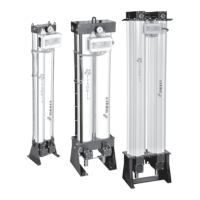
This document describes the Trident Dryspell Series Desiccant Compressed Air Dryer, a regenerative heatless desiccant dryer designed for purifying compressed air.
Function Description
The Dryspell Series dryer is a complete purification system that removes contaminants, dirt particles, and humidity (water vapor) from compressed air. Atmospheric air, which contains these impurities, is drawn in by a compressor. Without proper drying, this water vapor can condense in compressed air pipes, leading to issues like corrosion and freezing. The Dryspell dryer prevents these problems by adsorbing moisture from the air, ensuring a dry air supply for industrial applications.
The drying process involves several stages:
- Prefiltration: Wet air first enters a coalescing prefilter (optional but recommended) where solids and condensates (oil/water mixture) are retained. This stage reduces the residual oil content to 0.01 mg/cu.m.
- Adsorption Drying: The prefiltered air then flows to the heatless regenerative dryer, which contains two towers filled with desiccant material. The air is diverted to one tower, where the desiccant adsorbs moisture, drying the compressed air to an atmospheric dew point (ADP) of -40°F at standard inlet conditions (100°F, 100% saturated, 100 psig).
- Regeneration: While one tower is drying, a small portion (12%) of the already-dry compressed air is expanded to near atmospheric pressure by passing it through a purge orifice. This expanded, dry gas is used to strip previously adsorbed water vapor from the partially saturated desiccant bed in the offline tower. The air exhausts through an opened two-way purge valve.
- Repressurization: After regeneration, the purge valve closes, and the offline tower begins to repressurize before switching back to drying mode.
- Afterfiltration: Finally, an inbuilt 3-micron particulate after-filter (within the diffuser screen or compactor plate) removes any desiccant fines before the dried air travels downstream, protecting downstream equipment.
The dryer operates in a cyclical manner, with towers alternating between drying and regeneration. The cycle time is fixed at 4 minutes.
Important Technical Specifications
- Maximum Pressure: 225 PSIG (16 bar)
- Minimum Pressure: 29 PSIG (2 bar)
- Maximum Temperature: 158°F (70°C)
- Voltage: 115/1/60, 208-230/1/60, 220-240/1/50
- Power Consumption: 12 Watt Max
- Pre-filter Rating (Recommended): 0.01 Micron (Coalescer)
- After-filter Rating (Inbuilt): 3.0 Micron (within the diffuser screen or Compactor plate)
- Cycle Time: 4 minutes
- Purge Loss: 12%
- Air Outlet Conditions: Dry air down to -40°F ADP
- Power Cord Length: 7 ft
- Nominal Inlet Flow (SCFM): Models range from 10 SCFM to 375 SCFM (10, 20, 30, 45, 60A, 100, 125, 200, 250, 300, 375).
- Desiccant Quantity (Kgs): Varies by model, from 2 Kgs for the 10 SCFM model to 30 Kgs for the 375 SCFM model. Some larger models (100 SCFM and above) use desiccant bags/cartridges.
The dryer complies with several European directives:
- 97/23/CE: Pressurized Equipments
- 89/392/CEE: Machine Safety
- 89/336/CEE: Electromagnetic Compatibility
- 73/23/CEE: Low Voltage
Usage Features
The Dryspell Series is designed for small compressed air flows, offering a compact and easy-to-maintain solution. Key usage features include:
- Electronic Controller: Equipped with a manual purge economizer and compatible with a dew point sensor for automatic purge control. The control panel (DS 31-90 or DS 31-200) displays the machine diagram, LEDs indicating the drying tower (Tower 1 or Tower 2), and an LED for prefilter drain operation (if equipped with an electronic auto drain).
- Electronic Drain Valve: Located on the inlet filter for automatic condensate discharge.
- Purge Optimizer: A button on the control panel allows users to set the purge flow value (40% to 100%) by pressing it continuously for 8 seconds.
- Fixed Cycle Times: Drying time is 2 minutes, regeneration time is 1 minute 30 seconds, and repressurization time is 30 seconds. These times are fixed and not user-adjustable. The prefilter condensate drain discharges every 4 minutes for 4 seconds (for models with electronic auto drain).
- Dew Point Control (Econo Mode): If the dew point is "good" (contact closed), the dryer will stop switching towers and purge air until contacts are open (dew point poor), conserving energy.
- Bypass System: Installation requires a system of bypass valves to allow servicing the dryer without interrupting the compressed air supply.
Maintenance Features
The Dryspell dryers are described as robust and reliable, but regular inspections and maintenance are crucial for uninterrupted operation.
- Monthly Inspections:
- Check if drying and regeneration cycles function normally.
- Check if silencers are not clogged.
- Semi-Annual Inspections:
- Perform monthly checks.
- Replace filter elements.
- Annual Inspections:
- Perform semi-annual checks.
- Inspect the desiccant: If it's brown (indicating oil pollution) or dusty (disintegration), it needs to be changed.
- Inspect the state of block 'O' rings.
Desiccant Material: The dryer uses a smooth sphere of activated alumina as desiccant. Its benefits include:
- Uniform ball size, reducing pressure drop and channeling.
- High crush strength.
- Rapid pneumatic loading of towers.
- Low abrasion, which minimizes dusting during transport, loading, and service life, reducing pressure drop and downstream valve/filter plugging.
- High adsorptive capacity and excellent cyclical stability, leading to a long desiccant life.
The desiccant is non-toxic but can cause respiratory problems if inhaled in dust form, so a dust mask is recommended during handling.
Changing the Desiccant:
- Dryspell 10 to 60A models: Involves bypassing the dryer, disconnecting from airlines, loosening and removing the tie rod, replacing the old desiccant, ensuring O-rings/gaskets are in place, and re-installing the tie rod.
- Dryspell 100 to 375 models: Involves bypassing the dryer, disconnecting from airlines, loosening the M8 Allen Bolt, removing the top block and top compactor plate, removing the saturated desiccant bag (or tilting the dryer to remove loose desiccant), replacing with new desiccant, ensuring O-rings/gaskets are in place, and re-installing the top compactor plate and top block.
Replacement desiccant must be identical to the initial desiccant; contact the factory for the correct desiccant kit part number.
Troubleshooting: The manual provides guidance for common issues:
- LEDs not Glowing: Check power supply connection and tension.
- Tower Status LED not Changing: Change the controller.
- LEDs Status Change but Tower not Switching: Check coil connection at DIN and terminal connector in the controller, or check the solenoid valve.
- No Purging: Check the solenoid valve, exhaust valve, or clean the silencer (muffler).
- Continuous Purging at Tower 1: Check if the shuttle is not closing, pilot air for the exhaust valve, or if the exhaust valve piston is stuck.
- High Purge Loss: Check outlet shuttle closing or for silencer choke.
- High Pressure Drop across Dryer: Prefilter may be clogged (check and replace filter elements) or the dryer is being overflowed.
Safety Warnings:
- Only experienced and licensed electricians trained in compressed air systems should service or repair Trident products.
- Before startup or maintenance, turn off and disconnect all electrical power, bypass and depressurize the dryer to 0 PSIG.
- Do not operate the dryer if there is a leak.
- Ensure the dryer's protection rating is applicable to installation conditions.
- Do not operate above maximum allowable pressures/temperatures marked on the data label.
- Verify incoming voltage matches the data label.
- Do not lift the dryer by its piping or control box.
- The dryer is intended only for drying filtered, compressed air; ensure inlet air is filtered.
- Under no circumstances should the dryer be used to dry other gases.

 Need help?
 General

 To Next Page