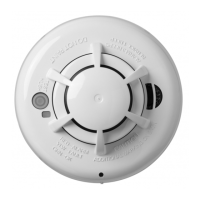
Need help?
Do you have a question about the Tyco MR601TEx and is the answer not in the manual?
Guidance on using the detector with suitable isolators or shunt diode safety barriers.
Enclosure's electrostatic hazard requires cleaning only with a damp cloth.
Describes the infra-red emitter and receiver system for detecting smoke particles via light scattering.
Details the vertical chevrons and optical system design to exclude ambient light and insects.
Detects hot air draughts using two negative temperature thermistors for enhanced detection.
Explains the detector's pulse stream emitter, amplifier gain control, and alarm latching mechanism.
Describes the assembly process involving body moulding, PCB potting, and cover clipping.
Covers functional testing, calibration in a smoke tunnel, and fitting of sealing rings.
Details the physical dimensions and materials used in the detector's construction.
Specifies operating and storage temperatures, humidity, shock, vibration, impact, and corrosion resistance.
States compliance with EN50130-4 and EN 61000-6-3 for disturbances, immunity, and emissions.
Lists key electrical parameters like operating voltage, quiescent current, and alarm current.
Defines sensitivity based on response threshold values (obscuration) for different smoke types.
Details how the detector enhances sensitivity based on rapid temperature rise detection.
Evaluates detector performance against standard fire tests (TF1-TF5) and their response to smoke colour.
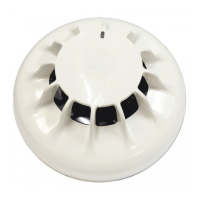
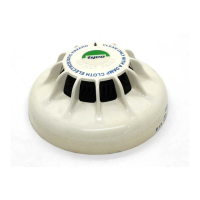
The MR601TEx is an Intrinsically Safe Enhanced Optical Smoke Detector, designed as part of the M600Ex series of plug-in detectors for ceiling mounting. It is intended for two-wire operation with most control equipment currently manufactured by the company. This detector is specifically engineered for use in potentially explosive gas and dust atmospheres, categorized for zone 0 gas and zone 20 dust. It complies with EN/IEC 60079-0:2006, EN/IEC 60079-11:2007, and EN/IEC61241-11:2006 standards for Intrinsically Safe apparatus, holding ATEX certification with code II 1 GD, certificate BAS01ATEX1134X, and gas/dust code Ex ia IIC T5, Ex iaD 20 T100°C. Its IECEx certificate is BAS 07.0056X. The detector is also designed and manufactured to protect against other hazards as defined in paragraph 1.2.7 of Annex II of the ATEX Directive 94/9/EC.
This detector operates by sensing the optical scatter from smoke particles generated during a fire. While standard optical scatter detectors perform well for most fires, some fast-burning fires produce minimal visible smoke, and some produce very black smoke, both of which are challenging for conventional optical scatter detectors to detect. Such fires, exemplified by Polyurethane and Heptane type fires in EN54-7, generate high heat outputs with a rapid rise in air temperature. The MR601TEx addresses this limitation by offering improved detection of these fires. It achieves this by detecting a rapid rate-of-rise in air temperature, which, under these conditions, increases the smoke detection sensitivity. This dual-sensing capability allows for earlier detection of such fires and provides a broader detection capability compared to a standard detector.
The MR601TEx incorporates two primary sensing systems: an optical chamber with associated electronics to measure smoke presence via light scatter, and a thermistor with its electronics to detect hot air drafts or high temperatures. The optical system consists of an infra-red emitter and receiver, each with a lens, arranged so their optical axes intersect in the sampling volume. The emitter, with its lens, produces a narrow light beam that is prevented from reaching the receiver by baffles. When smoke enters the sampling volume, a portion of the light is scattered, with some reaching the receiver. For a specific smoke type, the light reaching the photodetector is proportional to the smoke density. The amplified output from the sensor then activates an alarm circuit at a predetermined threshold. The detector utilizes vertical chevrons to exclude ambient light, and smoke is channeled into the detector through outer cover fins, passing through the vertical chevrons and into the optical chamber before exiting. The emitter is a GaAlAs solid-state type operating in the near infra-red (880nm peak), while the detector is a matched silicon photodiode. The design of the optical system is robust against small insects like thrips, preventing false alarms.
The thermal measuring system is designed to detect horizontally moving hot air drafts across the ceiling, which are characteristic of fast-burning fires. It comprises two fast-responding negative temperature thermistors. A sensing thermistor is positioned above the labyrinth under the cover, within the airstream, to detect sudden changes in air temperature or hot air drafts. A second thermistor, located outside the airflow within the smoke labyrinth, has a longer time constant and serves as a temperature reference for comparison with the sensing thermistor. When the temperature differential between the two thermistors exceeds a certain value, a comparator switches, increasing the amplifier's gain and thus the sensor's sensitivity. Fins on top of the labyrinth enhance air turbulence and the efficiency of the sensing thermistor.
In terms of operation, the emitter is pulsed every 10 seconds to minimize quiescent current. The photodiode receives the pulse signal, which is then fed to a high-gain amplifier. If smoke is present, the pulse signal varies proportionally to smoke density. The amplifier output is integrated and compared to a preset threshold. Sophisticated synchronous detection techniques are employed to reduce noise and spurious transients. The gain of the front-end amplifier is controlled by the thermistor bridge circuit. When the temperature differential between the thermistors exceeds a specific value, the amplifier gain increases, placing the detector in 'Enhanced Mode' where it becomes more sensitive to smoke. In Enhanced Mode, the detector will only alarm if a smoke signal is present; rising temperature alone does not trigger an alarm. If the signal amplitude surpasses a threshold, the emitter samples smoke every two seconds. If three consecutive pulses exceed the threshold, the output stage latches into an alarm condition, activating the alarm LED and providing drive for a remote LED indicator. If the second or third pulse amplitude falls below the threshold, the pulse period reverts to 10 seconds, and the counter resets. The critical front-end circuit operates on a 12V regulator, ensuring independence from supply voltage. The detector is polarity conscious.
For usage, it is recommended that the MR601TEx be used with a suitable isolator or shunt diode safety barrier within a certified Intrinsically Safe system, such as System 620. The apparatus has a plastic enclosure, which poses a potential electrostatic hazard. Therefore, the enclosure must only be cleaned with a damp cloth. The MR601TEx is designed to respond to mandatory test fires TF2 to TF5 as per BS5445 Pt 7. It offers an earlier response to TF5 fires compared to the standard MR601 due to its thermal circuit detecting heat and entering 'enhanced' mode. Similarly, it can detect test fire TF1 (open wood cellulosic flaming fire), which is typically not detected by optical smoke detectors, showcasing its broader detection capability. However, it does not respond to TF6 liquid (methylated spirit) fires, which, despite rapid temperature rises, do not generate optical scattering, confirming that the detector will not alarm due to hot air drafts without smoke.
Installation recommendations suggest avoiding areas where the detector is likely to be regularly enhanced, as this condition increases sensitivity and could lead to unwanted alarms from low ambient smoke levels. Given its design to be enhanced by detecting rapid temperature rises (>10°C) in horizontally moving air across the ceiling, it is crucial to avoid siting sensors in positions where air is forced through the detector. This includes areas near ceiling ducts, ceiling-mounted industrial heaters, or areas with forced ventilation like ducts and under-floor voids in computer suites. Areas open to the outdoors, such as cargo handling bays, or areas where contamination is likely, are also not recommended. The MR601TEx is not suitable for applications requiring a heater jacket and is primarily intended for benign environments.
Maintenance involves ensuring the detector's cleanliness, especially the plastic enclosure, which should only be wiped with a damp cloth to prevent electrostatic hazards. The detectors undergo full functional testing and sensitivity calibration in a smoke tunnel to ensure correct operation. A sealing ring and labels are fitted to complete the detector assembly. The body assembly consists of a plastic molding with four embedded detector contacts that align with the 5BEx base, incorporating securing features. The PCB is soldered to these contacts, providing electrical connection, and then potted. The chamber cover clips onto the body over the optical chamber, ensuring the thermistor protrudes. The light pipe slots into the chamber cover, and finally, the outer cover clips onto the body.
 General
| Power source | 120V AC |
|---|---|
| Hush Feature | Yes |
| Test Button | Yes |
| LED Indicator | Yes |
| Technology | Optical |
| Alarm sound level | 85 dB |
| Type | Smoke Alarm |

 To Next Page