M600 SERIES
01B-04-D12
55/10
PAG E 6 of 7
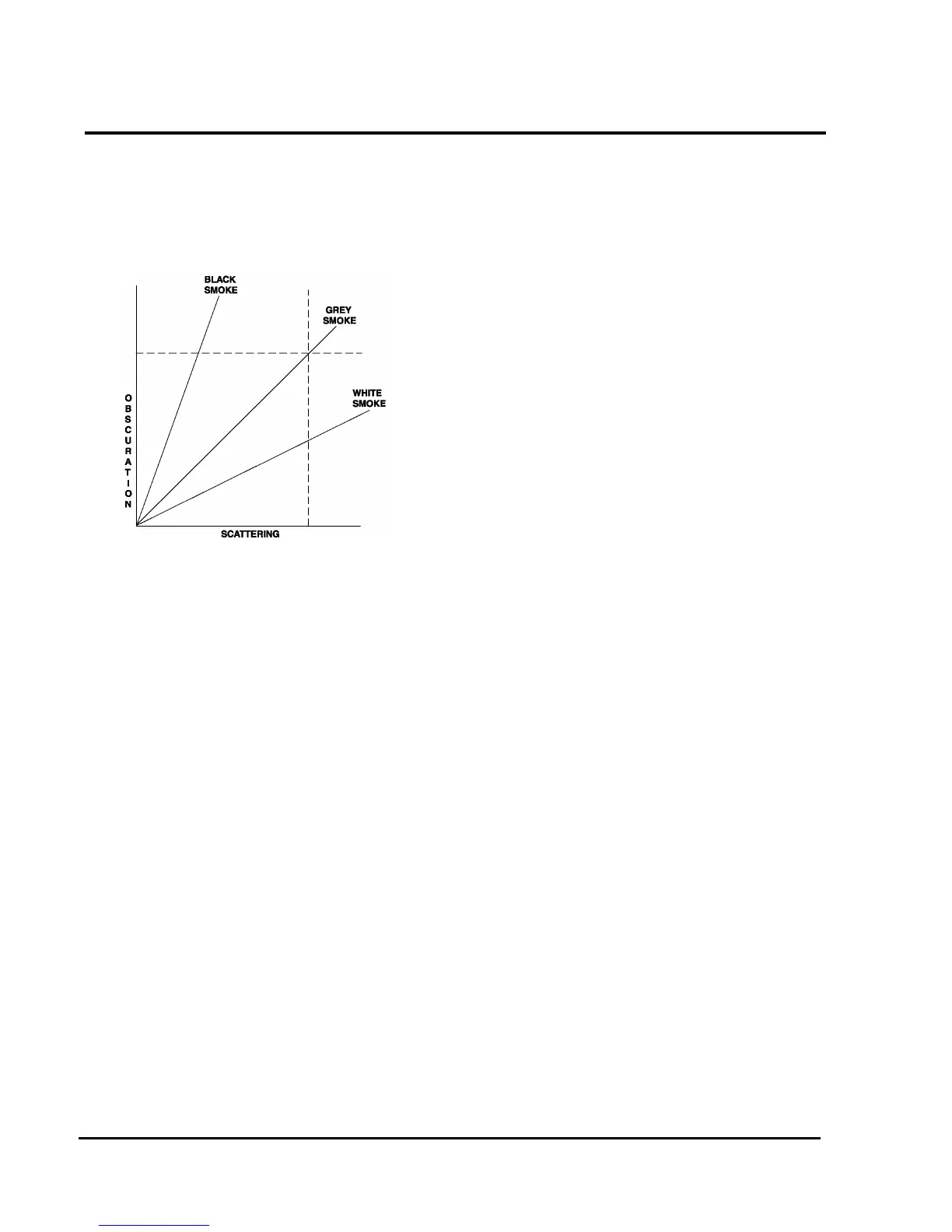
Interpretation of response threshold value is somewhat
complicated by the fact that the measurement is given in
terms of obscuration, whereas the detector works by
scattering from the smoke particles. The response threshold
(m) value will therefore, depend on the colour of the
smoke. Black smokes give less scattering than light smokes
for given values of obscuration as shown in Fig. 8.
Sensitivities are invariably specified for ‘grey’ smokes as
produced by typical smouldering fires. Values for the
MR601TEx are given below.
5.5.1 RESPONSE TO RATE OF CHANGE
OF TEMPERATURE
The detector will not be enhanced by slow rates of change of
temperature, or by cold air draughts moving across the
ceiling creating negative rates of change of
temperature. The detector is designed to detect sudden
horizontal draughts of hot air produced by fast burning
fires. The enhancement switching point has been set to
allow the detection of TF1 type fires.
Normal response threshold = 0.19 dB/m, 2.7%/m typical.
Enhanced mode threshold = 0.08 dB/m, 1.1%/m typical.
5.6 RESPONSE TO FIRE TESTS
The response of an optical scatter detector to a fire will
depend to a large extent on the colour of the smoke produced
in the fire. However, other factors such as the detector
smoke entry characteristics, the development of the fire and
the thermal lift produced by the fire are important. In order
to evaluate the response under realistic conditions, detectors
are subjected to test fires which cover a range of fire
types. These tests are defined in EN54 Pt 7. The
MR601TEx passes the following Fire Tests:
Note: TF2 to TF5 are mandatory test fires required to
meet EN54 Pt 7.
The MR601TEx is designed to respond to the mandatory
tests TF2 to TF5 as required by BS5445 Pt 7. The
MR601TEx gives an earlier response to TF5 fires than the
MR601 due to its thermal circuit detecting the heat
generated by this test of fire and the MR601TEx being
‘enhanced’. For the same reason the MR601TEx will
detect test fire TF1 (open wood cellulosic flaming fire)
which is not normally detected by optical smoke detectors -
demonstrating the detectors broader detection capability.
The MR601TEx does not respond to TF6 liquid
(methylated spirit) which although having a rapidly rising
temperature, does not generate any optical scattering. This
shows that the High Performance Optical detector will not
respond to hot air draughts without the presence of smoke.
6. INSTALLATION
RECOMMENDATIONS
It is not recommended that the MR601TEx be installed in
areas where it is likely to be regularly enhanced, since in
this condition the detector is extra sensitive and there is a
possibility of unwanted alarms from low ambient smoke
levels.
The MR601TEx is designed to become enhanced by
detecting a rapid temperature rise (>10°C) in air moving
horizontally across the ceiling. Siting sensors in positions
where air is being blown through the detector should
therefore, be particularly avoided, eg, close to ceiling ducts
or ceiling mounted industrial heaters; or areas of forced
ventilation, such as ducts and under floor voids of computer
suites.
Also, not recommended are areas open to the outdoors, such
as cargo handling bays, or areas where the detector may
become contaminated.
The MR601TEx is not recommended for use in applications
where a heater jacket is required.
The MR601TEx is primarily aimed at benign
environments.
TF1 open cellulosic (wood-flaming)
TF2 smouldering pyrolysis
TF3 glowing smouldering (cotton)
TF4 open plastics (polyurethane foam)
TF5 liquid (n-heptane)
Table 2: Response to Fire Tests


 To Next Page