Weight
Detector: 0.128kg
Detector + base: 0.174kg
5.2 ENVIRONMENTAL
Operating Temperature: -20
o
C to +70
o
C
(please see note below).
Storage Temperature: -25
o
C to +80
o
C
Note:
1) The operating temperatures quoted exceed
the ATEX Certification limits.
2) Operation below 0
o
C is not recommended
unless steps are taken to eliminate
condensation and hence ice formation on the
detector.
Relative Humidity: 95% non-condensing
Shock: )
Vibration: )
Impact: ) To EN54-7
Corrosion: )
5.3 ELECTROMAGNETIC COMPATIBILITY
The detector complies with the following:
Product family standard EN50130-4 in respect of
Conducted Disturbances, Radiated Immunity,
Electrostatic Discharge, Fast Transients and Slow High
Energy
EN 61000-6-3 for Emissions
5.4 ELECTRICAL CHARACTERISTICS
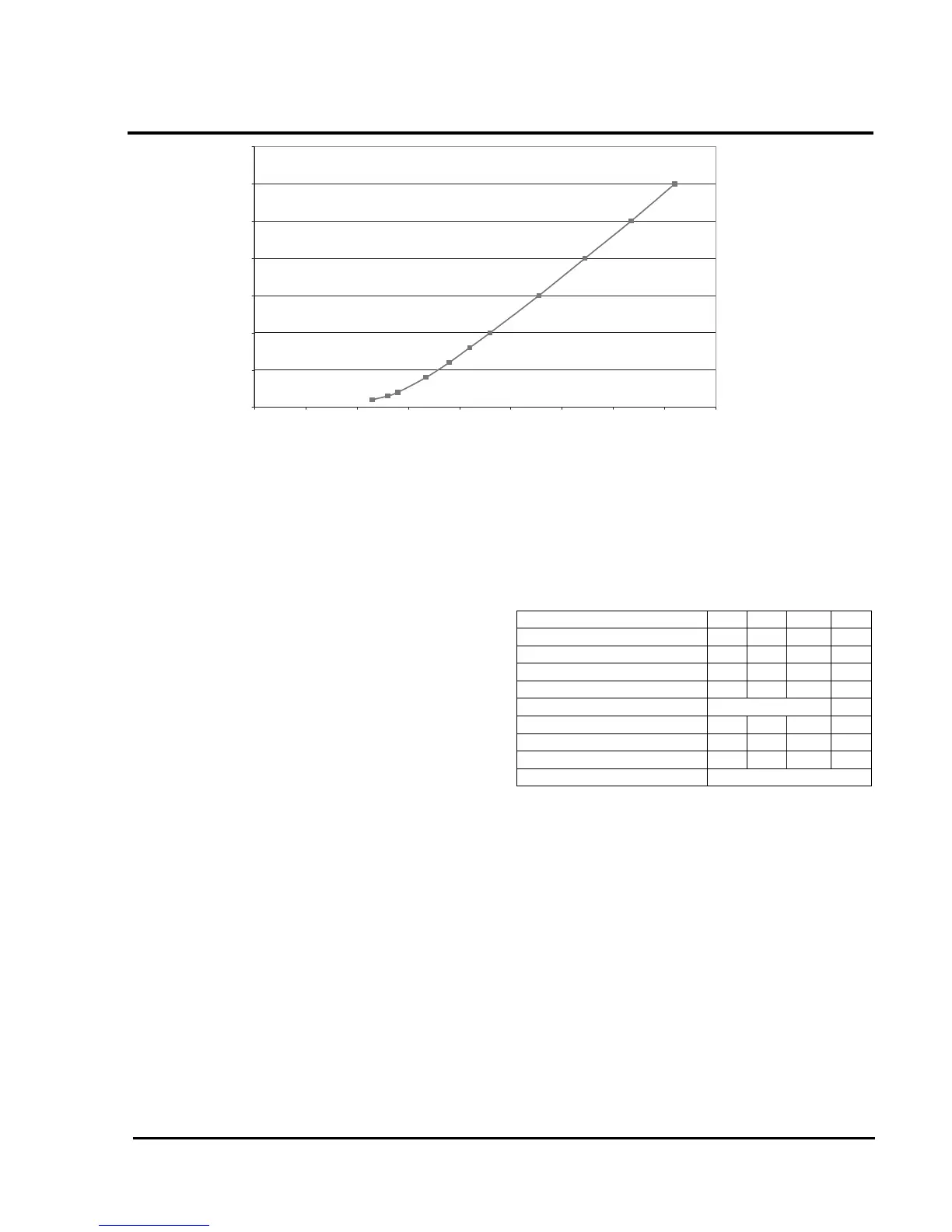
The alarm load presented to the controller is shown in Fig. 7.
The following characteristics shown in Table 1 are taken at
25
o
C with a supply voltage of 20V unless otherwise
specified.
Intrinsic Safety Rating:
Maximum Voltage for safety (U
i
): 28V
Maximum Current for Safety (I
i
): 93mA
Maximum Power Input (P
i
): 650mW
Equivalent Inductance (L
i
): 0
Equivalent Capacitance (C
i
): 0
5.5 PERFORMANCE CHARACTERISTICS
The fundamental parameter used to define the sensitivity of
an optical smoke detector is the level of smoke which will
just produce an alarm under ‘ideal’ conditions. This
parameter, known as the response threshold value, is
normally measured in a smoke tunnel and is defined in
terms of the obscuration produced by the smoke over a one
metre path. The response threshold value is normally given
in dB/m, (or % per m).
Characteristics Min. Typ. Max. Unit
Operating Voltage (d.c.) 16 20 28 V
Average Quiescent Current 90 110 μA
Switch-on-Surge 130 μA
Stabilisation Time 60 sec
Alarm Current See Fig. 6 mA
Holding Voltage 5 V
Holding Current 1 mA
Reset Time 2 5 sec
Remote LED Drive Remote LED via 3.4k
Table. 1 Electrical Characteristics


 To Next Page