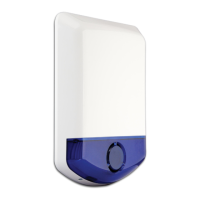
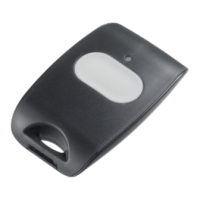
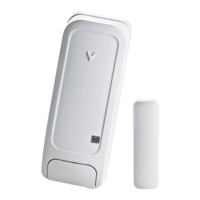
The NEKA Outdoor Self-Powered Siren is a microprocessor-controlled horn strobe/flash designed for outdoor applications, providing differentiated audible and visual alarm signals. The siren is available in three models: NEKA (self-powered horn with flash), NEKA-F (self-powered horn with flash and foam tamper device), and NEKA-FS (self-powered horn with strobe and foam tamper device).
Function Description:
The siren is a self-powered unit with a distinctive low-profile shape that ensures efficient acoustics and uniform sound distribution. Its robust construction and state-of-the-art technology enhance application flexibility. Microprocessor supervision of the battery charge (NEKA and NEKA-F only), horn, and flash ensures maximum performance and reliability.
Important Technical Specifications:
- Nominal voltage: 13.8 V===
- Alarm current: 1.4 A (max 2.8 A)
- Voltage on terminal +N: 13.8 V ±0.2 V
- Current on terminal +N: max 0.6 A
- Minimum (maximum) supply voltage: 10 V=== (13.8 V===)
- Battery requirements: 2 Ah (177x34x66 mm)
- Maximum alarm-time (programmable): 3 / 10 minutes
- Protection class: IP34
- Temperature range: -25 – +55 C°
- Dimensions (WxHxD): 208x252x98 mm
- Weight (without battery): 2300 g
Usage Features:
The siren offers four audible and visual signal inputs. Sound emission features modulated frequency with sound options. It includes a high-output magnetodynamic exponential horn with a test circuit. Protection features include tamper, wall tamper, flash bulb damage, and wire cutting. NEKA-F and NEKA-FS models include a foam tamper device. The maximum alarm time is programmable. A battery test circuit with flash shutdown is present under low battery or battery trouble conditions (NEKA and NEKA-F only). The drilling pattern is designed for easy installation, and the unit houses a 12 V, 2 Ah buffer battery.
The hard-wearing plastic molding is resistant to adverse weather conditions. The louver grille is designed to protect internal components from rain while optimizing sound emission. A tropicalized-steel innerplate provides extra protection against acts of delinquency.
Tamper Protection:
The tamper device, which must be anchored to the wall, triggers alarms if the frontplate or innerplate is removed, or if the siren is pulled from the wall (wall tamper). The foam tamper protection (NEKA-F and NEKA-FS only) uses an active infrared barrier with a dual detector to provide high immunity to false alarms caused by insects.
The siren can operate in normal or automatic mode. In normal mode, the siren opens the AS and ASG terminals when tampered, which must be connected to the control panel tamper line. In automatic mode, the siren independently activates acoustic and optical signaling for tamper events, and the tamper alarm ends 40 seconds after all causes are removed or when the maximum alarm time elapses.
Activation:
The siren can be activated by the tamper device, or by +N, AF, A, and F terminals. For example, the siren activates if the voltage fails on terminal +N, allowing it to detect wire cutting. The polarity-programmable AF, A, and F terminals can be connected to other devices. The siren blocks for 4 minutes if it receives more than 6 activation requests within 4 minutes to protect against control panel malfunctioning.
Signaling:
Audible and visual signals depend on the alarm type and signal configuration. Sound modulation extremes generate a fastidious shrill tone (to discourage intruders) and a low tone (to ensure good audibility). Two audible signal patterns can be selected for alarm inputs, except for the internal tamper event, which has only one audible signal (up-scale modulated frequency between 800 and 2000 Hz). The audible signals and modulated frequency range are 800/2000 Hz and 1100/2400 Hz. Audible signaling stops when the maximum alarm time expires, while visual signaling continues until alarm conditions clear (memory flashing).
Memory and Alarm Flash Sequences:
- NEKA/NEKA-F:
- Alarm flashing: ON (250 ms), OFF (750 ms) - Standard Blink
- Memory flashing: ON (250 ms), OFF (1500 ms) - Slow Blink
- NEKA-FS:
- Alarm flashing: Frequency (1 Hz) - Standard Blink
- Memory flashing: Frequency (0.6 Hz) - Slow Blink
Under low battery conditions, the siren bypasses the flash and uses residual charge to power the loudspeaker (NEKA and NEKA-F only). This status is signaled on terminal G (NEKA and NEKA-F only).
Alarm Priority:
Higher priority alarms override lower priority alarms, generating a variation in the audible signal.
- Internal tamper
- +N
- AF
- A, F (same priority)
The alarm time is counted from the activation of the loudspeaker and strobe/flash.
Mounting:
The siren should be mounted as high as possible on a flat wall. A drilling pattern and screws are provided for installation. The installation process involves marking anchor screw holes, drilling, inserting wall plugs, screwing a screw into hole F2 for temporary hanging, pulling wires through the cable entry, fixing the siren permanently, fixing the wall-tamper plate, setting the operating mode with jumpers, placing the battery and connecting it, and finally fixing the inner cover and outer cover.
Wiring:
The terminal board includes connections for:
- SPK: Loudspeaker connection terminals.
- AS/ASG: Tamper signaling terminals (open when cover/innerplate is removed, siren is pulled from wall, or foam tamper is detected in normal mode).
- FT: Foam tamper signaling terminal (open-collector normally closed to ground, opens after 30 seconds of infrared barrier interruption).
- G: Trouble signal terminal (open-collector normally closed to ground, opens for low battery, loudspeaker trouble, flash bulb damage).
- F: Alarm activation terminal with programmable polarity (optical signaling only).
- A: Alarm activation terminal with programmable polarity (acoustic signaling only).
- AF: Acoustic and optical signaling activation terminal with programmable polarity.
- +N: Power supply (positive) and alarm terminal (13.8 V for battery charge; siren alarms if voltage fails).
- : Negative supply terminal and ground of the internal circuit.
Shielded cable should be used, with one end connected to the control panel negative and the other left free.
Maintenance Features (Troubleshooting):
- Battery connected but flash not functioning: Battery may be low. Solution: Replace battery.
- Continuous flashing/sound: Wall-tamper device not secured, cover/innerplate not closed. Solution: Eliminate causes.
- Loudspeaker sounds but flash not functioning: Battery may be low, flash out-of-order. Solution: Replace battery, change flash bulb or call installer.
- Flash functions but loudspeaker silent: Max alarm-time elapsed, loudspeaker out-of-order, siren activated >6 times in 4 minutes. Solution: Eliminate alarm causes, call installer, wait 4 minutes without siren activation.
- Impossible to activate siren: Installation-time not expired, battery low. Solution: Wait 20 seconds, replace battery.


 To Next Page
 General