
 Need help?
Do you have a question about the Ubiquiti EdgeRouter Lite ERLite-3 and is the answer not in the manual?
Provides an overview of the Ubiquiti EdgeRouter Lite and its capabilities.
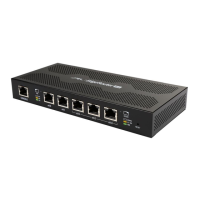
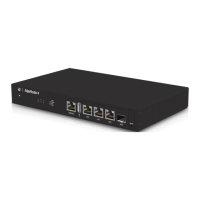
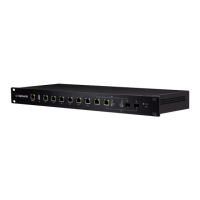
Details the physical components and ports of the EdgeRouter Lite.
Lists the requirements for accessing and using the EdgeOS configuration interface.
Covers installation instructions and typical deployment scenarios for the EdgeRouter Lite.
Instructions on how to physically mount or place the EdgeRouter Lite.
Guidelines for choosing appropriate Ethernet cables for indoor and outdoor use.
Step-by-step instructions for mounting the EdgeRouter Lite on a wall.
Optional steps for adding ESD grounding for enhanced protection.
Instructions on connecting the power adapter and power cord.
Illustrates common network setups using the EdgeRouter Lite.
Describes a typical corporate network setup scenario using the EdgeRouter Lite.
Introduces EdgeOS, the operating system for the EdgeRouter, and its interfaces.
Explains how to interpret port status and view system resource usage (CPU, RAM, Uptime).
Outlines the main tabs within the EdgeOS interface and their functions.
Describes how to view and manage system alerts and events within EdgeOS.
Details common navigation elements like Welcome, CLI, Toolbox, Alerts, and System.
Describes the 'Welcome' section, including the logout option.
Introduces the Command Line Interface (CLI) for advanced configuration.
Describes the Toolbox section for network administration and monitoring tools.
Displays status information for services like Routes, OSPF, NAT, Firewall, and DHCP.
Lists and describes different route types (Connected, Static, RIP, OSPF, EBGP, IBGP).
Shows OSPF status, settings, and area information.
Displays NAT status and the number of NAT rules.
Shows firewall status and the number of rules and sets.
Displays DHCP server status, active/inactive servers, and counts.
Covers interface status, traffic graphs, and VLAN creation.
Explains how to filter and create VLANs on the interface settings.
Detailed steps for configuring individual network interfaces, including IP addresses and MTU.
Information on viewing and creating static routes, including administrative distance.
Details on configuring OSPF options, including redistribution and router ID.
Explains EdgeOS support for IPv6 in specific sections and mentions CLI for full support.
Detailed guide on how to add static routes (Gateway, Interface, Black Hole).
Filtering options for routes and details about route table columns.
Step-by-step guide to configuring static routes with gateway or interface options.
How to configure a black hole route to drop unwanted traffic.
Explains OSPF communication and configuration of redistribution, metric, and default route.
How to configure OSPF router ID and manage redistribution/area settings.
How to create and configure OSPF areas, including Area ID, Type, and Auth Type.
How to configure OSPF interfaces, including Auth Type, Auth Key, and Cost.
How to create and configure firewall policies with default actions (Drop, Reject, Accept).
How to create groups for IP addresses, networks, or ports for firewall rules.
How to view and create NAT rules.
How to configure the EdgeRouter as a PPTP VPN server.
Filtering options for firewall policies based on their default action.
Details on configuring firewall rules, including criteria, actions, and order.
Configuration options for firewall rules: description, enable, action, protocol, logging.
Advanced firewall rule options: state, recent time, IPsec, P2P.
Configuring source criteria for firewall rules: IP address, MAC address, groups.
Configuring destination criteria for firewall rules: IP address, port, groups.
Configuring time-based criteria for firewall rules: days, dates, times.
Creating and configuring firewall groups by address, network, or port.
How to configure Source NAT rules for changing source IP addresses.
Detailed configuration options for Source NAT rules, including translation and protocol.
How to configure Destination NAT rules for changing destination IP addresses.
Detailed configuration options for Destination NAT rules, including inbound interface and translations.
How to configure the EdgeRouter as a PPTP VPN server.
Configuration parameters for the PPTP VPN server, such as IP pool and DNS.
How to configure DHCP servers to assign IP addresses to clients on different subnets.
How to configure DNS forwarding for LAN DNS requests.
Details on creating a DHCP server, including name, subnet, range, and DNS settings.
Information on DHCP server leases, static IP mapping, and viewing lease details.
Configuration for DNS forwarding, including cache size and listen interfaces.
Details on DHCP server leases, static map/IP mapping, and overall status.
How to create static MAC/IP mappings for DHCP clients.
Details on configuring static MAC/IP mappings, including ID, MAC, and IP address.
How to configure local user accounts with different permission levels (Admin, Operator).
Steps to create a new user account, including username, password, and role.
How to modify existing user account settings like username, full name, password, and role.
Displays statistics about users accessing the EdgeRouter remotely.
How to use the Ping tool to check network connectivity and latency.
How to use the Trace tool to find the route taken by packets to a destination.
How to use the Discover tool to search for Ubiquiti devices on the network.
How to capture network packets for analysis using filters.
How to view live system log updates and their details.
Introduction to the CLI, its benefits, and access methods.
Lists the four methods to access the Command Line Interface.
Detailed steps for connecting to the CLI via a console port.
Steps to access the CLI using SSH, including login and password.
Steps to access the CLI using Telnet, including enabling it and login.
How to access the CLI from within the EdgeOS web interface.
Explains the operational mode of the CLI and how to view commands.
How to enter and use configuration mode in the CLI, including set, show, delete commands.
Steps to remove the default 'ubnt' user account for security.
How to create a firewall rule using CLI commands like 'set' and 'edit'.
Using CLI commands to configure network interfaces, including IP addresses and descriptions.
Using the 'copy' command in the CLI to duplicate existing firewall rules.
Using the 'rename' command in the CLI to change firewall rule names.
How to save, load, and manage configuration files using CLI commands.
Using 'commit-confirm' to safely apply changes and avoid lockout.
Using 'rollback' to revert to previous configurations in the CLI.
Lists the features and protocols supported by the EdgeOS interface.
Important safety precautions related to voltage, grounding, and service.
FCC compliance statements and operating conditions.
Industry Canada compliance for digital apparatus.
Warning for Class A products in domestic environments.
Environmental compliance statements regarding disposal and recycling.
Spanish compliance statement for WEEE Directive.
French compliance statement for WEEE Directive.
Italian compliance statement for WEEE Directive.
Information on how to contact Ubiquiti Networks support engineers.
Links to support, wiki, forums, and downloads for the EdgeRouter.
 General
| Category | Network Router |
|---|---|
| Memory | 512 MB DDR2 RAM |
| Storage | 4 GB NAND Flash |
| Operating Temperature | -10 to 45° C (14 to 113° F) |
| Operating Humidity | 10 to 90% non-condensing |
| Certifications | CE, FCC, IC |
| Operating System | EdgeOS |
| Product Name | EdgeRouter Lite |
| Ports | 3 x Gigabit Ethernet |
| CPU | Dual-Core 500 MHz |
| Max Throughput | 1 million packets per second (64-byte packets) |




 To Next Page
