MAX-M10M-Integration manual
Appendix
A Migration
A.1 Hardware changes
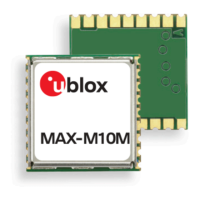
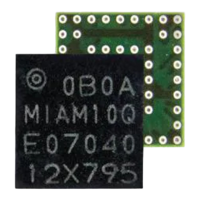
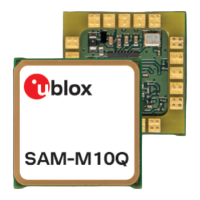
Table 32 lists the key hardware-related changes between MAX-M10M and the MAX-M8 modules.
Feature Change Action needed / Remarks
VCC, V_IO
The V_IO voltage range is selected with
the VIO_SEL pin.
For designs with 1.8 V supply at V_IO, switch off V_IO supply
100 ms before VCC when transitioning to hardware backup
mode. Alternatively, put the receiver in software standby mode
by sending the UBX-RXM-PMREQ message before switching off
V_IO and VCC.
Refer to the minimum and maximum VCC and V_IO ramp
requirements in the MAX-M10M data sheet [1].
VCC and V_IO
supply range
MAX-M10M: V_IO: 1.68 V - 1.98 V, 2.7 V
- 3.6 V VCC: 1.76 V - 5.5 V
MAX-M8C: 1.65 V - 3.6 V
HW change is required when migrating from a MAX-M8C
design that uses less than 2.7 V VCC and V_IO supply because
VIO_SEL (pin 15) needs to be connected to GND in MAX-M10M
and the voltage range for 1.8 V designs is different.
V_BCKP supply
range
MAX-M10M: 1.65 V - 3.6 V
MAX-M8Q/C/W: 1.4 V - 3.6 V
HW change is required when migrating from a MAX-M8 design
that uses less than 1.65 V V_BCKP supply.
Backup current
The hardware and software backup
current in MAX-M10M is higher than in
MAX-M8Q/W modules.
The backup current in MAX-M10M is
significantly lower than in MAX-M8C.
Check the backup battery capacity if it is still suitable for the
target design requirements.
Pin-out 1:1 pin-out mapping with MAX-M8Q/C
modules, but not with MAX-M8W.
HW change is required for MAX-M8W designs that use V_ANT
(pin 13) to supply an active antenna.
SAFEBOOT_N,
TIMEPULSE
The SAFEBOOT_N pin is internally
connected to TIMEPULSE pin through
a 1 kΩ series resistor.
Do not drive the TIMEPULSE pin low at startup because it will
put the receiver in safeboot mode.
RESET_N Resetting the receiver clears the BBR
content.
MAX-M10M: time information, GNSS
orbit data and receiver configuration
stored in BBR cleared
MAX-M8: time information cleared
TTFF after resetting MAX-M10M with the RESET_N pin is
similar to performing a cold start.
Digital IO
Digital IO pins must not be driven if VCC
and V_IO are not supplied.
The electrical specification for digital
IO pins has changed. The voltage levels
are defined at 1 mA current (exception:
TIMEPULSE pin 2 mA).
Do not drive IO pins when VCC and V_IO are not supplied.
Otherwise permanent damage may result. If driving the IO pins
cannot be avoided, buffers are required to isolate the pins.
Additional external pull-up resistors may be required to increase
the drive strength of the digital IO output pin or adjust the load
accordingly.
Table 32: MAX-M10M hardware features compared to MAX-M8 modules
Migrating from MAX-M8W to MAX-M10M requires special care and may require some re-design
because pin 13 and pin 15 are different as shown in Figure 34. Consequently, pin 15 should be
left open (i.e. not connected) when migrating from MAX-M8W because there is no built-in antenna
supervisor support in MAX-M10M. Therefore in MAX-M10M, the active antenna supply and the
antenna supervisor circuitry (if used) needs to be connected externally as shown in Figure 38.
UBX-22038241 - R01
Appendix Page 79 of 90
C1-Public


 To Next Page