38
Save & Load
Once you have created your calibration, you can save the file to your hard drive
or an external storage device. To save, click the Save button on the toolbar.
Then, browse to the location where you want it saved and click Save. Use
“Save As” under the FILE menu to leave the original file unchanged and create
a new version. Type the desired filename and click Save. Files are saved with a
.btc extension.
To load a calibration file, click the Open button on the toolbar. Then, browse
to the file and click Open.
Writing a Calibration to the Quick 6
For the changes you've made to take effect on
the Quick 6 controller, you first must write the
calibration to the unit. Connect the Quick 6 to
your computer using a standard USB cord (Type
A to Type B). Click the Write Calibration
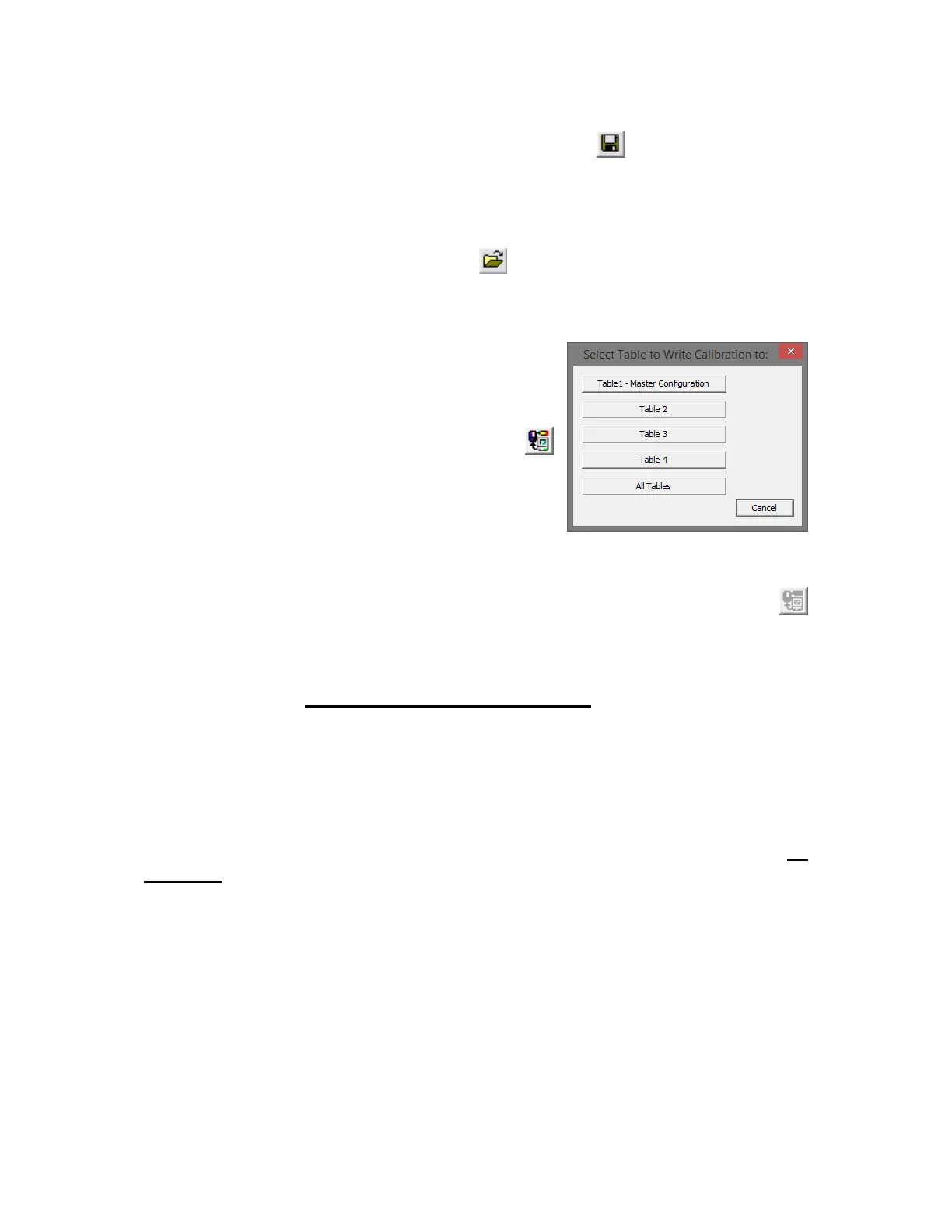
button on the toolbar and a menu will appear. If
you aren’t using multiple calibrations, click the All
Tables button to save the calibration to the
controller. The Quick 6 can now be disconnected
from the computer. (To use multiple tables, you can create a new calibration and
choose one of the other table buttons when writing to the controller.) When the
Quick 6 unit is disconnected from the computer, the Write Calibration
button will be grayed out.
IMPORTANT INFORMATION
How to Avoid Errors
The Shiftware software gives you complete freedom and flexibility to customize
your shifting calibration however you want. This freedom requires diligence to
avoid errors.
It is very important that the up-shift and down-shift curves for a given gear do
not cross. The up-shift point at any throttle position should usually be at least
15% greater than the down-shift point. For instance, if the 2-3 up-shift point at
½-throttle is 45MPH, then the 3-2 down-shift point should usually be less than
40MPH.
The “On-Off” differential between up-shift and down-shift points is called
Deadband (also known as Hysteresis). The more deadband you use for your
shift points, the more stable the system will be. Not using enough deadband can
result in erratic shift behavior. Too much deadband will result in sluggish
behavior due to a reluctance to down-shift.


 To Next Page