OTDR Series e-Manual, D07-00-076P-RevC00 Page 34 of 107
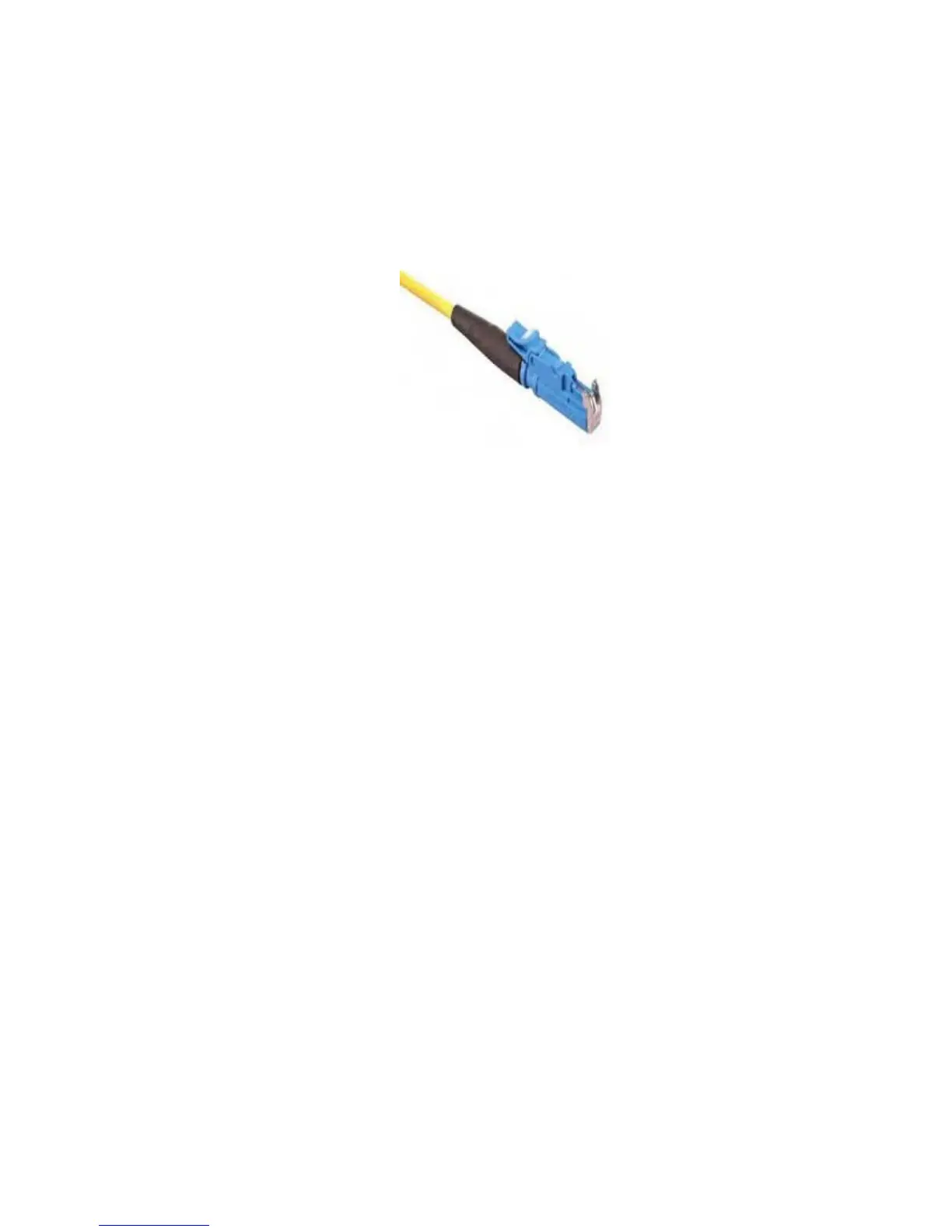
E2000 Connector
Developed by Diamond, this connector has proven its performance worldwide in CATV and
telecommunication networks. The connector features a spring-loaded shutter used to protect
the ferrule from dust and scratches, and to provide increased safety protection. It uses a high
precision Zirconia full ceramic ferrule with an insertion loss of 0.1dB. The APC version has a
return loss of better than 85dB. The connector is especially suited for installation in global high
performance networks.
The E2000 patchcords is available in simplex and duplex versions and comply with IEC 61
754-15 and TIA/EIA 604-16 standards
6.5.2 Connector Performance and Polishing
Polishing of fiber optic connectors is the process of polishing the end-face of the ceramic
ferrule within the fiber optic connector. The purpose is to improve the light transfer between the
mating of connectors, in order to minimize optical losses and reducing reflections. This is an
important aspect of fiber optic communications as losses affect the quality of the light signals.
There are two main types of losses that are affected by the style and quality of polishing, which
dictate the optical performance level of terminated fiber optic connectors:
• Insertion Loss (IL) - The most important performance indicator of a fiber optic
connection. This is the loss of light signal, measured in decibels (dB), during the
insertion of a fiber optic connector.
• Return Loss (RL) - Also known as back reflection, is the portion of the light signal that
is reflected back to the original light source. This occurs as the light is reflected off the
connector and travels back along the fiber to the light source. This indicator is measured
in negative decibels (dB). When reading return loss figures, the higher the absolute
value of the decibel unit means the better the performance of the interconnection.
The amount of insertion loss is affected by fiber alignment, and/or the quality of the finishing on
the end of ferrule, while reflectance is affected by the style of polishing on the ceramic ferrule
in a connector. There are three different styles of polishing, reflected by their shape of the
finish:
• Physical Contact (PC) - In the PC style finish, the fiber is polished to a smooth curve.
As the name implies (i.e. physical contact), the ferrules of adjoining fibers come into
physical contact and this reduces the air gap between the contacting ferrules, resulting
in lower insertion losses. The smooth curve in the PC style is designed to reduce the
return loss by reflecting the light out of the fiber. However, the PC polishing style incurs
more return loss than other styles.



 To Next Page