EasyManua.ls Logo

Viatom PO2 - User Manual

Viatom PO2
3 pages
Print Icon
To Next Page IconTo Next Page
Loading...
Pulse Oximeter
Instruction for Use
1. Introduction
1.1 Intended use
This Pulse Oximeter is intended to be used for
measuring, displaying and storing of pulse oxygen
saturation (SpO
2
), pulse rate of adults in home or
healthcare facilities environment.
1.2 Contraindications
No contraindications.
1.3 Warnings and Cautions
DO NOT squeeze the sensor part or apply excessive
force on it.
Do not use this device during MRI examination.
Do not use this device with a defibrillator.
Do not store the device in the following locations:
locations in which the device is exposed to direct
sunlight, high temperatures or levels of moisture, or
heavy contamination; locations near to sources of
water or fire; or locations that are subject to strong
electromagnetic influences.
Do not use the device in a combustible environment
(i.e., oxygen-enriched environment).
Never submerge the device in water or other liquids.
Do not clean the device with acetone or other volatile
solutions.
Do not drop this device or subject it to strong impact.
The device and accessories are provided non-sterile.
Do not place this device in pressure vessels or gas
sterilization device.
Do not dismantle the device, as this could cause
damage or malfunctions or impede the operation of the
device.
Consult your doctor immediately if you experience
symptoms that could indicate acute disease.
Do not self-diagnose or self-medicate on the basis of
this device without consulting your doctor. In particular,
do not start taking any new medication or change the
type and/or dosage of any existing medication without
prior approval.
Use only cables, sensors and other accessories
specified in this manual.
Prolonged continuous monitoring may increase the risk
of undesirable changes in skin characteristics, such as
irritation, reddening, blistering or burns.
Do not open the device cover without authorization.
The cover should only be opened by a qualified service
personnel.
The biocompatibility testing has been performed on the
materials in contact with the person in accordance with
ISO10993.
Do not place the SpO
2
probe on a finger with edema or
fragile tissue.
Check the SpO
2
sensor and cable before use. Do not
use a damaged SpO
2
sensor.
Check the SpO
2
sensor application site every 6-8 hours
to determine the positioning of the sensor and the
circulation and skin sensitivity of the patient. Patient
sensitivity varies depending on medical status or skin
condition. For patients with poor peripheral blood
circulation or sensitive skin, inspect the sensor site
more frequently.
The functional tester cannot be used to assess the
accuracy of the SpO
2
sensor or a device.
The device has no alarm system.
Continuous use for a long time may cause allergies,
redness, blistering or burns. Check the wearing
position every 6-8 hours.
The local laws and regulations should be followed
when disposing of the device and accessories.
The battery inside this product cannot be replaced.
1.4 Guide to Symbols
Symbol
Description
Type BF-Applied Part
Manufacturer
Date of manufacture
Authorized Representative in the
European Community
Follow Instructions for Use.
MRI unsafe. Presents hazards in
all MR environments as device
contains strongly ferromagnetic
materials.
IP22
Protected against spraying water
and against access to hazardous
parts with a tool, per IEC60529.
SN
Serial number
No alarm system
Temperature limitation
Humidity limitation
Atmospheric pressure limitation
Indicate separate collection for
electrical and electronic equipment
(WEEE).
1.5 Unpacking
Device
User Manual
Data/ Charging Cable
2 Overview
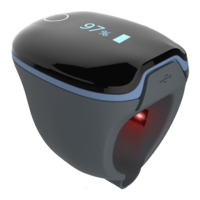
Name: Pulse Oximeter
Model: PO2
1. Touch Switch:
Wake up the screen and switch the interface.
2. Backlit Screen:
Show SpO
2
value and pulse rate value .
3. USB Charging Port:
Can be charged and data transmission.
4. Sensor:
The device turns on/off automatically in a moment after
you take on/off the sensor.
The blood SpO
2
and pulse rate can be measured.
3 Using the Device
3.1 Charging
Use the USB cable to charge the product. Connect
the USB cable to a USB charger or to the PC.
There will be a battery logo flash on the device
when charging.
A fully charge will need 2-3 hours. After fully
charged, the device will power off automatically.
Note: The device cannot be used during charging,
and if choosing a third party charging adaptor
(Class II), select one that complies with IEC60950
or IEC60601-1.
3.2 POWER ON/OFF
POWER ON:
Wear the device, it will turn on automatically.
POWER OFF:
The device turns off automatically in a moment
after you take off the sensor.
3.3 Typical steps
1) START. After charge the battery ,wear the
device to power on.
2) STOP. Take off the device, the recording will
be over after the countdown.
3) DATA Uploading. Run your phone to
download data.
3.4 Start working
1) Wear the device on index finger. Try to
move the device along the forefinger to find
out a best fit. Avoid being loose. Loose
wearing causes inaccurate measure.
2) Device will turn on automatically. After a few
seconds, the device will begin to work.
Notice:
If the working time is less than 2 minute, the
data will not be saved.
Please avoid excessive motion.
Please avoid strong ambient light condition.
SpO
2
measurement principle:
The Pulse Oxiemter is a lightweight, portable
health oximeter for use in the home or in
Sensor
Question and Answer IconNeed help?

Do you have a question about the Viatom PO2 and is the answer not in the manual?

Summary

Introduction

Intended Use

Device intended for measuring SpO2 and pulse rate in home or healthcare settings.

Contraindications

No contraindications are listed for this device.

Warnings and Cautions

Important safety warnings and precautions for using the pulse oximeter.

Guide to Symbols

Explanation of symbols used in the pulse oximeter manual.

Unpacking

Items included in the pulse oximeter package.

Overview

Using the Device

Charging

Instructions for charging the pulse oximeter battery via USB.

Power On;Off

How to turn the pulse oximeter on and off.

Typical Steps

Steps for initial setup and operation of the device.

Start Working

Guide on how to wear and start using the pulse oximeter.

Stop Working & Upload Data

Procedure for stopping use and uploading recorded data.

Screen Wake Up

How to wake the device screen from power-saving mode.

How to Check Battery

Method to check the remaining battery level.

Unavailable Symbol

Meaning of the unavailable symbol and potential causes.

Bluetooth Connection

Steps and troubleshooting for connecting via Bluetooth.

Add a New Device

Procedure to pair and add a new device to your phone.

Smart Vibration by SpO2

Explanation of vibration alerts for low SpO2 levels.

Smart Vibration by Pulse Rate

Explanation of vibration alerts for abnormal pulse rates.

Maintenance

Time & Date

How the device time and date are synchronized.

Cleaning

Instructions for cleaning the reusable pulse oximeter.

Troubleshooting

Specifications

FCC Warning

Overview

The Pulse Oximeter is a lightweight, portable health oximeter designed for measuring, displaying, and storing pulse oxygen saturation (SpO2) and pulse rate (PR) in adults, suitable for use in home or healthcare facilities environments.

Function Description

The device operates based on a developed photoelectron method. When a finger is inserted into the sensor, two emitting tubes (red light diodes and infrared diodes) located on the inner upside of the sensor emit red and infrared light. A receiving end on the inner downside of the sensor transmits the red and infrared light into a pulse signal through the finger. The microcontroller (MCU) receives this pulse signal, counts its frequency, processes the digital signal, and ultimately calculates the measured SpO2 value. The PR is calculated by averaging the peak intervals of the PR waveform.

The device features a backlit screen that displays SpO2 and pulse rate values. It also includes a USB charging port for both charging and data transmission. A touch switch allows users to wake up the screen and switch interfaces. The device is designed to turn on and off automatically when the sensor is worn or removed.

Usage Features

To begin using the device, first ensure the battery is charged. A full charge takes approximately 2-3 hours, after which the device will power off automatically. It's important to note that the device cannot be used while charging. If a third-party charging adapter (Class II) is used, it should comply with IEC60950 or IEC60601-1.

To power on the device, simply wear it on your index finger. The device will turn on automatically. To ensure accurate measurements, try moving the device along your forefinger to find the best fit and avoid loose wearing. Loose wearing can lead to inaccurate measurements. After a few seconds, the device will begin to work.

The device has a built-in memory that can store up to 4 records. The oldest record will be overwritten by the fifth, so it's important to upload data to your phone regularly. To stop a recording, simply take off the device; a countdown will begin. If the working time is less than 2 minutes, the data will not be saved. If the device is worn again during the countdown, the recording will resume. After the countdown, the data will be ready for uploading.

The screen will automatically turn off in Standard Mode to save power. To wake up the screen or check the battery level, touch the key on top.

The device supports Bluetooth connectivity. Bluetooth is automatically enabled when the device is turned on. To establish a connection, ensure both the device's and your phone's Bluetooth are enabled. For initial use, you will need to add a new device by turning on the device, running the phone application, selecting "O2Ring," and touching the key on top of the device. It is important not to pair the device in your phone's Bluetooth settings directly.

The device includes smart vibration features. The vibrator in the sensor will activate if the SpO2 level falls below a pre-set threshold and will stop once SpO2 recovers. Similarly, vibration will activate if the pulse rate goes above the upper threshold or below the lower threshold.

During use, avoid excessive motion and strong ambient light conditions, as these can affect measurement accuracy. If the "unavailable symbol" appears on the device screen, it indicates that readings are currently unavailable, possibly due to excessive movement, poor signal, or a cold finger. Readings usually recover within a few seconds once at rest.

Maintenance Features

After connecting with a phone, the device's time and date will automatically synchronize with your phone's time.

The device is reusable and should be cleaned before each reuse. To clean, use a soft, dry cloth with 70% alcohol. Do not use petrol, thinners, or similar solvents. The device is a non-sterile medical device and does not contain any sterile or degradable components, so it is not subject to shelf-life requirements.

Warnings and Cautions

  • Do not squeeze the sensor part or apply excessive force.
  • Do not use the device during MRI examination or with a defibrillator.
  • Avoid storing the device in direct sunlight, high temperatures, high moisture, heavy contamination, near water or fire sources, or areas with strong electromagnetic influences.
  • Do not use the device in a combustible or oxygen-enriched environment.
  • Never submerge the device in water or other liquids.
  • Do not clean the device with acetone or other volatile solutions.
  • Avoid dropping the device or subjecting it to strong impact.
  • The device and accessories are provided non-sterile.
  • Do not place the device in pressure vessels or gas sterilization devices.
  • Do not dismantle the device, as this could cause damage, malfunctions, or impede its operation.
  • Consult your doctor immediately if you experience symptoms that could indicate acute disease. Do not self-diagnose or self-medicate based on this device without consulting your doctor.
  • Use only cables, sensors, and other accessories specified in this manual.
  • Prolonged continuous monitoring may increase the risk of skin irritation, reddening, blistering, or burns.
  • Do not open the device cover without authorization; it should only be opened by qualified service personnel.
  • The biocompatibility testing has been performed on the materials in contact with the person in accordance with ISO10993.
  • Do not place the SpO2 probe on a finger with edema or fragile tissue.
  • Check the SpO2 sensor and cable before use; do not use a damaged SpO2 sensor.
  • Inspect the SpO2 sensor application site every 6-8 hours to determine the positioning of the sensor and the circulation and skin sensitivity of the patient. For patients with poor peripheral blood circulation or sensitive skin, inspect the sensor site more frequently.
  • The device has no alarm system.
  • The battery inside this product cannot be replaced.
  • Follow local laws and regulations when disposing of the device and accessories.

Viatom PO2 Specifications

General IconGeneral
SpO2 Range70% - 99%
Pulse Rate Accuracy±2 bpm or ±2%, whichever is greater
TypePulse Oximeter
SpO2 Accuracy±2%
Pulse Rate Range30 BPM
ResolutionSpO2: 1%; Pulse Rate: 1 bpm

Related product manuals