
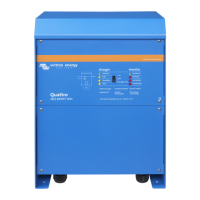
 Need help?
Do you have a question about the Victron energy Quattro 24/5000/120-100/100 and is the answer not in the manual?
 General
| Brand | Victron energy |
|---|---|
| Model | Quattro 24/5000/120-100/100 |
| Category | Inverter |
| Language | English |
General safety advice and product usage guidelines.
Instructions for safe and proper installation of the product.
Guidelines for safe handling, transport, and storage of the device.
Overview of the Quattro's core functions and unique characteristics.
Suitability of the Quattro for solar energy applications and autonomous systems.
Details on the Quattro's adaptive 4-stage battery charging system.
Using the Quattro in grid-feed systems and compliance with local rules.
Operating modes and switch functions for the Quattro.
Options for remotely controlling the Quattro unit.
Methods for activating specific battery charging modes.
Guidelines for selecting an appropriate installation location for the Quattro.
Instructions and recommendations for connecting battery cables.
Detailed instructions for connecting AC input and output cables.
Various connection options like starter battery, remote control, and relays.
Default factory settings and important notes on battery compatibility.
Detailed explanations of various configurable settings for the Quattro.
Procedures and software for configuring the Quattro via a computer.
How to configure the Quattro using a VE.Net panel.
Steps for configuring settings using DIP switches.
Setting AC input and charging current limits via DIP switches.
Setting AC input current limits for generator and shore supply.
Setting the battery charging current limit.
Examples of DIP switch settings for various configurations.
Configuration of other settings like charging voltages and UPS function.
Examples of DIP switch settings for Step 2 configurations.
Troubleshooting common problems and their causes/solutions.
Special LED indications and their meanings beyond general error codes.
VE.Bus specific LED indications for system troubleshooting.
Detailed description of EN connection points and their functions.
Details the four stages of the battery charging process.
Describes the 4-stage charging process in French.
Explains the 4-stage charging process in German.
Details the 4-stage charging process in Spanish.
Explains the 4-stage charging process in Swedish.
Explains default output voltages and temperature compensation.
Details charge voltage settings and temperature compensation in French.
Explains standard output voltages and temperature compensation in German.
Describes output voltages and temperature compensation in Spanish.


 To Next Page