3
an seine Adresse sendet.
DerAdressumfangistvondemFormatabhängig,
mit dem der Decoder angesteuert wird.
Motorola-Format: Der Decoder beherrscht 255
Adressen mit 14 Fahrstufen.
DCC- Format: 127 Basis-Adressen oder 10.239
erweiterteAdressen.ImDCC-Formatkannder
DecoderinallenFahrstufenmodi(14,28oder128
Fahrstufen)angesteuertwerden.
DieProgrammierungdesDecoderserfolgtDCC-
konformüberdieEinstellungderKongurations-
variablen(CV).
Wahlweise ist auch über die Registerprogram-
mierungdieProgrammierungderCVs1bis8
möglich.
Ansteuerung im Analogbetrieb
Den Lokdecoder können Sie auch in analogen
Modellbahnanlageneinsetzen(Gleichspannung).
Sobald Sie das Fahrzeug auf das Gleis stellen, er-
kennt der Decoder automatisch, ob er analog oder
digital angesteuert wird, und stellt den entspre-
chenden Betriebsmodus ein. Die automatische
Analogerkennung ist abschaltbar.
Ausgänge, die mit F0 geschaltet werden, werden
im Analogbetrieb entsprechend der Fahrtrichtung
ein- oder ausgeschaltet.
Das Ein- und Ausschalten anderer Funktions-
ausgänge ist im Analogbetrieb nicht möglich. Sie
können aber so programmiert werden, dass sie
im Analogbetrieb entweder an- oder ausgeschal-
tet sind.
Im Analogbetrieb ist eine Beschleunigungsrampe
wirksam, die allerdings wesentlich schneller
abläuftwieimDigitalbetrieb(sieheCV3).Ein
schnell aufgedrehter Trafo führt also trotzdem zu
einem sanften Start des Modells.
Überlast-Schutz
Sobald der zulässige Gesamtstrom des Decoders
andenFunktionsausgängen(ca.500mA)über-
schritten wird, schaltet der Decoder automatisch
die Funktionsausgänge ab. Sie bleiben bis zur Un-
terbrechungderStromversorgungdesDecoders
abgeschaltet und werden erst bei Wiedereinschal-
tungderStromversorgungerneuteingeschaltet,
sofern die Überlastung dann beseitigt ist.
Bitte beachten Sie:
Bei einem Kurzschluss an den Motoraus-
gängen gegen das Lokchassis werden die
Motorausgänge abgeschaltet.
Der Kurzschluss wird durch abwechseln-
des Blinken der Funktionsausgänge F0 si-
gnalisiert.
Digital operation
Thislocomotivedecoderisamulti-protocoldecod-
er supporting both DCC and Motorola. It auto-de-
tects the data format transmitted by the command
station.
The number of supported addresses depends on
the data format used.
Motorola format: The decoder supports 255 ad-
dresses with 14 speed steps
DCC format: The decoder supports 127 base ad-
dresses or 10,239 extended addresses. In DCC
mode the decoder operates in all speed step set-
tings(14,28or128).
Programming the decoder is done DCC compliant
bysettingthecongurationvariables(CVs).
ProgrammingofCV1to8canalsobedoneby
physical register programming.
Operation in analogue mode
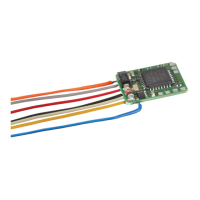
Thelocomotivedecoders5244and5245canalso
be operated in analogue DC.
Whenputtingthevehicleonthetrackthedecoder
automatically detects if it is run in analogue or
digital mode and sets the corresponding operating
mode. The automatic detection of the analogue
mode can be switched off.
Function outputs controlled by F0 are switched
subject to direction in analogue mode.
Switching any other function outputs is not pos-
sibleinanaloguemode.However,theycanbe
programmed in such a way that they are either
switched on or off in analogue mode.
In analogue mode there is an accleleration ramp
activehavingahigherspeedofaccelerationasin
digitaloperation(seeCV3).Turningatransforma-
torquicklytohighvoltagewillneverthelessresult
in a smooth starting of the loco.
Overload protection
Assoonascumulativecurrentofthefunction
outputs exceeds the maximum permitted current
(appr.500mA)thedecoderautomaticallyswitch-
es off the function outputs, which will be automati-
cally turned on again after reconnecting power to
thedecoderprovidedthecauseoftheoverload
has been corrected.
Please note:
In case of a short circuit between the motor
outputs and the chassis the motor outputs
will be turned off.
Ashortcircuitwillbeindicatedbyalternate
blinkingoftheheadlights.


 To Next Page