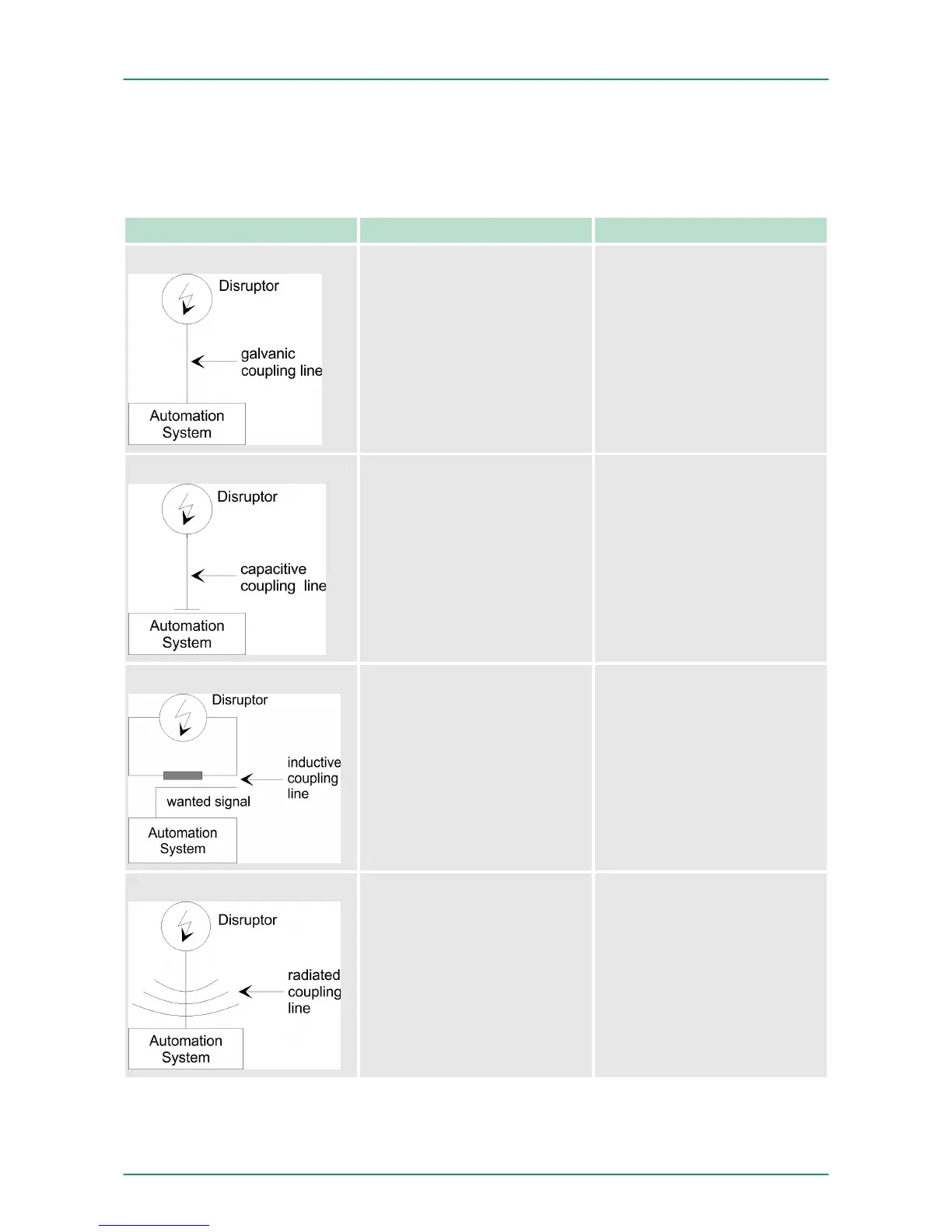
The following table shows the four different coupling mechanisms,
their causes and possible interference sources.
Coupling mechanism Cause Typical source
Galvanic coupling Galvanic or metallic coupling
always occurs, when two cur-
rent circuits have a common
line.
n Pulsed devices (Net influ-
ence from transducers and
foreign net devices)
n Starting motors
n Different potential of com-
ponent cubicles with
common current supply
n Static discharges
Capacitate coupling Capacitate or electric coupling
occurs between conductors
with different potential. The
coupling is proportionate to the
temporal change of the
voltage.
n Interference through par-
allel signal lines
n Static discharge of the per-
sonnel
n Contactors
Inductive coupling Inductive or magnetic coupling
occurs between two current
active line loops. The magnetic
flows associated with the cur-
rents induct interference vol-
tages. The coupling is propor-
tional to the time related
change of the current.
n Transducers, motors, elec-
tric welding devices
n Parallel net cables
n Cables with toggled cur-
rents
n Signal cable with high fre-
quency
n Unused coils
Radiate power coupling One talks of radiate power cou-
pling, when an electromagnetic
wave meets a line circuit. The
hit of the wave inducts currents
and voltages.
n Sender in the neighbour-
hood (e.g. walkie-talkie)
n Sparking lines (sparking
plugs, collector of electric
motors, welding devices)
Coupling mechanisms
and interference
sources
VIPA HMI Touch PanelInstallation Guidelines
Basic rules for the EMC-equitable assembly of installations
HB160 | TP-ECO | 62K-NHC0 | GB | 14-27 68


 To Next Page