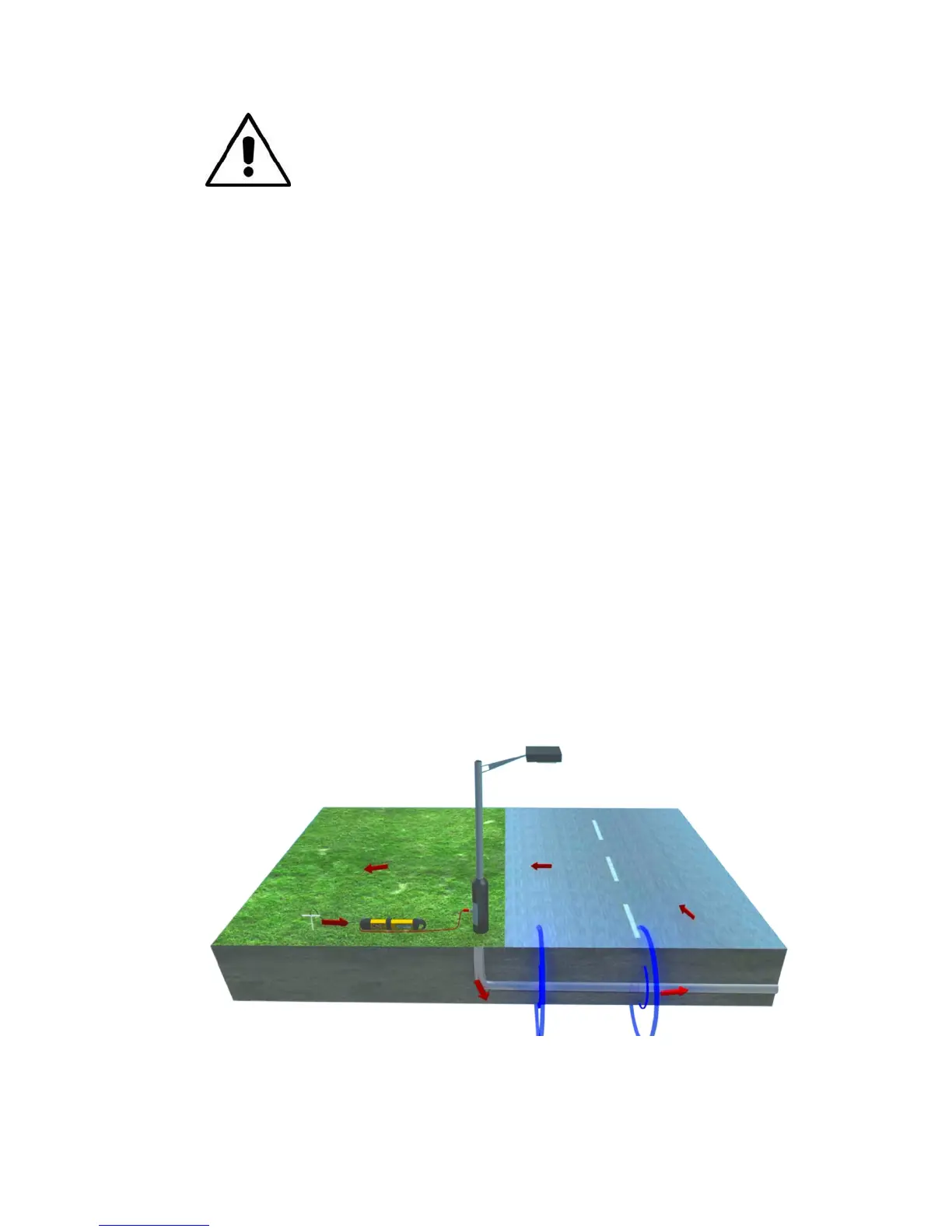
To make a direct connection, insert the direct connection connector to the vScan transmitter. Insert the
ground stake into the ground a few meters perpendicular to the line. Connect the black lead to the ground
stake. Now take the red lead and connect to the target line.
Switch on the transmitter by pressing and holding the on/off button down for a couple of seconds. The
transmitter will emit a tone. The better the connection to the line and ground the lower the tone will be. Check
for a good connection by disconnecting and then reconnecting the red lead. If no tone change is heard
recheck connections.
Things that can affect the quality of connection are:
1. Rusty pipe connection point: clean the connection area with a wire brush.
2. Poor grounding: try inserting the stake into damp ground. Dampen the surrounding ground with water. If
still an issue, try connecting to a manhole cover surround. Avoid connecting to fence railings as these
may create return signal currents along the fencing that will interfere with the locating signal.
The output of the vScan transmitter can be set to battery save or high output levels. Always start with a low
output and increase the output if the received signal is not strong enough. Setting the output to high when it is
not required may result in some of the signal “bleeding off” onto other services and will drain more power
from the battery.
Also note that the transmitter transmits two frequencies simultaneously (33 kHz and 131 kHz). The purpose
of these two frequencies is explained in the section relating to “Using the vScan locator”.
When connecting to a ferrous material, it is sometimes not possible to find a suitable projection to apply the
connection clip. If this is the case, use the magnet supplied to make contact to the line and then clip the red
clip to the magnet. A good example of this is to make a connection to a street lighting circuit. Usually it is the
practice to connect the sheath of a lighting cable to the metallic inspection cover of a street lamp. Making a
connection to the inspection plate will energize the cable via the plate and sheath. Usually there is no
projection on the plate on which to clip so using the magnet on the plate provides a suitable clipping point.


 To Next Page