4 Locating
Page 17 of 33
4.2.3 Induction (33 kHz)
With no direct connection lead or signal clamp connected, the transmitter will automatically start to radiate a
signal around the transmitter. These signals will penetrate the ground and couple onto buried lines. The
signal will then travel along the line which can be detected with the vScan locator.
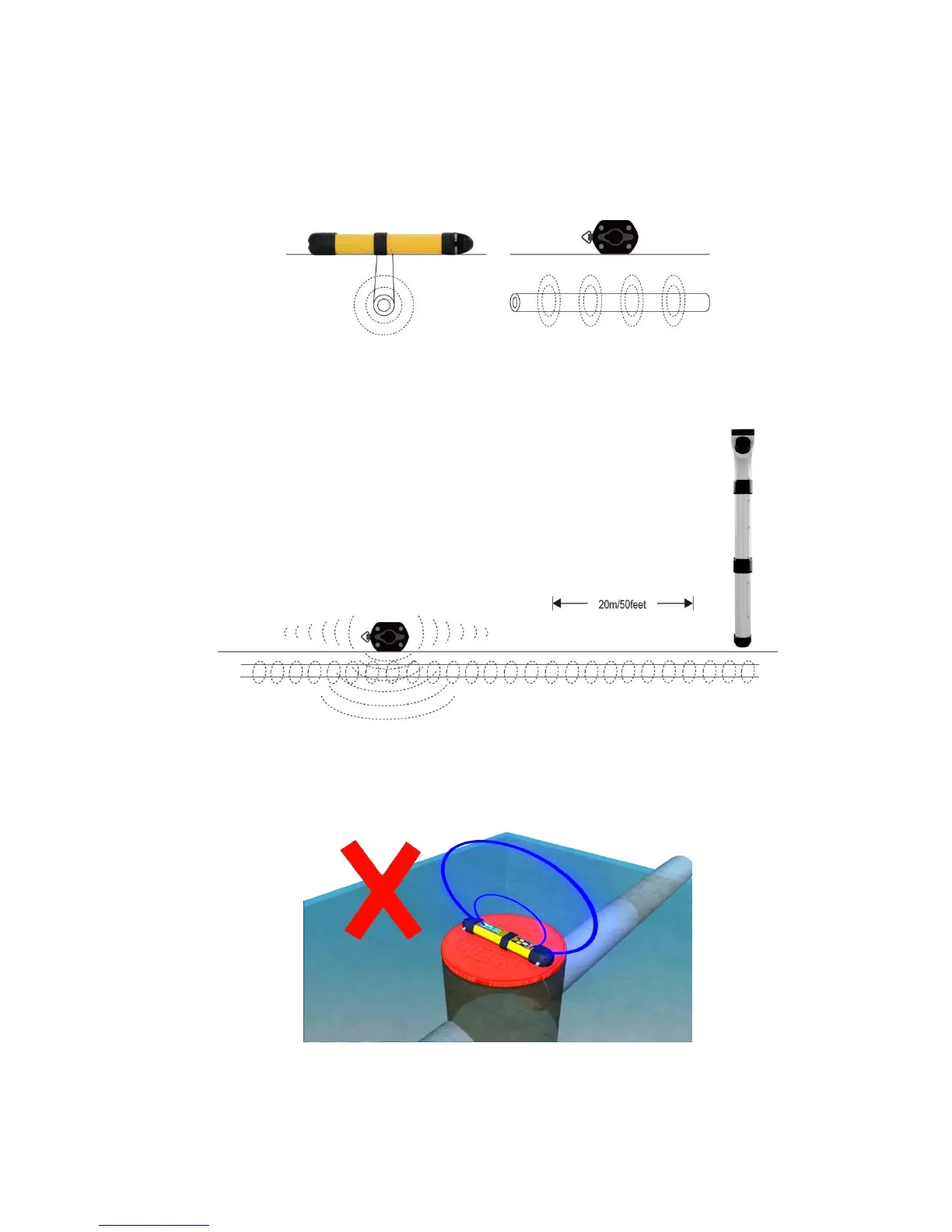
Applying an induction signal to a line.
Remove any connections from the output connector. Switch on the transmitter and place it over the
suspected position of the line and position it so that it is across the line as above.
The Induction mode is particularly useful where there is no access to the line, but it should be noted that this
is the least efficient method of applying a signal and it is also prone to signals being applied to adjacent lines.
Also note that the signal will radiate out to the side of the transmitter as well as below. For this reason it is
recommended that when applying a signal using the Induction method, a distance of at least 20m is kept
from the transmitter when pinpointing or taking depth readings. Locating closer than 20m is possible but the
operator should be aware that the signal directly received from the transmitter may be strong enough to
influence the results.
When using the Induction mode, avoid placing the transmitter over metallic manhole covers as this will
severely reduce the effectiveness of the transmitter and in extreme cases cause damage to the transmitter’s
circuitry.


 To Next Page