4 Locating
Page 24 of 33
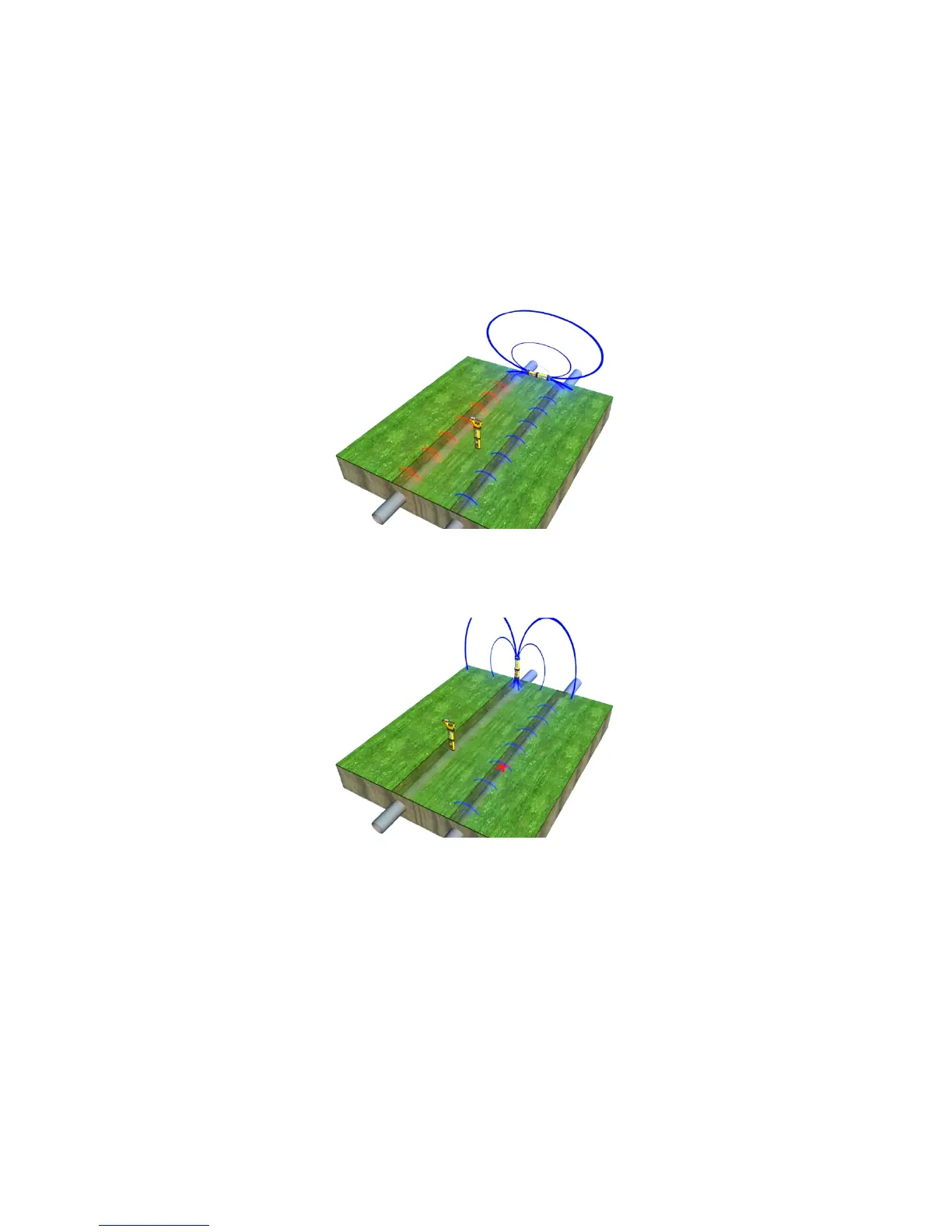
4.7.3 Nulling Out a Signal (Induction Mode)
In congested areas it can be difficult to trace a particular service. This is particularly the case when two or
more services are routed close to each other along, for instance, a pathway. Using the Induction mode in this
situation will make the situation worse as the signal will induce on to adjacent services as well as the target
service.
This situation can be greatly improved by using the “Nulling out” technique.
Method:
1. First locate the services using Induction in the usual way.
2. Now position the vScan receiver exactly over the unwanted signal. The person at the transmitter end can
now hold the transmitter vertically over the position of the unwanted signal. Move the transmitter side to
side across the line of the unwanted service whilst asking the person at the receiver end to indicate when
the signal is “nulled out”. Insert the transmitter into the Tx foot and place in the null position.
3. The signal should now only be visible in the wanted service but not on the unwanted service.
Note that only one service at a time can be nulled out using this method, so if there are more than two
services the above may need to be repeated to null out other services.
4.7.4 Capacitive Coupling
There may be times when direct connection is not possible and it is not possible to deploy a signal clamp as
a means of signal injection. If this is the case an alternative is to use the “capacitive coupling” technique. This
uses the high frequency (131 kHz) part of the signal. The high frequency has the ability to couple to a service
just by being in close proximity to it.
Method:
1. Identify the service to be energized. Wrap the red direct connection lead around the cable. If possible
wrap more than once round as the more surface area close to the cable the better. Take the black lead
and connect it to a suitable ground. Create your own ground if possible using the earth stake.
2. Switch on the transmitter. Note that there will not be a tone change to indicate a good connection as only


 To Next Page