SAVE THESE
INSTRUCTIONS
2
Let equipment
cool completely before
putting
away.
Loop
cord
loosely around
equipment when
storing.
To
protect
against
electric
shock hazards,
do
not
immerse this
equipment in water or other
liquids.
lo. To avoid
electric shock hazard, do not
disassemble
this
equipment, but take it
to
a
qualified serviceman
when
some
service
or
repair
work is required.
Incorrect
reassembly can
cause
electric
shock hazard when
the equipment is used
subsequently.
Table of Contents
Getting
Acquainted
With Your
285HV Flash Unit
5
Power Sources
5
Ready
Light
6
Battery
Saving circuit
7
Battery Operation
7
Inserting
Batteries
Forming
The Capacitor
Thyristor circuit
Zoom/Bounce
Flash
Head
8
Zoom
Position
Bounce Angle
Automatic
Operation
9
Vari
Sensor
Module
Mode
Selector Dial
Calculator
Dial
11
Sufficient
Light
Indicator
13
Attaching The Flash
To The
Camera
14
Shooting Automatically
t 4
On-Camera Direct Flash
On-Camera Bounce
Flash
Off-Camera Direct And Bounce
Flash
Shooting
Manually
18
Direct
Flash
Zoom
Bounce Flash
Van-Power
Fill-In Flash
21
Multiple
Flash Lighting
22
4
Descnption
of
Flash
Unit
Open
Flash Button
Sensor
Sockel
Battery Compartment Cover
Illuminated Calculator Dial
ASA/DIN
Indicator Arrow
Lens/Filter
Slot
7,
Zoom/Bounce Flash Head
Zoom Setting
Indicator
Bounce
Angle Scale
Sufficient Light
Indicator
Òaiculator
Dial
Light Button
On-Off Switch
Ready Light
Mounting Foot
Lock Lever
Mounting Foot
Shutter Cord Socket
AC Adapter/HVP-1
/PPG-1
Receptacle
Van-Power Settings
Van-Power
Dial
(Black Arrow)
Distance
Scales (fi & ro)
t-Stop
Scale
ASA/DIN Film
Speed Dial
Aulo Modes
(colored wedges)
Mode
Selector Dial
Mode
Selector
Window
Vari Sensor Module
Alkaline/NiCad
Battery Holder
28mm Wide
Angle Lens
Detachable
Shutter Cord
Specifications
23
Power Specifications
General Specifications
Vivitar
2B5HV Zoom
Thrynistor Flash
System
Accessories
24
Manual Operation
Guide Numbers
26
Automatic
f-Stop
Settings And Corresponding
Ranges
27
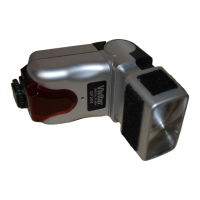
Getting
Acquainted With Your 285HV
Flash Unit
The purpose of this
Owners Manual is to
familiarize you with
your
flash and give you the
basics for taking
flash
pictures.
After
reading it, we suggest you
experiment
with the
unit's
various
features
by
shooting
a
roll of
film. This will
help
you to
use
your flash
more effectively.
Once
youve used your
flash for
a
while, you may want more
in-depth
information on flash
lighting techniques. There
is
a
wealth of information
currently
available, and
we suggest you
check
with your local photo
dealer, bookstore or
library for
books on
specific techniques.
Power
Sources
Your
Vivitar Model 285HV
offers
you
the flexibility of
working
with
several power sources. It
operates on
four
1.5
volt
size
AA
alkaline
batteries as a standard
power source, If you'll be
using
your flash
frequently, you may want to
consider any of three
other
optional
power sources:
1)
Nickel-Cadmium
Batteries (N/Cads)
- In
addition to
being rechargeable,
NiCads also
provide
a
faster recycling
time.
Ask your dealer about the
Vivitar NC-3 NiCad
Battery
Pack
and the Charge
12/20
unit for fast 20-minute
recharges
of the
NC-3.
CAUTION: When using
NiCad
batteries, firing
your
flash
continuously more than 25 times may
damage
your flash.
Wait
5
PDF compression, OCR, web optimization using a watermarked evaluation copy of CVISION PDFCompressor



 To Next Page