Need help?
Do you have a question about the Vivotek FD8169 and is the answer not in the manual?
Provides essential information and package contents before camera installation and use.
Instructions for removing the dome cover, installing the SD card, and preparing for mounting.
Steps for mounting the camera, routing cables, and connecting power and network.
Guidance on connecting the camera using PoE-enabled switches or power injectors.
Configuring router settings, including port forwarding for remote access.
Steps for installing and using the VIVOTEK Installation Wizard 2 for network setup.
Instructions for accessing the camera's interface through web browsers.
Enabling ActiveX controls in browser security settings for proper camera access.
Accessing video streams using RTSP players and understanding URL formats.
Description of the main interface sections including logo, host name, and control areas.
Controlling camera pan, tilt, and zoom using the PTZ panel and global view.
Explanation of video control functions like snapshot, digital zoom, pause, and recording.
Selecting stream transmission modes and understanding H.264 protocol options.
Enabling, configuring, and calibrating joystick controls for camera operation.
Configuring basic system settings like hostname and LED indicators.
Setting the camera's system time via manual, computer sync, or NTP.
Adjusting image parameters like title, timestamp, color, and power line frequency.
Configuring automatic switching to B/W and enabling IR illuminators at night.
Adjusting Smart IR for exposure and configuring IR cut filter modes.
Configuring white balance, image adjustments, and noise reduction.
Configuring LAN connection, static IP, and network type settings.
Setting up PPPoE for internet access using ISP credentials.
Configuring HTTP and RTSP streaming with authentication and port settings.
Managing user accounts, setting root passwords, and configuring privileges.
Enabling secure HTTPS connection by creating and installing certificates.
Enabling IEEE 802.1x for port-based network access control.
Configuring event triggers (motion, tampering) and associated actions.
Setting up motion detection windows, sensitivity, and percentage.
Enabling and configuring camera tamper detection for security incidents.
Configuring recording parameters like source, schedule, and adaptive recording.
Managing SD card status, cyclic storage, and automatic cleanup.
Searching and viewing recorded files, with options to lock or remove them.
API commands for managing storage, including search, delete, and update operations.
API for changing virtual input status and handling manual triggers.
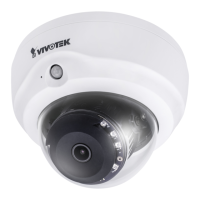
Detailed specifications for camera features, video, network, and system requirements.
FCC, CE, and VCCI statements regarding device compliance and interference.
 General
| Type | IP security camera |
|---|---|
| PTZ control | Yes |
| Certification | CE C-Tick FCC ( Class B ) LVD VCCI |
| Placement supported | Indoor |
| Connectivity technology | Wired |
| Wi-Fi | No |
| Cabling technology | 10/100Base-T(X) |
| Networking standards | IEEE 802.3af |
| Supported network protocols | IPv4, IPv6, TCP/IP, HTTP, HTTPS, UPnP, RTSP/RTP/RTCP, IGMP, SMTP, FTP, DHCP, NTP, DNS, DDNS, PPPoE, CoS, QoS, SNMP, 802.1X, UDP, ICMP |
| Ethernet LAN (RJ-45) ports | 1 |
| Form factor | Dome |
| Mounting type | Ceiling |
| Product color | Black, White |
| LED indicators | Power, Status |
| Signal-to-Noise Ratio (SNR) | 53 dB |
| Total megapixels | 2 MP |
| Maximum resolution | 1920 x 1080 pixels |
| Video formats supported | H.264, MPEG |
| Image quality adjustment | Brightness, Contrast, Saturation, Sharpness |
| DC output voltage | 12 |
| Power source type | PoE |
| Power consumption (Power over Ethernet (PoE)) | 7.5 W |
| Pan range | 0 - 348 ° |
| Tilt angle range | 0 - 70 ° |
| Angle of rotation | 345 ° |
| Minimum illumination | 0 lx |
| Storage temperature (T-T) | 0 - 50 °C |
| Operating temperature (T-T) | -10 - 50 °C |
| Sensor type | CMOS |
| Optical sensor size | 1/2.7 \ |
| Digital zoom | 48 x |
| Flash memory | 128 MB |
| Internal memory | 256 MB |
| Compatible memory cards | MicroSD (TransFlash), SDHC, SDXC |
| LED type | IR |
| Night vision distance | 15 m |
| Number of illumination LEDs | 6 |
 Weight and Dimensions
| Length | 98 mm |
|---|---|
| Weight | 435 g |
| Diameter | 128 mm |

 To Next Page