EasyManua.ls Logo

Vox V847 - User Manual

Vox V847
3 pages
Print Icon
To Next Page IconTo Next Page
Loading...
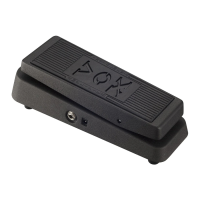
Thank you for purchasing the VOX Wah Wah pedal. VOX
designed the first Wah Wah Pedal in 1967. It has been the
choice of legendary players the world over.
To help you get the most out of your new instrument, please
read this manual carefully.
WAH-WAH PEDAL OPERATION MANUAL
Battery installation
Remove the 4 screws from the rubber feet that secure the
bottom cover. And then install a 9-volt battery (6F22/6LF22/
6FR61), being sure to connect the correct polarity.
If you plan on not using the pedal for an extended period of
time, remove the battery to avoid damage caused by leakage.
You can connect an optional AC adapter (DC9V ) to
DC9V jack.
Connection
1. Connect a cable from your guitar to the “Instrument”
input jack on the right side of the wah-wah pedal.
The input and output jacks are labeled on the top of your
new wah-wah pedal.
NOTE: This pedal uses a battery which is connected when a
plug is inserted into the “Instrument” jack. For longest
battery life, always remove the instrument cable from jack
when not in use.
2. Connect a cable from the “Amplifier” output jack on the
left side of the wah-wah pedal to your guitar amp or the
next effect pedal.
A wah-wah pedal sounds very different when placed
before a distortion pedal compared with after a distortion
pedal. Don’t be afraid to experiment!
3. To turn the wah-wah effect ON; push the toe of the pedal
all of the way down until you feel a click.
A wah-wah pedal is a sweepable bandpass filter. With the
heel down, low frequencies are accentuated and, with the
toe down, high frequencies are accentuated.
4. To turn the wah-wah effect OFF; push the toe of the pedal
all of the way down until you feel a click.
Merci pour l’achat de votre pédale Wah Wah VOX. C’est VOX
qui a inventé la toute première pédale Wah Wah en 1967 et
depuis, c’est le choix de tous les plus grands musiciens de
légende à travers le monde.
Pour vous aider à obtenir le meilleur de votre Wah Wah,
merci de lire attentivement la notice.
MANUEL D’UTILISATION DE LA PEDAL
WAH WAH
Installation de la pile
Pour installer la pile 9 Volts (6F22/6LF22/6FR61), enlever les
4 vis des 4 pieds de caoutchouc qui maintiennent la plaque
arrière. Par la suite installez la pile 9 Volts en vous assurant
que vous connectez les bonnes polarités.
Si vous comptez ne pas utiliser votre pédale pendant une
longue période, enlever la pile pour éviter tout risque
d’endommagement dû à un écoulement.
Vous pouvez connecter un adaptateur secteur, en option,
(DC9V ) a l’entrée alimentation DC9V de votre
pédale.
Connexion
1. Connectez un câble de votre guitare à l’entrée instrument
située sur le coté droit de votre pédale Wah Wah.
Les entrées et sorties sont indiquées sur le dessus de votre
pédale Wah Wah.
Note: Cette pédale utilise une pile qui est connectée
lorsqu’un câble est inséré dans l’entrée instrument. Pour
augmenter la durée de vie de votre pile, toujours débrancher
le câble inséré dans l’entrée instrument lorsque vous
n’utilisez pas cette pédale.
2. Connectez un câble de la sortie ampli (Amplifier) située
sur le côté gauche de votre pédale, à votre ampli ou à une
autre pédale d’effet.
Une pédale Wah Wah sonne vraiment différemment selon
si vous la placez avant ou après une pédale de distorsion.
N’ayez pas peur d’expérimenter !
3. Pour activer l’effet Wah Wah, appuyer sur le haut de la
pédale de la Wah Wah, avec la pointe de votre pied
jusqu’à ce que vous sentiez un click.
Une pédale Wah Wah est un filtre qui balaye plusieurs
plages de fréquences. Avec la pédale régler au plu bas,
vers le talon, les fréquences graves sont accentuées alors
qu’avec la pédale réglée au plus haut, vers la pointe du
pied, se sont les fréquences aigues qui sont accentuées.
4. Pour desactiver l'effet Wah Wah, appuyer sur le haut de la
pédale de la Wah Wah, avec la pointe de votre pied
jusqu'à ce que vous sentiez un click.
Glückwunsch zum Kauf des VOX Wah Wah Pedals. Bereits
im Jahr 1967 entwickelte VOX das allererste Wah Wah Pedal.
Schnell wurde es zur bevorzugten Wahl vieler namhafter
Künstler weltweit.
Um das Optimum aus ihrer neuen Anschaffung herauszuho-
len, empfehlen wir Ihnen diese Bedienungsanleitung
aufmerksam durchzulesen.
WAH-WAH Pedal - Bediener Handbuch
Einsetzen der Batterie
Zum Einsetzen der 9 Volt Batterie (9V Block 6F22/6LF22/
6FR61) lösen Sie bitte zunächst die 4 Schrauben der Gummi-
füße, welche die Bodenplatte fixieren. Achten Sie beim
Einsetzen und Anschluss der
9 Volt Batterie auf die richtige Polarität. Falls Sie das Wah
Wah Pedal längere Zeit nicht nutzen sollten, empfehlen wir
Ihnen die Batterie zu entfernen, um etwaige Schäden durch
Auslaufen zu verhindern.
Für eine dauerhafte Stromversorgung können Sie alternativ
den optionalen Netzadapter (DC9V – Modellnummer:
KA189/A9600E) an die DC9V Buchse anschließen.
Anschluss
1. Verbinden Sie das Klinkenkabel von Ihrer Gitarre mit der
„Instrument“ Eingangsbuchse, welche auf der rechten
Seite des Wah Wah Pedals positioniert ist.
Die Input und Output Buchsen sind oben auf dem
Gehäuse Ihres neuen Wah Wah Pedals gekennzeichnet.
Hinweis: Dieses Pedal wird durch eine Batterie mit
Spannung versorgt, sobald ein Klinkenkabel mit der
Inputbuchse verbunden wird. Für eine längere Batterie-
lebensdauer empfehlen wir Ihnen das Kabel herauszuziehen,
wenn Sie länger nicht spielen.
2. Verbinden Sie nun ein Klinkenkabel von der „Amplifier“
Ausgangsbuchse, welche auf der linken Geräteseite
positioniert ist, mit Ihrem Verstärker oder einem weiteren
Effektpedal.
Ein Wah Wah Pedal klingt höchst unterschiedlich je nach
Position in der Effektgerätekette. Probieren Sie ruhig eine
Platzierung vor oder nach einem Distortion-/Overdrive
Pedal aus.
3. Um den Wah Wah Effekt zu aktivieren, drücken Sie das
Pedal ganz nach unten durch, bis Sie einen deutlich
wahrnehmbaren „Klick“ vom darunter liegenden Schalter
spüren/hören.
Ein Wah Wah ist ein stufenlos regelbarer Bandpass Filter.
Mit der Ferse nach unten, werden die tiefen Frequenzen
angehoben. Mit dem Vorderfuß nach unten werden die
hohen Frequenzen entsprechend akzentuiert.
4. Um den Wah Wah Effekt auszuschalten, drücken Sie das
Pedal erneut ganz nach unten durch, bis Sie einen
deutlich wahrnehmbaren „Klick“ vom darunter liegenden
Schalter spüren/hören.
Gracias por comprar el pedal VOX de Wah Wah. VOX diseñó
el primer pedal de wah wah en el año 1967. Ha sido el
favorito de muchos músicos legendarios en todo el mundo.
Para ayudarte a sacar el máximo rendimiento de tu nuevo
pedal, por favor, lee atentamente este manual.
Manual de operación del pedal Wah-Wah
Instalación de la batería
Para instalar una batería de 9 voltios (6F22/6LF22/6FR61),
quita los 4 tornillos que sujetan las patas de goma a la tapa
inferior. Retira la tapa e instala una batería de 9 voltios,
respetando la polaridad correcta.
Si no vas a usar el pedal por un periodo de tiempo prolonga-
do, quita la batería para evitar daños por pérdida de ácido.
También puedes conectar un alimentador externo de 9 voltios
al conector dedicado.
Conexión
1. Conecta un cable desde tu guitarra al jack de entrada
rotulado como “Instrument” en el lateral derecho del
pedal.
Los jacks de entrada y salida está rotulados en la parte
superior del pedal.
NOTA: Este pedal usa una batería que entra en funciona-
miento cuando se conecta un jack a la entrada del pedal.
Para una mayor conservación de la batería, desconecta el
cable del pedal cuando no lo vayas a usar.
2. Conecta un cable de la salida del pedal rotulada como
“Amplifier” a la entrada de tu amplificador.
Un pedal de wah-wah suena muy diferente si se intercala
antes o después de uno de distorsión. ¡No temas experi-
mentar!
3. Para activar el efecto de wah-wah, pisa el pedal a fondo
hasta que sientas un “click.”
Un pedal de wah-wah es un filtro pasa banda que va
haciendo un barrido. Con el pedal hacia abajo se acentúan
las frecuencias más graves, mientras que en la posición
más alta se enfatizan las frecuencias agudas.
4. Para desactivar el efecto de wah-wah pulsa de nuevo el
pedal hasta que escuches el “click”.
IMPORTANT NOTICE TO CONSUMERS
This product has been manufactured according to strict
specifications and voltage requirements that are applicable in
the country in which it is intended that this product should
be used. If you have purchased this product via the internet,
through mail order, and/or via a telephone sale, you must
verify that this product is intended to be used in the country
in which you reside.
WARNING: Use of this product in any country other than
that for which it is intended could be dangerous and could
invalidate the manufacturer’s or distributor’s warranty.
Please also retain your receipt as proof of purchase otherwise
your product may be disqualified from the manufacturer’s or
distributor’s warranty.
REMARQUE IMPORTANTE POUR LES CLIENTS
Ce produit a été fabriqué suivant des spécifications sévères et
des besoins en tension applicables dans le pays où ce produit
doit être utilisé. Si vous avez acheté ce produit via l’internet,
par vente par correspondance ou/et vente par téléphone,
vous devez vérifier que ce produit est bien utilisable dans le
pays où vous résidez.
ATTENTION: L’utilisation de ce produit dans un pays autre
que celui pour lequel il a été conçu peut être dangereuse et
annulera la garantie du fabricant ou du distributeur.
Conservez bien votre récépissé qui est la preuve de votre
achat, faute de quoi votre produit ne risque de ne plus être
couvert par la garantie du fabricant ou du distributeur.
WICHTIGER HINWEIS FÜR KUNDEN
Dieses Produkt wurde unter strenger Beachtung von
Spezifikationen und Spannungsanforderungen hergestellt,
die im Bestimmungsland gelten. Wenn Sie dieses Produkt
über das Internet, per Postversand und/oder mit telefoni-
scher Bestellung gekauft haben, müssen Sie bestätigen, dass
dieses Produkt für Ihr Wohngebiet ausgelegt ist.
WARNUNG: Verwendung dieses Produkts in einem anderen
Land als dem, für das es bestimmt ist, verwendet wird, kann
gefährlich sein und die Garantie des Herstellers oder
Importeurs hinfällig lassen werden. Bitte bewahren Sie diese
Quittung als Kaufbeleg auf, da andernfalls das Produkt von
der Garantie des Herstellers oder Importeurs ausgeschlossen
werden kann.
NOTA IMPORTANTE PARA EL CONSUMIDOR
Este producto ha sido fabricado de acuerdo a estrictas
especificaciones y requerimientos de voltaje aplicables en el
país para el cual está destinado. Si ha comprado este
producto por internet, a través de correo, y/o venta
telefónica, debe usted verificar que el uso de este producto
está destinado al país en el cual reside.
AVISO: El uso de este producto en un país distinto al cual
está destinado podría resultar peligroso y podría invalidar la
garantía del fabricante o distribuidor.
Por favor guarde su recibo como prueba de compra ya que
de otro modo el producto puede verse privado de la garantía
del fabricante o distribuidor.
1SGFE
Original Wah Wah Pedal
V847
Owners Manual
Manuel d’utilisation
Bedienungsanleitung
Manual de Usuario
Classic Wah Wah Pedal
V845
Question and Answer IconNeed help?

Do you have a question about the Vox V847 and is the answer not in the manual?

Summary

Wah-Wah Pedal Operation Manual

Battery Installation

Instructions for installing a 9-volt battery and optional AC adapter.

Connection and Operation

Steps to connect the pedal to a guitar and amplifier, and how to operate the effect.

Precautions and Disposal

Operational Precautions

Guidelines for product placement, handling, and preventing foreign objects.

Power and Care Instructions

Proper power connection and cleaning instructions for the equipment.

Disposal Notice (EU Only)

Instructions for environmentally responsible disposal of the product and its components.

Overview

The VOX Wah Wah pedal, available in the Original V847 and Classic V845 models, is a renowned effects pedal designed to modify the tone of an electric guitar. First introduced by VOX in 1967, it has become a staple for countless legendary musicians, celebrated for its distinctive "wah" sound that adds expressive vocal-like qualities to guitar playing.

Function Description

At its core, the wah-wah pedal operates as a sweepable bandpass filter. This means it selectively emphasizes a narrow range of frequencies within the guitar's signal, and the player can dynamically shift this frequency range by rocking the pedal back and forth. When the pedal is in the "heel down" position, it accentuates lower frequencies, producing a deep, resonant tone. As the pedal is moved towards the "toe down" position, it gradually shifts the emphasis to higher frequencies, creating a brighter, more piercing sound. The continuous sweep between these two extremes is what generates the characteristic "wah" effect, allowing guitarists to mimic vocal inflections or create rhythmic textural changes.

The pedal is designed for easy integration into an existing guitar setup. It features an "Instrument" input jack on the right side, where the guitar's signal is connected, and an "Amplifier" output jack on the left side, which connects to a guitar amplifier or another effect pedal further down the signal chain. This straightforward input/output configuration ensures that the pedal can be quickly and efficiently incorporated into a pedalboard.

A key operational feature is the pedal's activation mechanism. To engage the wah-wah effect, the player simply pushes the toe of the pedal all the way down until a distinct click is felt. This click signifies that the effect is now active and the filter is engaged. Conversely, to disengage the effect and return to a clean signal, the player again pushes the toe of the pedal all the way down until another click is felt. This tactile feedback ensures that the player can confidently switch the effect on and off during performance without needing to visually confirm its status.

The placement of the wah-wah pedal within the signal chain can significantly alter its sound. For instance, placing it before a distortion pedal will yield a different sonic character compared to placing it after. This encourages experimentation, allowing musicians to discover various tonal possibilities and tailor the effect to their specific musical needs and preferences. The manual explicitly encourages users not to be afraid to experiment with pedal order, highlighting the versatility of the wah-wah effect.

Usage Features

The VOX Wah Wah pedal is designed for both battery and optional AC adapter power. For battery operation, it requires a 9-volt battery (specifically 6F22/6LF22/6FR61). Battery installation involves removing four screws from the rubber feet that secure the bottom cover, inserting the battery, and ensuring correct polarity. A crucial design aspect for battery life is that the battery is only connected when a plug is inserted into the "Instrument" jack. To maximize battery longevity, it is recommended to always remove the instrument cable from this jack when the pedal is not in use. This prevents unnecessary power drain and extends the time between battery replacements. For users who prefer not to rely on batteries, an optional DC9V AC adapter can be connected to the dedicated DC9V jack, providing a continuous power supply. It is also advised to remove the battery if the pedal will not be used for an extended period to prevent potential damage from battery leakage.

Connecting the pedal is a simple two-step process. First, a cable from the guitar is plugged into the "Instrument" input jack. The input and output jacks are clearly labeled on the top of the pedal for easy identification. Second, a cable from the "Amplifier" output jack is connected to the guitar amplifier or the next effect pedal in the signal chain. This clear labeling and intuitive connection scheme make the pedal user-friendly, even for those new to guitar effects.

The interactive nature of the pedal, where the player physically rocks it to control the filter sweep, makes it a highly expressive tool. The range of motion allows for subtle tonal shifts or dramatic sweeps, giving the player direct control over the intensity and character of the wah effect. This hands-on control is a fundamental aspect of its appeal and utility in various musical genres.

Maintenance Features

Maintaining the VOX Wah Wah pedal involves a few simple practices to ensure its longevity and optimal performance. Regular cleaning of the exterior is recommended. If the pedal becomes dirty, it should be wiped with a clean, dry cloth. It is crucial to avoid using harsh liquid cleaners such as benzene or thinner, or any cleaning compounds or flammable polishes, as these can damage the pedal's finish or internal components. Adhering to this simple cleaning guideline helps preserve the aesthetic and structural integrity of the device.

Proper handling is also emphasized to prevent damage. Users are advised not to apply excessive force to the switches or controls. While the pedal is built to withstand the rigors of performance, undue pressure can lead to mechanical failure. Gentle and deliberate operation ensures that the internal mechanisms, particularly the activation switch and the sweep potentiometer, remain in good working order.

Environmental considerations are important for preventing malfunctions. The pedal should not be used or stored in locations exposed to direct sunlight, extreme temperatures or humidity, excessive dust or dirt, or excessive vibration. Additionally, it should be kept away from strong magnetic fields. These environmental precautions help protect the sensitive electronic components from degradation and ensure consistent performance.

A critical safety and maintenance instruction is to prevent foreign matter, especially liquids and metal objects, from entering the equipment. The manual explicitly warns against placing any container with liquid near the pedal. Should liquid or metal objects get inside, it could lead to a breakdown, fire, or electrical shock. This highlights the importance of keeping the pedal in a clean and safe environment, away from potential spills or small metallic items that could accidentally fall into the casing.

Finally, the manual itself serves as a maintenance feature, as users are advised to keep it for later reference after reading. This ensures that important operational guidelines, troubleshooting tips, and maintenance instructions are readily available should any questions or issues arise during the pedal's lifespan. This commitment to providing clear, accessible information underscores VOX's dedication to user support and product longevity.

Vox V847 Specifications

General IconGeneral
Best usesGuitar
Product typeWah pedal
Product colorBlack, Silver
Non-slip surfaceYes
6.35 mm (1⁄4-inch) output1
Battery voltage9 V
Power consumption540 mA
Power source typeAC, Battery
Weight and Dimensions IconWeight and Dimensions
Depth252 mm
Width102 mm
Height75 mm
Weight1760 g

Related product manuals