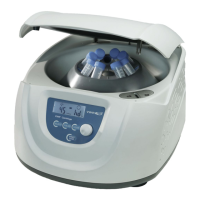
This document outlines the operation and maintenance of the VWR® Centrifuge, a laboratory device designed for the centrifugal separation of human blood or urine samples. It is intended for use by trained operators in a laboratory environment, adhering to the IVD Directive 98/79/EC and EN ISO 12772.
Function Description
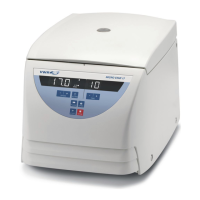
The VWR® Centrifuge is a laboratory centrifuge primarily used for the centrifugal separation of human blood or urine samples. It operates by spinning a rotor at high speeds, generating centrifugal force to separate components of a sample based on density. The device features a brushless DC motor for efficient and reliable operation.
Key functional aspects include:
- Speed Control: The centrifuge allows for precise adjustment of rotational speed, with a minimum increment of 100 rpm. Operators can increase or decrease speed values using a parameter button, with a circulating function for quick adjustments across the range.
- Time Control: The running time can be set from 30 seconds to 99 minutes, or to a continuous "HOLD" mode. The time setting is divided into 10 sections, visually represented on the display.
- RCF Operation: The device supports Relative Centrifugal Force (RCF) operation, allowing users to input desired RCF values with an increment of 100 × g. This ensures consistent separation results regardless of the rotor used.
- Pulse Operation: A dedicated pulse function allows for quick spins to remove residual samples adhered to the interior of tubes. This function is active only when the rotor is stopped and the door is locked.
- Deceleration Curves: Two deceleration curves (fast stop and slow stop) can be set, providing flexibility for different sample types and experimental requirements. This feature is accessed by holding the parameter button for more than 7 seconds.
- Safety Interlocks: The centrifuge is equipped with a door interlock, preventing operation when the door is not securely closed and locked. The door can only be opened when the rotor has stopped rotating and the power is on.
- Automatic Internal Diagnosis: The device includes an automatic internal diagnosis system to detect and report any abnormalities during operation, displaying warning codes on the time/display area.
- Over-speed Detector: An over-speed detector ensures that the rotor does not exceed its allowable maximum speed, enhancing safety and preventing damage.
- Voice Reminder: The centrifuge provides voice reminders, likely for operational cues or alerts.
- Processing Display: A display shows the current operational status, including speed, lock status, and remaining time. A rotating speed symbol indicates that the centrifuge is running, with faster rotation signifying higher speed.
Usage Features
The centrifuge is designed for straightforward operation with a user-friendly interface.
- Operation Panel: The front panel includes dedicated buttons for "SELECT," "PULSE," "DOOR," and "START/STOP," along with a parameter button (rotary knob) for adjusting values.
- Program Setting: Users can select and modify operational programs by pressing the "SELECT" button. Parameters like speed and time can be adjusted when flashing on the display using the parameter button.
- Starting and Stopping: The "START/STOP" button initiates centrifugation. Pressing it during operation will brake the centrifuge to a stop.
- Door Release: The "DOOR" button opens the lid when the centrifuge is not running. In case of a power outage, the lid can be opened manually using a screw driver inserted into designated holes on the unit's sides.
- Rotor Preparation: Samples must be prepared and placed into tubes without overloading. It is crucial to keep tubes balanced to extend the centrifuge's life expectancy and prevent vibrations. Rotors should be inspected for corrosion or scratches before use.
- Rotor Loading: Only VWR's rotors should be used. Centrifuge tubes must be loaded symmetrically into the rotor. The rotor lid and shaft must be securely tightened to prevent the rotor from lifting off during rotation.
- Sample Density Consideration: For samples with a density greater than 2.0 g/ml, operators must calculate the allowable speed using a provided formula to prevent tube breakage.
- Warning Display: In case of an error, the centrifuge automatically stops and displays an error code, which can be referenced in the manual for corrective actions.
- Post-Operation: After an operation, the centrifuge beeps to indicate completion. The door unlocks automatically, and the system stores the last used parameters for recall upon restarting.
Maintenance Features
Regular maintenance is essential for safe and efficient operation of the VWR® Centrifuge.
- Cleaning:
- Centrifuge Exterior: The centrifuge should be covered with a cloth when not in use to protect it from direct exposure to ultraviolet rays, which can cause discoloration or label peeling. Cleaning should be done with a cloth or sponge moistened with a neutral detergent solution. Sterilization can be achieved by wiping with a 70% ethanol solution.
- Rotor Chamber: The rotor chamber should be kept clean. If fluid spills, it must be promptly cleaned and dried to prevent contamination. Water, neutral detergents, or disinfectants should not be poured directly into the chamber to avoid leakage into drive units and subsequent corrosion or bearing deterioration.
- Lid: The lid should be cleaned and sterilized using the same methods as the centrifuge exterior.
- Drive Shaft Maintenance: Regular maintenance of the drive shaft is recommended. It should be wiped with a soft cloth, and a thin coat of silicon grease should be applied.
- Rotor Care:
- Corrosion Prevention: To prevent corrosion, the rotor should be removed from the chamber when not in use for extended periods. The rotor lid should be detached and turned upside down to dry tube holes and keep them clean.
- Spill Cleanup: If samples spill into the rotor, it should be rinsed with water, dried completely, and then a thin coat of silicon grease applied.
- Regular Checks: The rotor should be checked every 3 months to ensure tube and rotor holes are clean.
- Rotor and Adapter Compatibility: Only combinations of rotor/buckets/adapters recommended by VWR should be used. All adapters must be correctly installed.
- Tube Sterilization: The manual provides a detailed table outlining cleaning and sterilizing conditions for different tube materials (PA, PC, PP), including acidic, alkaline, neutral cleaning fluids, warm water, ultrasonic cleaning, autoclaving, boiling, ultraviolet sterilization, and gas sterilization. Specific instructions are given for autoclaving PA, PC, and PP tubes, emphasizing temperature limits and proper tube placement to prevent deformation.
- Life Expectancy of Tubes: The life expectancy of plastic tubes depends on sample characteristics, rotor speed, and temperature. High-quality tubes generally last for 30-50 operations, while ordinary tubes last around 10 operations at maximum speed. Low-speed operation can extend tube life. Pretreatment conditions like cleaning and sterilization can affect lifetime. Damaged or cracked tubes should not be used.
- Repair and Technical Service: Users are advised not to attempt repairs themselves. In case of problems, the local VWR sales or service center should be contacted. If the unit needs to be shipped for repair, a Return Authorization Number and shipping instructions must be obtained.
- Equipment Disposal: The centrifuge, marked with a crossed-out wheeled bin symbol, must not be disposed of with unsorted domestic waste. It falls under group 8 (medical devices) of the WEEE guideline and should be handled by an authorized facility for separate collection and recycling. Proper decontamination is required before disposal.

 Need help?
 General

 To Next Page