Attack
Operation Manual 26 Waldorf
Simmons SDS-5 Bass Drum
The Simmons SDS-5 bass drum consists of an oscillator and a noise generator, both
routed into a low pass filter and an amplifier. An envelope controls the oscillator pitch,
the filter cutoff, and the amplifier volume. The envelope has a decay shape that is in-
between exponential and linear.
The oscillator plays a triangle wave whose pitch is controlled by a "Tune" control and a
"Bend" parameter that controls the influence of the amp envelope to oscillator pitch.
A "Noise - Tone" parameter controls the mix between the oscillator and the noise gene-
rator.
A "Noise" parameter controls the filter cutoff. (Very confusing, isn't it?)
A "Decay" parameter controls the envelope decay rate.
A "Click - Drum" parameter controls the most important aspect of the Simmons drums:
the mix between the original signal from the pad trigger microphone and the triggered
drum sound.
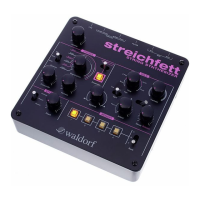
On the Attack, you can make this sound as follows:
Oscillator 1 plays a triangle or sine wave pitched at around 30Hz, and Envelope 2 is u-
sed to modulate its pitch. Use the "Vel" control to simulate the velocity-dependent pitch
bend amount that you would find on the SDS-5. You can simulate the click by setting
FM Env to a medium value, with Envelope 1 set to a very short decay. Oscillator 2 ge-
nerates noise, and the pitch is set to center. The Filter Cutoff can vary between 100Hz
and 5000Hz, and Vel should be set at 25% or so. Filter Resonance should be set to
10%. Envelope 2 should be set to an almost linear shape. Use Osc 1 and Osc 2 Level
to adjust the mix of tone and noise, and use Osc 1 FM Env to vary the click strength.
Roland TR-808 Snare Drum
On the Roland TR-808, the snare drum was made of two resonating filters and a noise
generator with high pass filtering. The "Tone" parameter controlled the output mix from
the first and the second filters, while "Snappy" controlled the volume of the noise gene-
rator. The noise generator was routed through a separate envelope and a high pass fil-
ter.
On the Attack, you can make this sound as follows:
Oscillator 1 plays a sine wave at around 150Hz, and you can use a little FM to disturb
the periodic character of the sine wave. This trick makes the oscillator sound thicker,
almost as if two oscillators were running at once.
Oscillator 2 generates noise, and you should use Pitch to high pass filter it.
In the Mixer, turn up Osc 1 to 50% and Osc 2 Env to 50%, set to Envelope 1.
Set Envelope 1 to a shorter decay phase than Envelope 2.
Use the filter with a low pass setting and add a little resonance to emphasize the high
frequency range.
Roland TR-909 Snare Drum
The TR-909 Snare Drum was made with two oscillators and two filters for noise. The
two oscillators started in phase but were slightly detuned, and one of the oscillators was
modulated a bit by a pitch envelope. The "Tune" parameter controlled the basic pitch



 To Next Page