4
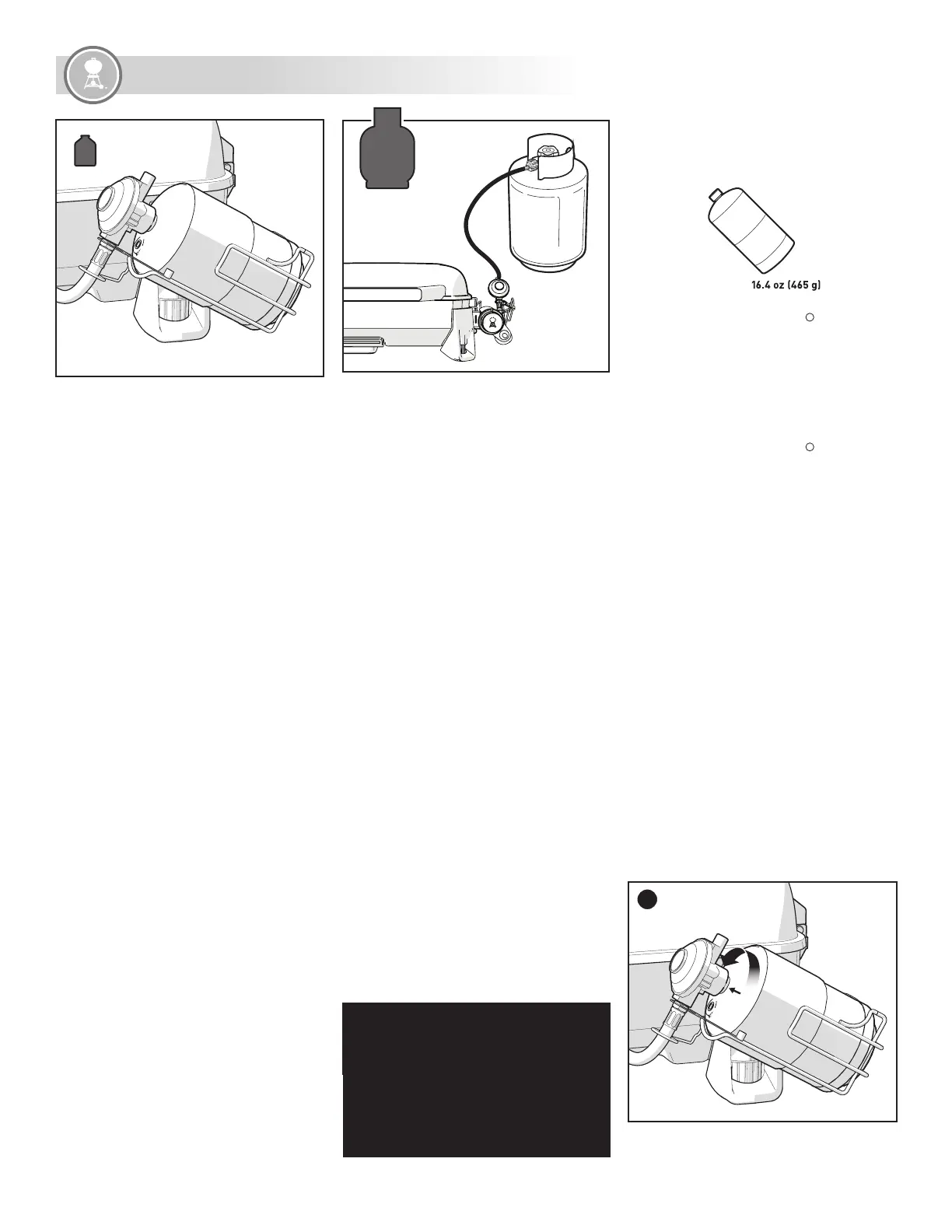
A B
Additional Tip for Cartridges
• Always turn o the burner control knob before
disconnecting gas cartridge from the regulator.
Additional Tips for Cylinders
• Always close the cylinder valve before disconnecting the
cylinder from the adapter hose.
• Cylinders must be installed, transported, and stored in an
upright position.
• Routinely check the cylinder to ensure the test date has not
expired. Do not use a cylinder which has an expired test
date.
What is a Regulator?
Your gas barbecue is equipped with a pressure regulator,
which is a device to control and maintain uniform gas
pressure as gas is released from the gascylinder.
Regulator Connections
Requirements for Both Cartridges and Cylinders
• Any parts sealed by the manufacturer must not be altered
by the user.
• Any modification of the appliance may be dangerous.
Additional Requirements for Cylinders
• Avoid kinking the hose.
• Change the flexible hose when national regulations stipulate
this as a requirement.
• Only a nationally approved low-pressure hose and regulator
must be used.
• Replacement regulator and hose assemblies must be as
specified by Weber-Stephen Products LLC.
This appliance shall only be used with:
i. a 100% propane fuel, non-refillable gas cylinder
complying to UN1978/US DOT 39 with a BOM/CGA600
connection, or;
ii. ULPG supplied from a refillable cylinder complying with
AS2030.1, using the supplied high pressure gas hose
with BOM/CGA600 connection.
Important Information about Propane Gas
& Gas Connections
Liquefied petroleum gas, also called ULPG, LP gas, liquid
propane, or simply propane or butane, is the flammable,
petroleum-based product used to fuel your barbecue. It is a
gas at moderate temperatures and pressure when it is not
contained. But at moderate pressure inside a container, such
as a tank, ULPG is a liquid. As pressure is released from the
tank, the liquid readily vapourises and becomes gas.
Safe Handling Tips for Cartridges And Cylinders
There are various guidelines and safety factors that you need
to keep in mind when using propane gas. Carefully follow
these instructions before using your gas barbecue.
• Do not use a damaged cartridge/cylinder. A dented or rusty
cartridge/cylinder or a cartridge/cylinder with a damaged
valve may be hazardous and should be replaced with a new
cartridge/cylinder immediately.
• Handle “empty” cartridges/cylinders with the same care as
you handle full cartridges/cylinders. Even when a cartridge/
cylinder is empty of liquid, there may still be gas pressure
inside the cartridge/cylinder.
• Cartridges/cylinders should not be dropped or handled
roughly.
• Never store or transport the cartridge/cylinder where
temperatures can reach 51° C (the cartridge/cylinder will
become too hot to hold by hand). For example: do not leave
the cartridge/cylinder in a car on a hot day.
• Check that seals between the appliance and the gas
container are in place and in good condition before
connecting the gas container.
• Do not use this appliance if it has damaged or worn seals.
• Do not use this appliance if it is leaking, damaged or does
not operate properly.
• Leak-test the joint where the regulator connects to the
cartridge/cylinder each time a reconnection occurs. For
example: test each time the cartridge/cylinder is reinstalled.
• Store cartridges/cylinders outdoors in a well-ventilated area
out of the reach of children. Any indoor storage must comply
with AS/NZS 1596.
• Do not connect to natural gas supply (city gas). The valves
and orifices are designed exclusively for liquefied petroleum
gas.
• The areas around the cartridge/cylinder must be free and
clear from debris.
• The cartridge/cylinder should be changed in a well-
ventilated location, preferably outside away from people and
any sources of ignition, such as naked flames, pilot flames,
electric heaters/equipment.
• To check for gas in the cylinder, liquid fuel may be heard or
detected when the container is gently shaken.
The instructions in this owner's manual explain installation of two possible types of fuel sources:
disposable fuel cartridges (A) and larger refillable gas cylinders (B). Your barbecue can use either of
these two options. Follow the specific gas connection instructions that match your fuel source.
GETTING STARTED
A
Disposable Propane Cartridge
Installation & LeakChecking
Installing the Propane Cartridge
m WARNING: Do not use a wrench to tighten the
connection. Using a wrench could damage the
regulator coupling and could cause a leak.
m CAUTION: Use cartridges that are marked
"Propane" only.
m WARNING: It may be hazardous to attempt to fit
other types of gas containers.
m This appliance must only be serviced by an
authorised person.
1) Make sure burner control knob is turned o by pushing it
in and turning it clockwise to the o ( ) position.
2) Push propane cartridge into regulator and turn
clockwise until tight (A). Gas flows from the propane
cartridge once it is connected.
Removing the Propane Cartridge
Every time you need to lower the barbecue cart, or your
propane cartridge needs to be removed, follow these
instructions to remove it.
1) Make sure burner control knob is turned o by pushing it
in and turning it clockwise to the o (
) position.
2) Unscrew propane cartridge from regulator and remove it
from the barbecue.
Storage and/or Travel
Disconnect the cartridge if: 1) the cartridge is empty; 2)
you're lowering the barbecue cart 3) the barbecue is being
transported; 4) the barbecue is being stored in a garage or
other enclosed area; 5) the barbecue is not in use.
• Place dust cap on cartridge valve outlet whenever the
cartridge is not in use. Only install the type of dust cap
on the cartridge valve outlet that is provided with the
cartridge. Other types of caps or plugs may result in
leakage of gas.
• Do not store a disconnected propane cartridge in a building,
garage, or any other enclosed area.
• Do not store or transport a disconnected propane cartridge
inside the barbecue.
For barbecues that have been stored or left unused for a
while, it is important to follow these guidelines:
• The WEBER gas barbecue should be checked for gas
leaks and any obstructions in the burner tube before it is
used. (Refer to “CHECKING FOR GAS LEAKS” and “ANNUAL
MAINTENANCE.”)
• Check that the areas under the cookbox and the removable
catch pan are free from debris that might obstruct the flow
of combustion or ventilation air.
• The spider/insect screen should also be checked for any
obstructions. (Refer to “ANNUAL MAINTENANCE.”)


 To Next Page
 Loading...