
 Need help?
Do you have a question about the Weber TRAVELER 76417 and is the answer not in the manual?
Definitions of DANGER, WARNING, and CAUTION statements for safe operation and to prevent injury.
Instructions and warnings for proper grill setup and assembly to ensure safety.
Crucial safety precautions for using the grill outdoors in a well-ventilated area.
Guidelines for safely storing the grill and LP cylinders, including disconnection requirements.
Health warnings regarding chemicals in product combustion byproducts and brass material.
Outlines owner's duties for warranty coverage, including proper care and registration.
Details the process for submitting warranty claims and conditions that void coverage.
Lists the duration of warranty coverage for different grill components like cookbox and grates.
Legal statements regarding the voluntary warranty's scope and liability.
Visual guide with numbered steps for assembling the WEBER Traveler grill.
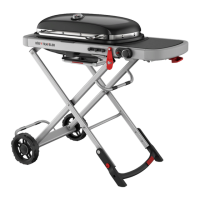
Highlights of the grill, including its folding cart, porcelain-enameled grates, and built-in thermometer.
Instructions on how to safely operate the grill's unique raising and lowering mechanism.
Essential information on LP gas properties and safe handling of gas cylinders.
Step-by-step guide for safely connecting and disconnecting the gas cylinder.
Safety advice for storing and transporting the grill, especially with the LP cylinder.
Procedure to check the gas system for leaks using a soap and water solution.
Recommended first-time use heating process for the grill to prepare it for cooking.
Essential daily checks and cleaning for grease management system before each use.
Steps for preheating the grill and cleaning cooking grates for optimal results.
Instructions on using the ignition system to start the grill burners safely.
Proper procedure to turn off the grill burners to ensure safety.
Comprehensive guide to cleaning the cookbox, lid, and burner components.
Instructions for cleaning burner ports and spider screens for optimal performance.
Methods for cleaning stainless steel, painted, and plastic exterior parts.
Diagnosing and resolving issues when the grill burner fails to ignite.
Troubleshooting problems related to gas supply, burner flame patterns, and smells.
Addressing issues like peeling paint appearance and excessive flare-ups during cooking.
Advice on preheating, grate care, and technique for achieving optimal grilling results.
Tips on flipping food, monitoring temperature, and using essential grilling tools.
Illustrated guide to identify and order replacement parts for the grill.
The Weber Traveler LP grill is a portable gas grill designed for outdoor use, offering convenience and versatility for grilling on the go. Its primary function is to cook food using liquid propane gas, providing a compact and easy-to-transport grilling solution.
The grill operates by connecting to a 16.4 oz./465 g (1.02 lbs) disposable LP cylinder, which fuels a single burner. The burner's heat is distributed evenly across porcelain-enameled, cast-iron cooking grates, designed for superior heat retention and consistent cooking. A built-in thermometer in the lid allows users to monitor the internal temperature of the grill, enabling precise heat adjustments for various cooking needs. The ignition system uses a spark from an igniter electrode, activated by pushing an igniter button, to light the burner. The burner control knob allows users to adjust the flame intensity from off to start/high.
The Weber Traveler is built with a folding cart for easy transport and storage. To set up the grill, the cart lock is moved to the unlocked position, and the grill is lifted from the end of the side table frame until it clicks into the raised position. When raising or lowering, it's crucial to stabilize the grill by placing a foot on the foot stand and grasping the end of the side table frame. The automatic lid lock engages when the grill is lowered, keeping the lid closed and cooking grates in place, further securing it for transport. For added convenience, the foot stand can be rotated upward in the folded position, providing areas for lifting the grill into storage or transportation.
Before each use, a "Meal-to-Meal Maintenance" routine is recommended, which includes checking for grease accumulation in the slide-out catch pan and disposable drip tray. The grease management system efficiently funnels grease away from the food into this disposable container, which should be cleaned or replaced regularly to prevent fires. Preheating the grill is a critical step for successful grilling, preventing food from sticking and ensuring proper searing. The grill should be preheated on the highest setting for 10 to 15 minutes, or until the lid thermometer reaches 500° F (260° C). After preheating, the cooking grates should be brushed with a stainless steel bristle grill brush to remove any leftover food debris.
The grill features a side table with tool hooks, providing a convenient workspace for platters, seasonings, and essential grilling tools, keeping them within arm's reach and organized. The compact design allows the Traveler to fit easily in a car trunk or small storage spaces.
Safety is paramount when using the grill. It must only be used outdoors in a well-ventilated area, away from combustible materials, and never in enclosed spaces or vehicles. The LP cylinder must be installed correctly, and a leak check should be performed after installation and every time the gas fitting is disconnected and reconnected. This involves applying a soap and water solution to the connections and checking for bubbles, which indicate a leak. If a leak is detected, the grill should not be operated, and the issue must be resolved before further use.
Regular cleaning and maintenance are essential to ensure the grill's optimal performance and longevity. A thorough cleaning is recommended at least twice a year, or quarterly with consistent use, and before storing the grill vertically. The cleaning process should start from the top down, with the grill turned off and cool.
The inside of the lid can accumulate carbonized grease and smoke vapors, which may peel off and resemble paint flakes. This "paint-like" residue is non-toxic but should be brushed off with a stainless steel bristle grill brush to prevent it from falling onto food. Wiping the inside of the lid with a paper towel after grilling, while still warm, can help minimize build-up.
The porcelain-enameled, cast-iron cooking grates should be brushed clean with a stainless steel bristle grill brush after preheating.
The burner requires specific attention to its ports and spider/insect screens for optimum performance. The burner ports, which are small openings along the length of the burner, should be cleaned with a stainless steel bristle grill brush, brushing across the top of the burner. Care should be taken not to damage the ignition electrode during this process. The spider/insect screens, located at the ends of the burner behind the control panel, prevent spiders and other insects from building nests inside the burner tubes. These screens should be cleaned with a soft bristle brush to ensure proper oxygen flow to the burners.
The cookbox should be inspected for grease accumulation and food particles. A plastic scraper can be used to scrape debris off the sides and bottom of the cookbox into the slide-out catch pan. The grease management system, including the slide-out catch pan and disposable drip tray, should be regularly cleaned and replaced as part of the meal-to-meal maintenance.
For the exterior surfaces, different cleaning methods are recommended based on the material. Stainless steel surfaces should be cleaned with a non-toxic, non-abrasive stainless steel cleaner or polish and a microfiber cloth, following the grain of the steel. Abrasive pastes, cleaners with acid, mineral spirits, or xylene should be avoided as they can damage the finish. Painted, porcelain-enameled, and plastic components can be cleaned with warm soapy water and a paper towel or cloth, followed by rinsing and thorough drying. In harsh environments, such as coastal areas or near pools, more frequent cleaning with warm soapy water, rinsing, and drying is advised, along with weekly application of a stainless steel cleaner to prevent surface rust.
The manual also emphasizes the importance of using genuine Weber-Stephen parts for any repairs or replacements to maintain warranty protection and ensure safe operation. Any unauthorized conversion of a gas grill will void the warranty.
 General
| Type | Portable Gas Grill |
|---|---|
| Cooking Area | 320 square inches |
| Burners | 1 |
| Fuel Type | Propane |
| Warranty | 5 years |
| Grate Material | Porcelain-enameled cast iron |
| Lid Material | Porcelain-enameled |


 To Next Page