
 Need help?
Do you have a question about the Weber TRAVELER and is the answer not in the manual?
Steps to take if you smell gas, including shutting off, extinguishing flames, and contacting services.
Safety guidelines for installing and assembling the barbecue, including warnings against modifications.
Safe operating practices, including outdoor use, clearance from combustibles, and handling hot parts.
Safety advice for storing the barbecue, including gas supply shut-off and cylinder storage.
Instructions for raising the barbecue unit into its operational position.
Detailed steps for safely lowering the barbecue, including handling the release lever and maintaining grip.
Guidelines for safely handling and storing disposable gas cartridges.
Step-by-step instructions for installing the disposable gas cartridge.
Instructions for safely removing the disposable gas cartridge from the barbecue.
Detailed steps for checking gas connections using a soap and water solution.
Step-by-step guide for igniting the barbecue using the built-in ignition system.
Diagnosing and resolving issues when the barbecue burner fails to ignite.
Steps to check wires and igniter button for spark creation.
Identifying and resolving issues related to insufficient gas flow or improper burner flame.
Troubleshooting gas leaks, incomplete connections, or damaged regulator couplings.
The Weber Traveler LPG Owner's Manual describes a portable gas barbecue designed for outdoor use. This appliance is intended to provide a convenient and enjoyable barbecuing experience, featuring a compact, folding design for easy transport and storage.
The Weber Traveler is a gas barbecue that uses liquefied petroleum gas (LPG) from disposable cartridges (EN 417, 80% butane/20% propane, 430g-460g capacity) as its fuel source. It is equipped with a single burner that provides heat for cooking. The barbecue features porcelain-enamelled, cast-iron cooking grates designed for even heat distribution and superior heat retention, allowing for proper searing and cooking of various foods. A built-in thermometer on the lid allows users to monitor the internal temperature of the barbecue, aiding in heat adjustment for optimal cooking. The ignition system uses a spark from an igniter electrode, activated by a push-button, to light the burner. The burner control knob allows for adjustment of the flame intensity, from off to start/high positions.
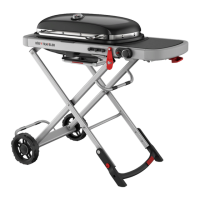
The barbecue is designed with a grease management system that funnels grease away from food into a slide-out catch pan, which holds a disposable drip tray. This system helps prevent grease fires and simplifies cleanup. The cart itself is foldable, allowing the barbecue to be easily transported and stored in a compact form. An automatic lid lock engages when the barbecue is lowered to the down position, keeping the lid closed and cooking grates in place during transport. The cart also features a foot stand for stability during setup and use, and side tables with tool hooks to keep cooking essentials within reach.
The Weber Traveler is designed for ease of use and portability. To set up the barbecue, the cart lock is moved to the unlocked position, and the barbecue is lifted from the end of the side table frame until it clicks into the raised position. It is crucial to keep a foot on the foot stand for stability during this process. When lowering the barbecue for storage or transport, the burner control knob must be in the off position, the lid closed, and the barbecue allowed to cool completely. The LP cartridge should be removed by turning off the regulator valve and then rotating the cartridge anticlockwise. The slide-out catch pan should be checked and cleaned. To lower the cart, the release lever beneath the side table is disengaged, and the barbecue is slowly guided down, maintaining a steady grip on the frame. Once folded, the automatic lid lock engages, and the cart lock can be fastened over a pin to secure it. The foot stand can be rotated upward for even more compact storage or easier lifting into a vehicle.
Before each use, an initial burn-off is recommended by heating the barbecue on the highest setting with the lid closed for at least 20 minutes. This helps to clean the grates and prepare the barbecue for cooking. Preheating the barbecue for 10-15 minutes with all burners on start/high is critical for preventing food from sticking and achieving proper searing. The built-in thermometer helps monitor this preheating process.
Connecting the LP cartridge involves ensuring seals are in place, turning off the burner control knob and regulator gas control valve, then pushing the cartridge into the regulator and turning it clockwise until tight. A leak check is mandatory after connecting the cartridge and every time a gas fitting is disconnected and reconnected. This involves applying a soap and water solution to fittings and checking for bubbles, which indicate a leak. If a leak is detected, the barbecue should not be operated, and the gas supply should be turned off.
Igniting the barbecue requires opening the lid, ensuring the burner control knob is off, turning on the gas supply via the regulator gas control valve, pushing in and turning the burner control knob to start/high, and then repeatedly pushing the red igniter button until the burner lights. If ignition does not occur within five seconds, the burner control knob should be turned off, and five minutes allowed for accumulated gas to dissipate before attempting again. To extinguish burners, the control knob is pushed in and turned clockwise to the off position.
Regular cleaning and maintenance are essential for the longevity and optimal performance of the Weber Traveler. A thorough cleaning of the barbecue's interior is recommended at least twice a year, or more frequently with consistent use. This involves cleaning the lid, cooking grates, burner, and spider screens.
For the lid, any carbonised grease flakes, which can resemble peeling paint, should be brushed off with a stainless steel bristle barbecue brush. Wiping the inside of the lid with a paper towel while the barbecue is still warm (but not hot) can minimise build-up.
Cooking grates should be brushed with a stainless steel bristle barbecue brush immediately after preheating to remove any food debris.
The burner requires cleaning of its ports and spider screens. The burner ports (small openings along the length of the burner) should be cleaned by brushing across them with a clean stainless steel bristle barbecue brush, avoiding brushing lengthwise. The ignition electrode should also be carefully brushed around to prevent damage. The spider/insect screens, located at the ends of the burner where it meets the valve, should be cleaned with a soft bristle brush to prevent obstructions that can affect gas flow and combustion.
The grease management system, including the slide-out catch pan and disposable drip tray, must be checked and cleaned before each use to prevent grease build-up and potential fires. Debris from the cookbox should be scraped into the catch pan using a plastic scraper.
The exterior surfaces, including stainless steel, porcelain-enamelled, and plastic components, should be cleaned regularly. Stainless steel surfaces should be cleaned with a non-toxic, non-abrasive stainless steel cleaner or polish and a microfibre cloth, cleaning in the direction of the grain. Abrasive pastes, acids, mineral spirits, xylene, oven cleaner, or abrasive cleaning pads should not be used. Painted, porcelain-enamelled, and plastic components can be cleaned with warm soapy water and paper towels or a cloth, followed by rinsing and thorough drying. In harsh environments (coastal areas, near pools), more frequent cleaning of the exterior with warm soapy water, rinsing, and drying is recommended, possibly with weekly application of a stainless steel cleaner to prevent rust.
The gas hose assembly should be inspected for signs of cracking, abrasions, or cuts. If any damage is found, the barbecue should not be used, and the hose must be replaced with a WEBER authorised replacement hose. The regulator coupling with the LP cylinder should also be inspected for damage.
When storing the barbecue, especially for extended periods, it should be thoroughly cleaned, and the LP cylinder disconnected and stored outdoors, out of reach of children, and not in an enclosed space. The barbecue itself can be stored indoors only if the LP cylinder is disconnected and removed. During storage or transit, additional items should not be stacked on the barbecue, and it should not be moved while in use or hot.
 General
| Type | Barbecue |
|---|---|
| Heat source | Gas |
| Total power | 3800 W |
| Cooking area | 2065 cm² |
| Adjustable thermostat | - |
| Number of cooking zones | 1 zone(s) |
| Castor wheels | Yes |
| Number of wheels | 2 wheel(s) |
| Form factor | Cart |
| Lid features | Locking lid |
| Product color | Black, Grey |
| Housing coating | Enamel |
| Housing material | Steel |
| Top surface type | Grate |
| Built-in capability | No |
| Cooking surface shape | Round |
| Cooking surface coating | Enameled |
| Cooking surface material | Cast iron |
 Weight and Dimensions
| Depth | 584 mm |
|---|---|
| Width | 1108 mm |
| Height | 945 mm |
| Weight | 28141 g |


 To Next Page
