Weldmatic 215Operators Manual
Model No. CP111-0, Iss A 02/05 11
Quality, Reliability, Performance
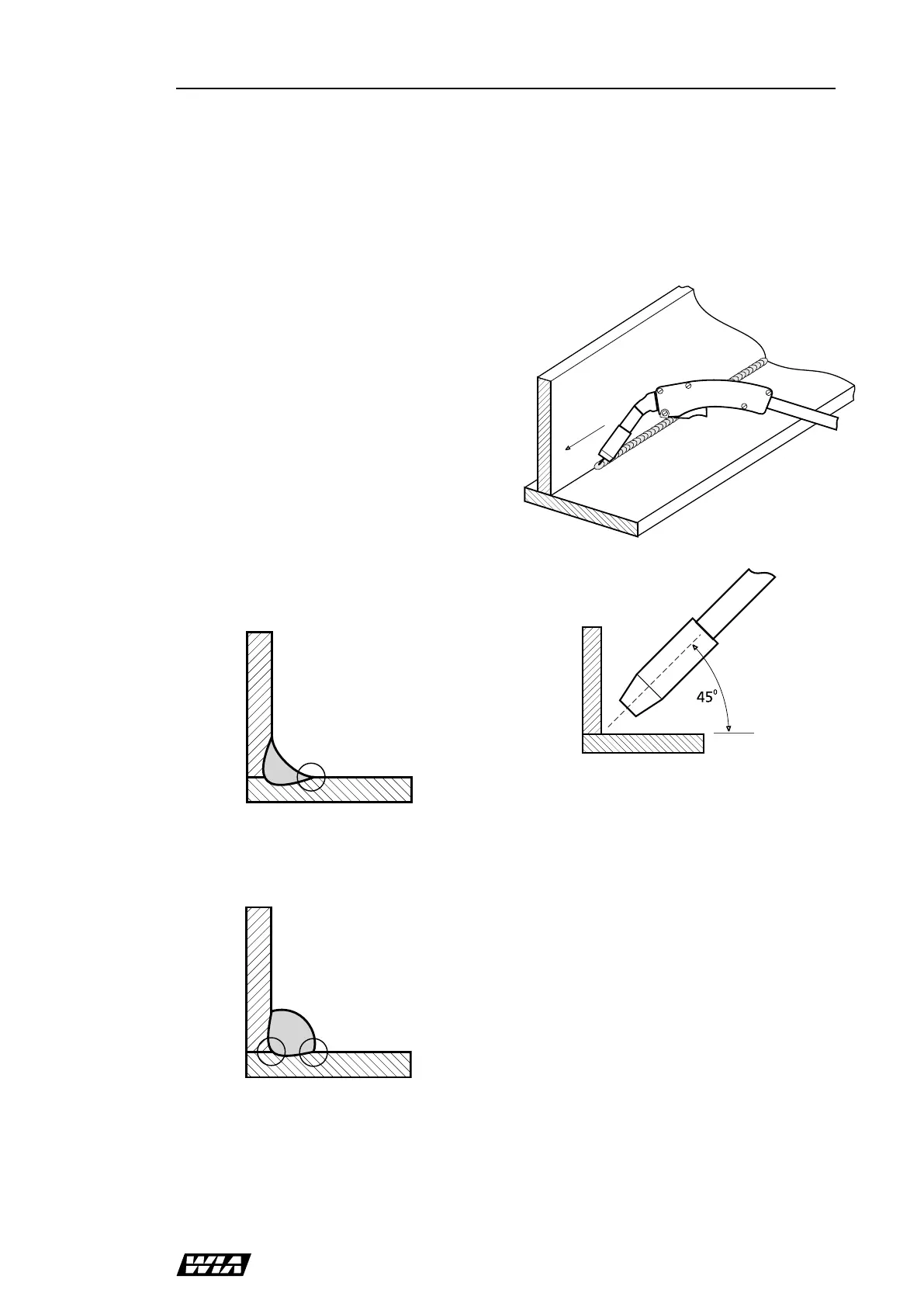
Fig 4 “Good” Weld
Fig 5 “Bad” Weld
Fig 6 Gun Position
Gun Position
For “down hand” fillet welding, the gun is
normally positioned as shown in Figure 6 below
with the nozzle end pointing in the direction of
travel.
If the voltage is too low the wire will stub and
stutter, and there will not be a steady arc. If
the voltage is too high the arc will be long with
metal transfer occurring as a series of large
droplets.
Important: Do not operate the Voltage
Control switches during welding.
The weld setting should be chosen to suit the
application and the thickness of the metal to
be welded. It is important to check that the
deposited weld provides sufficient strength to
suit the application.
A “good” weld will have the characteristics
illustrated in Figure 4. The weld has penetrated
into the parent metal, fusing the root of the
joint where the two plates meet, and the weld
blends smoothly into the side walls.
A “bad” weld is shown in Figure 5. The weld
has not penetrated the joint root, and there is
poor side wall fusion. This lack of fusion would
normally be corrected by increasing the arc
voltage, or by increasing both wirefeed speed
and arc voltage to achieve a higher current
weld setting.


 To Next Page