Need help?
Do you have a question about the Wen 6528 and is the answer not in the manual?
Guidelines for maintaining a safe and clear workspace.
Precautions for safe use of electrical power tools.
Essential personal protective measures for tool operation.
Proper handling, usage, and maintenance of power tools.
Procedures for keeping tools in good working order.
Safety measures during the operation of the hand planer.
Safety considerations during tool maintenance and adjustments.
Guidance on proper grounding for electrical safety.
Recommendations for selecting and using extension cords.
How to utilize the safety kickstand for stability.
Instructions for attaching dust collection systems.
Procedure for powering the planer on and off.
How to set the desired depth of cut.
Guidance on selecting the appropriate feed rate.
Proper planing direction relative to wood grain.
Step-by-step guide for operating the hand planer.
Creating chamfers using the V-grooves.
How to perform rabbeting cuts with the planer.
Instructions for blade replacement and maintenance.
Procedures for cleaning the planer.
How to inspect and replace carbon brushes.
Information on tool lubrication and greasing.
How to inspect and replace the drive belt.
When and how to replace noisy bearings.
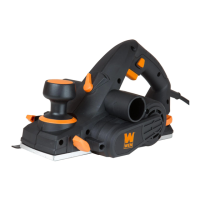
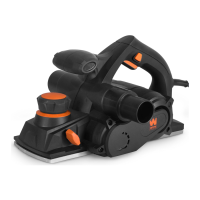
The WEN 2-3/8-inch hand planer is a versatile and dependable power tool designed for a variety of woodworking tasks, offering ease of operation and operator safety. It is engineered to provide years of rugged, trouble-free performance when properly cared for and used for its intended purpose. This manual outlines its functions, usage, and maintenance to ensure safe and reliable service.
The WEN hand planer is primarily used for smoothing and shaping wood surfaces by removing thin layers of material. It is equipped with a rotating blade drum that houses two reversible planer blades, allowing for efficient material removal. The tool features an adjustable front shoe that controls the cutting depth, enabling precise and consistent planing. With a maximum cutting depth of 1/16 inch, it can handle both rough cuts and fine finishing. The planer also includes specialized V-grooves in the front shoe, designed for creating quick and easy chamfers along the corners of workpieces. Additionally, it is capable of making rabbeting cuts up to 1/3 of an inch, expanding its utility for joinery and other woodworking applications.
The planer is designed with user safety in mind, incorporating a safety kickstand that prevents the blades from contacting the work surface when the tool is not in use. This kickstand automatically retracts when the planer crosses the leading edge of the workpiece during operation. For dust management, the tool features a chip extraction port, allowing connection to a dust extraction system or dust bag to maintain a clean work area and reduce exposure to wood dust. The motor is designed for efficiency and durability, with easily replaceable carbon brushes to ensure consistent performance over time. The drive belt, which transmits power to the blade drum, is also designed for inspectability and replacement, contributing to the tool's longevity.
Operating the WEN hand planer involves several key steps to ensure both effectiveness and safety. Before any operation, it is crucial to secure the workpiece to a stable platform using clamps or other practical methods, as unstable support can lead to loss of control and personal injury. The planer should always be held firmly with both hands for maximum control during use.
To adjust the cutting depth, the depth adjustment knob is rotated until the indicator arrow aligns with the desired depth on the gauge. Turning the knob clockwise increases the cutting depth, while counter-clockwise rotation decreases it. It is recommended to make multiple progressive cuts, removing small increments of material (e.g., less than 1/64 inch per pass) to achieve the total desired cutting depth and ensure an even, smooth finish. The minimum cutting increment is 1/128 inch, with a maximum of 1/16 inch. When not in use, the depth gauge should be set to "0," and the safety kickstand engaged to prevent accidental blade contact.
When planing, it is essential to always work along the grain direction of the wood. Planing against the grain, or planing end grain, can cause the wood to splinter or even explode, posing a serious risk of injury and damage to the workpiece and tool. The planer should be started before the blades contact the workpiece, allowing them to reach full speed. During operation, gentle forward pressure should be applied, starting with pressure on the front of the tool and shifting to the rear towards the end of the planing stroke. The tool should be pushed beyond the edge of the workpiece without tilting it downwards, and then turned off, allowing the cutter to stop completely before setting it down.
For chamfering, the V-grooves in the front shoe are utilized. The appropriate V-groove (large or small) is aligned with the corner edge of the workpiece, ensuring the blades are not touching. Steady pressure is applied to the front shoe, keeping the V-groove flat on the edge to be beveled, and the planer is pushed forward along the grain. Rabbeting cuts are performed similarly, with the planer capable of cutting up to 1/3 inch deep, limited by the tool's housing. Multiple progressive cuts are recommended for achieving the desired rabbeting depth.
The tool is equipped with a trigger lock to prevent unintentional start-ups. To turn the planer on, the trigger lock is pressed, and then the trigger switch is squeezed. Releasing the trigger switch turns the tool off. For dust management, the 1-1/4 inch chip extraction port can be connected to a dust extraction system or bag. If shavings jam the port, especially when cutting damp wood, they should only be cleared with a stick after the cutter has stopped running and the tool has been unplugged from the power source.
Proper maintenance is crucial for the longevity and safe operation of the WEN hand planer. Before performing any adjustments, changing parts, or storing the tool, it is imperative to disconnect the power cord plug from the electrical outlet to prevent accidental start-ups. All protection and safety devices must be in place and in good working order after any repair or maintenance procedures.
The planer blades are sharp and fragile, requiring the use of protective work gloves when removing or installing them. The blades are reversible, each having two cutting edges. If one edge becomes dull, the blade can be reversed. If both edges are dull, they should be replaced with new ones. It is critical to replace both blades as a matched set to maintain balance and prevent vibration, which can lead to poor planing action and shorten the tool's life. Only blades designated for this model (Model 6528B) should be used, as sharpening or using resharpened blades is not recommended and can cause clamping issues and decreased performance.
To replace blades, the planer is placed upside down on a secure work surface, and the blade drum is carefully rotated to expose the three clamping screws. These screws are loosened using the onboard blade wrench. The blade is then carefully slid out, or pushed out with a wooden block. Before installing new or reversed blades, the blade drum and blade should be cleaned of any chips or foreign matter using a soft brush or compressed air. The blade is then slid into the blade retainer with the good side up, ensuring it is positioned in the center of the blade drum, with the flat side facing the front of the planer and the ridged side facing the back. The cutting edge must be absolutely level and parallel to the surface of the rear shoe, with both ends protruding evenly. All clamping screws must be tightened carefully and securely, as a loose screw can be extremely dangerous. After changing blades, the blade drum should be rotated manually to ensure the blades do not hit any part of the blade head housing.
Regular cleaning of the planer is essential. Wood chips, dust, dirt, and debris should be kept clear from ventilation openings and switch levers. Compressed dry air is effective for cleaning these components, always while wearing safety goggles. Care should be taken not to use pointed objects to clean openings. Certain cleaning agents and solvents, such as gasoline, carbon tetrachloride, ammonia, and household detergents containing ammonia, can damage plastic parts and should be avoided.
For maintaining motor efficiency, the carbon brushes (Model 6530-038) should be inspected and replaced every 60 hours of operation. This involves unscrewing and opening the motor cover, carefully removing the old brushes with pliers, and installing new, genuine WEN replacement brushes. The motor cover is then replaced and secured. The tool's gears are pre-lubricated but should be regreased with a special gear lubricant at every carbon brush change. The drive belt should also be inspected every 60 hours for signs of drying, cracking, tearing, or improper tracking, and replaced if necessary. This involves unscrewing and opening the belt cover, replacing the belt, and closing the cover. Bearings that become noisy due to heavy load or abrasive material cutting should be replaced by a qualified technician as soon as possible to prevent overheating or motor failure.
Adhering to these maintenance guidelines will help ensure the WEN hand planer remains in optimal working condition, providing safe and reliable service for years to come.
 General
| Model | 6528 |
|---|---|
| Type | Planer |
| Power | 15 Amp |
| Max Cutting Depth | 1/8 inch |
| Weight | 68 pounds |
| Amperage | 15 Amps |
| Cord Length | 6 feet |
| Maximum Cutting Depth | 1/8 inch |
| Maximum Cutting Width | 12 inches |
| Dust Port Size | 2-1/2 in. |
| No Load Speed | 34, 000 RPM |


 To Next Page