32
LEANING LADDER GUIDELEANING LADDER GUIDE
•
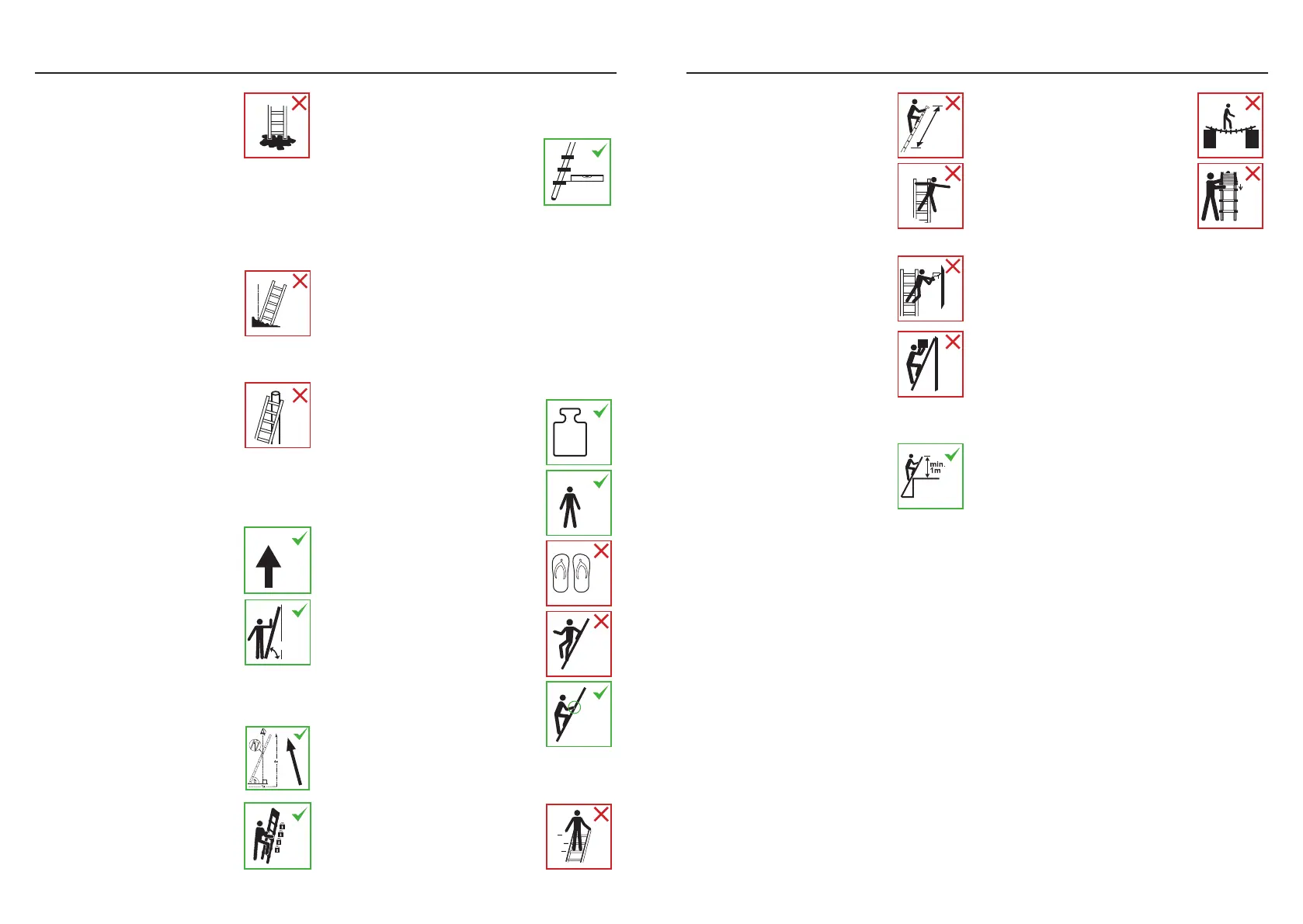
Do not erect ladder on
contaminated ground.
Ladders shall not be
positioned on slippery
OI
2
O
surfaces (such as ice, shiny surfaces
or significantly contaminated solid
surfaces) unless additional effective
measures are taken to prevent the ladder
slipping or ensuring contaminated
surfaces are sufficiently clean.
•
Do not use the ladder on an
unlevel or unfirm base.
•
Ladder shall be on an even, level and
unmovable base.
•
Do not lean the ladder
against unsuitable surfaces.
Leaning ladder should lean
against a flat non-fragile
surface and should be
secured before use e.g. tied
or use of a suitable stability
device.
•
Only use the ladder in the
direction as indicated.
UP
•
Ladder shall be erected at
the correct position, such
as the correct angle for a
leaning ladder (angle of
inclination approximately
1:4) with the rungs or treads
level.
65-75º
•
Keep the arrow vertical for
correct working angle.
•
All locking mechanisms for
all extended rungs/steps
shall be checked and be
locked before use.
•
Ladder should be stood on its feet, not
the rungs or steps.
•
Leaning ladders with steps,
shall be used that the steps
are in a horizontal position.
•
Secure ladder at the top and bottom
wherever possible. If not, station
someone at the foot of the ladder.
•
Do not move a ladder while standing
on it.
•
Ladder shall never be repositioned from
above.
USING THE LADDER
•
Do not exceed the maximum
total load (load includes
users, tools, materials, etc.).
max.
150
kg
•
Maximum number of users
on the ladder.
max. 1
•
Do not wear unsuitable
footwear when climbing a
ladder.
•
Do not ascend or descend
unless you are facing the
ladder.
•
Keep a secure grip on the
ladder when ascending
and descending. Maintain
3 points of contact whilst
working from a ladder
or take additional safety
precautions if you cannot.
•
Do not stand on the top
three steps/rungs of a
leaning ladder.
1
2
3
•
Do not stand on the last
metre of a telescopic ladder
1 m
•
Do not overreach, user
should keep their belt buckle
(navel) inside the stiles and
both feet on the same step/
rung throughout the task.
•
Avoid work that imposes a
sideways load on ladders,
such as side-on drilling
through solid materials.
•
Do not carry equipment which
is heavy or difficult to handle
whilst using a ladder.
KG
•
Equipment carried while using a ladder
should be light and easy to handle.
•
Leaning ladders used for
access to a higher level shall
be extended at least 1m
above the landing point and
secured if necessary.
•
Use non-conductive ladders for
unavoidable electrical work.
•
Secure doors (not fire exits) and
windows where possible in the work
area.
•
Do not use the ladder outside in
adverse weather conditions, such as
strong wind.
•
When outdoors, be cautious in windy
conditions.
•
Ladders should only be used for light
work of a short duration.
•
Do not spend long periods on the
ladder without regular breaks (tiredness
is a risk).
•
Do not use the ladder as a
bridge.
•
Do not bring your hands/
fingers in rung area (area
of shearing) when bringing
the ladder in to its possible
position of use.
•
Take precautions against children
playing on the ladder.
PN127521-01_IM_TelescopicLadder_A5_Rev A 0922.indd 2-3PN127521-01_IM_TelescopicLadder_A5_Rev A 0922.indd 2-3 03/10/2022 15:3403/10/2022 15:34


 To Next Page
 Loading...