This document is the user manual for the Westinghouse WGen9500 Portable Generator, a robust power solution designed for various applications, from home backup to job site use. The manual provides comprehensive instructions for operation, maintenance, and safety, ensuring users can maximize the generator's performance and longevity.
Function Description
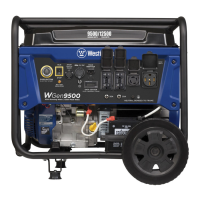
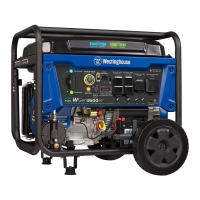
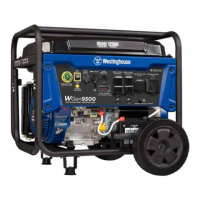
The Westinghouse WGen9500 is a portable generator designed to provide electrical power for a wide range of devices and appliances. It features both push-button electric start and remote start capabilities, making it convenient to operate. The generator is equipped with a powerful engine that delivers substantial running and peak wattage, suitable for powering essential home appliances during outages, tools at a job site, or equipment for outdoor events. It includes multiple AC outlets, including GFCI-protected duplex outlets, twist-lock outlets, and a 50A outlet, along with DC USB ports, offering versatility in power delivery. A VFT Data Center on the control panel provides real-time information on voltage, frequency, total hour meter, and run/maintenance timer, aiding in monitoring and maintenance scheduling. The generator also incorporates safety features such as circuit breakers and a low oil shutdown switch to protect both the unit and connected devices.
Important Technical Specifications
Power Output:
- Gasoline Running Watts: 9500
- Gasoline Peak Watts: 12500
- Running Amps: 79A @ 120V, 39.5A @ 240V
- Peak Amps: 104A @ 120V, 52A @ 240V
- AC Voltage: 120/240 Volts
- DC Voltage: 5 Volts
- AC Frequency: 60 Hz
- Total Harmonic Distortion (THD): <23%
Engine and Fuel:
- Engine Displacement: 457cc
- Engine Brand: Westinghouse
- Engine Type: OHV 4 Stroke
- Engine RPM: 3600
- Fuel Tank Material: Steel
- Fuel Tank Capacity: 6.6 gallons (25 L)
- Fuel Type: Unleaded Gasoline, 10% Ethanol or less
- Fuel Shut Off: Manual
- Engine Lubrication: Splash
- Recommended Oil: SAE 10W30
- Oil Capacity: 1.1 qt. (37.2 oz)
- Spark Plug (included): Torch F7TC
Run Time:
- Run Time at 25% Load: 17.5 hrs.
- Run Time at 50% Load: 12 hrs.
Dimensions and Weight:
- Assembled Length: 27 in (687mm)
- Assembled Width: 22 in (555mm)
- Assembled Height: 22 in (567mm)
- Dry Unit Weight: 216 lb. (98kg)
- Shipping Weight: 227 lb. (103kg)
Other Specifications:
- Starting System: Electric, Remote, Recoil
- Battery Included: Yes
- Battery Charger Included: Yes (factory paired)
- Remote Start Fob Included: Yes
- Remote Start Distance: 109 yd. (100 m.)
- Push Button Start: Yes
- Mobile App Compatible: No
- Parallel Capable: No
- Automatic Voltage Regulator (AVR): Yes
- Low Idle Control: Yes
- Operational Volume: As low as 74 dBA
- Emissions: EPA, CARB
- Residential Warranty: 3 Years
- Commercial Warranty: 1 Year
Usage Features
The WGen9500 is designed for user-friendly operation with several convenient features:
- Remote Start: The generator can be started and stopped remotely using a key fob from up to 109 yards away, offering convenience, especially in adverse weather conditions. The key fob comes pre-paired, but instructions are provided for re-pairing if needed.
- Push Button Electric Start: For direct operation, a push-button electric start simplifies the startup process. The engine automatically sets the choke and initiates the start sequence.
- Recoil Start: A traditional recoil start is available as a backup for manual starting, ensuring operation even if the battery is low or disconnected.
- VFT Data Center: This digital display provides critical operational data at a glance, including voltage, frequency, total hour meter, and a run/maintenance timer. The maintenance timer includes reminders for oil changes and air filter cleaning, helping users adhere to the maintenance schedule.
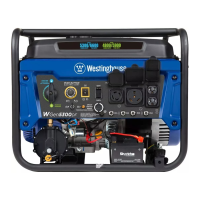
- Multiple Outlets: The control panel features a variety of outlets to accommodate different power needs:
- Two 120V 20A Duplex GFCI Outlets (NEMA 5-20R)
- One 120/240V 30A Twist Lock Outlet (NEMA L14-30R)
- One 120/240V 50A Outlet (NEMA 14-50R)
- Two 5V USB ports (1 amp and 2.1 amps)
- Fuel Shut-off Valve: A manual fuel shut-off valve allows users to control fuel flow to the engine, which is particularly useful for draining the carburetor for storage.
- Auto Choke: The generator features an auto choke system that works when the battery is connected, simplifying cold starts. Manual adjustment is possible if the battery is not connected.
- Never-Flat Wheels and Single Piece Handle: Equipped with never-flat wheels and a single-piece handle with a rubber grip, the generator is easy to transport and maneuver.
- Low Oil Shutdown: An automatic low oil shutdown switch protects the engine from damage by stopping it if the oil level drops below a safe threshold.
- Circuit Breakers: Main and individual circuit breakers protect the generator and connected appliances from overload conditions.
- Ground Terminal: A ground terminal is provided for connecting the generator to earth ground, as required by electrical codes, to ensure safety.
- Altitude Conversion Kit: For operation at high altitudes, an optional carburetor kit (Part Number: 140548) is available to optimize performance and reduce emissions.
Maintenance Features
The manual outlines a clear maintenance schedule to ensure the generator's optimal performance and longevity. Key maintenance features and procedures include:
- Engine Oil Maintenance:
- Checking Engine Oil: Users are instructed to check the oil level before every use, ensuring it is within the acceptable range on the dipstick.
- Adding Engine Oil: Detailed steps are provided for adding the specified SAE 10W30 oil using a funnel, with warnings against overfilling.
- Changing Engine Oil: The manual specifies intervals for oil changes (after the first 20 hours/month, then every 50 hours/6 months, or every 300 hours/year), with instructions for draining old oil and adding new.
- Air Filter Maintenance:
- Cleaning the Air Filter: The air filter should be cleaned every 50 hours of use (or more frequently in dusty conditions) by rinsing with cleansing solvent and drying, then saturating with clean engine oil.
- Replacing the Air Filter: The air filter should be replaced every 100 hours of use or every 6 months, or every 300 hours/year.
- Spark Plug Maintenance:
- Inspecting and Cleaning: The spark plug should be checked and cleaned every 100 hours of use or every 6 months.
- Replacing: The spark plug should be replaced every 300 hours of use or every year. Recommended replacement spark plug is Torch F7TC.
- Spark Arrestor Maintenance:
- Inspecting and Cleaning: The spark arrestor should be inspected and cleaned every 100 hours of use or every 6 months to prevent carbon buildup that could restrict exhaust flow.
- Draining the Carburetor Float Bowl: Instructions are provided for draining the carburetor float bowl, which is crucial for preparing the generator for prolonged storage to prevent fuel degradation and gum buildup.
- Battery Service:
- Charging: The electric start generator includes a battery charging feature that recharges the battery while the engine is running. Instructions for using the included battery charger are also provided, with a warning against overcharging.
- Replacement: Specifications for battery replacement (YTX14-BS, 12V, 14Ah) are listed, along with steps for safe removal and installation.
- Cleaning the Generator: Regular cleaning of engine air inlet/outlet ports, cooling fins, and alternator cooling air inlets/exhaust ports is recommended to prevent debris buildup and ensure proper cooling.
- Storage Procedures: Detailed steps are provided for preparing the generator for storage, including draining fuel, changing oil, and lubricating the cylinder, to prevent damage during extended periods of inactivity.
- Troubleshooting Guide: A comprehensive troubleshooting section helps users diagnose and resolve common issues such as no electrical output, engine not starting, or erratic engine performance.
- Authorized Service: The manual emphasizes contacting an authorized Westinghouse Generator dealer or service team for complex issues, altitude kits, or if parts are missing. A hotline number and email are provided for support.

 Need help?
 General

 To Next Page