Using the Self-Cleaning cycle
The self-cleaning cycle uses
very high heat
to burn away soil. Before you start,
make sure you understand exactly how to use the cycle safely.
Before you start
1.
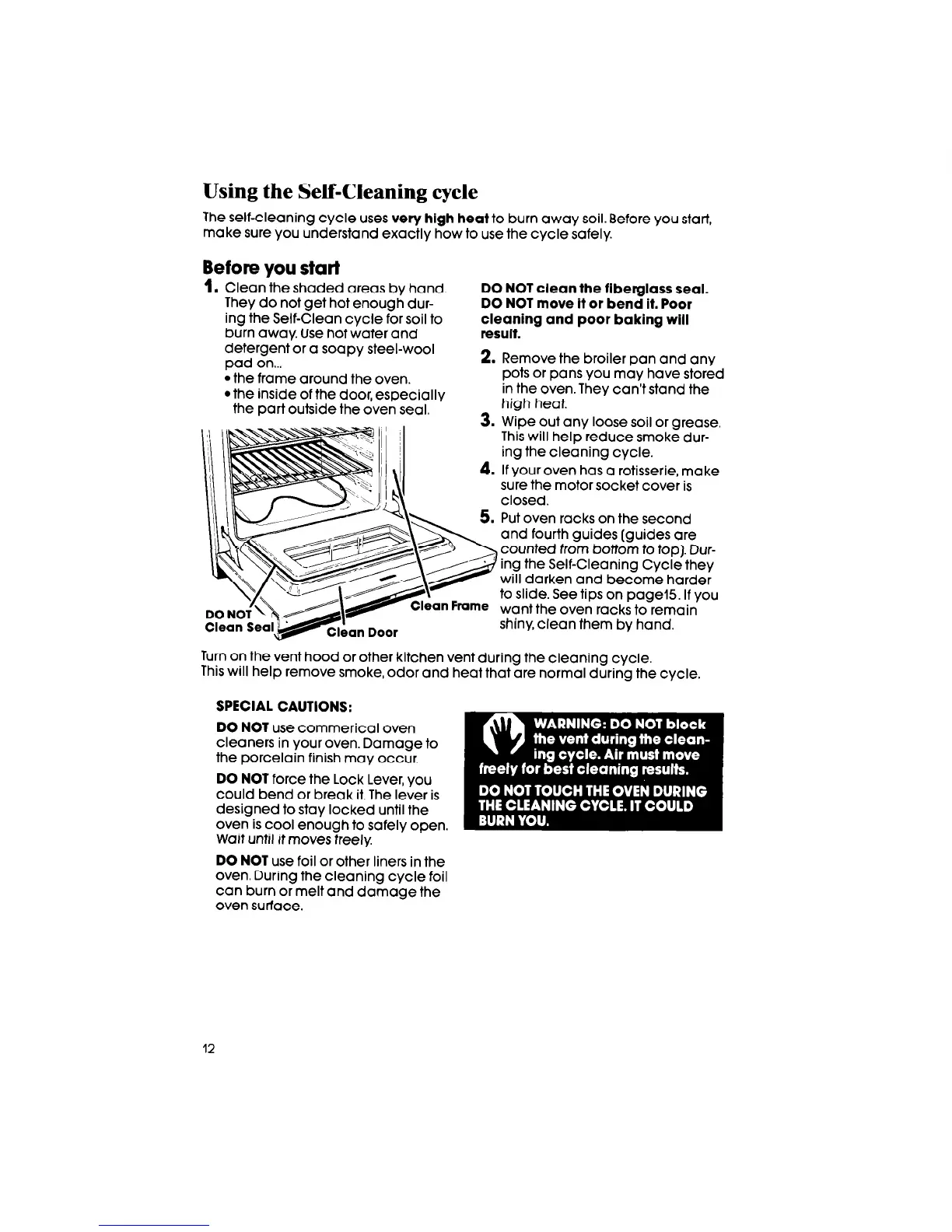
Clean the shaded areas by hand.
They do not get hot enough dur-
ing the Self-Clean cycle for soil to
burn away. Use hot water and
detergent or a soapy steel-wool
pad on...
l the frame around the oven.
l the inside of the door, especially
the part outside the oven seal.
DO NOT clean the fiberglass seal.
DO NOT move it or bend it. Poor
cleaning and poor baking will
result.
2. Remove the broiler pan and any
pots or pans you may have stored
in the oven. They can’t stand the
high heat.
a
3. wrpe out any loose soil or grease.
This will help reduce smoke dur-
ingthecleaning cycle.
4. If your oven has a rotisserie, make
sure the motor socket cover is
closed.
5. Put oven racks on the second
and fourth guides (guides are
counted from bottom to top). Dur-
rng the Self-Cleaning Cycle they
will darken and become harder
rf*anPmm*
to slide. See tips on page15. If you
want the oven racks to remain
shiny, clean them by hand.
Turn on the vent hood or other kitchen vent during the cleaning cycle.
This will help remove smoke, odor and heat that are normal during the cycle.
SPECIAL CAUTIONS:
DO NOT
use commerical oven
cleaners in your oven. Damage to
the porcelain finish may occur,
DO NOT
force the Lock Lever, you
could bend or break it. The lever is
designed to stay locked until the
oven is cool enough to safely open.
Wait until it moves freely
DO NOT
use foil or other liners in the
oven. During the cleaning cycle foil
can burn or melt and damage the
oven surface.
12



 To Next Page