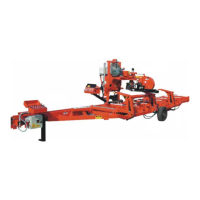
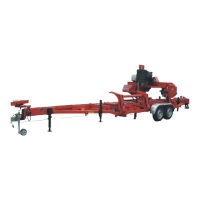
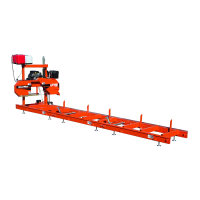
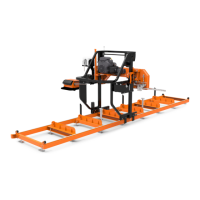
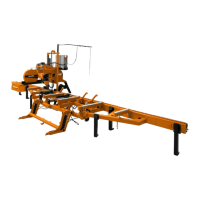
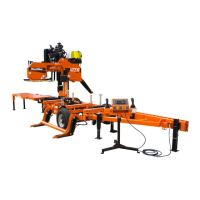
This document outlines the safety, operation, maintenance, and parts information for the D34 Engine, specifically for Wood-Mizer sawmills, including LT30, LT40, LT30HD, and LT40HD models. It serves as a supplementary manual to the equipment manufacturer's manuals, providing details specific to the engine's integration and use within these sawmills.
Function Description
The D34 Engine is a diesel engine designed to power Wood-Mizer sawmills. It is a critical component that drives the sawmill's operations, enabling the cutting and processing of wood. The manual covers various aspects of the engine, from its initial setup and starting procedures to routine maintenance and the identification of replacement parts. The engine's operation is monitored through a control panel with indicator lights for alternator charge, engine temperature, key switch status, oil pressure, and glow plugs, providing essential feedback to the operator.
Usage Features
The manual emphasizes safety as the primary concern, instructing users to read and understand all safety information and instructions before operating, setting up, or maintaining the machine. It includes specific warnings related to engine exhaust and wood dust, aligning with California's Proposition 65, advising operation in well-ventilated areas, proper exhaust venting, and the use of personal protective equipment like dust masks.
Starting the engine involves a sequence of steps, including checking the engine manufacturer's manual for lubricating oil recommendations based on temperature, using appropriate diesel fuel (#2 for above freezing, #1 for below freezing), and turning the key switch to the "on" position. A crucial step is observing the recommended glow plug "on" times, which vary with ambient temperature, ranging from 30 seconds below 32°F (0°C) to 10 seconds above 80°F (27°C). The glow plug sensing relay provides manual control over this operation. Operators are cautioned against leaving the key in the pre-start position for more than 30 seconds to prevent battery drain. Before starting, it is imperative to ensure the blade is disengaged and all persons are clear of the blade's path to prevent serious injury. The engine should only be operated in well-ventilated areas to avoid the dangers of exhaust gases. Additionally, operators must ensure the power feed switch is in the neutral position before turning the key switch to prevent accidental carriage movement. The engine should not be operated without a proper and operational spark arrester/muffler to prevent fires. After starting, a 2-minute idle time is recommended before applying a load to prevent engine damage. For engine shutoff, a minimum 2-minute idle time is recommended to allow the battery charge to recover before turning the key switch to the "off" position.
The manual also details RPM adjustments, which are critical for optimal engine performance. Before adjusting RPM, operators must ensure belt and brake strap tensions are correct and check oil, fuel, and coolant levels. The throttle solenoid linkage must be properly adjusted, with specific instructions for setting play with the clutch disengaged and engaged. Failure to properly adjust this linkage can cause damage to the solenoid. The low-end RPM should be adjusted to 1500 after the engine has idled for 10 minutes, by loosening or tightening the idle adjustment screw. The high-end adjustment screw should not be adjusted.
Maintenance Features
Maintenance is a key focus of the manual, with instructions to refer to the engine manufacturer's manual for general maintenance intervals and procedures, especially for dusty conditions. This manual specifically highlights additional or different maintenance intervals. A critical safety warning for maintenance involves cleaning sawdust from all guards, vents, and control boxes after every shift to prevent fire hazards. When performing maintenance, operators must exercise caution around rotating shafts, pulleys, and fans, ensuring loose clothing or long hair does not get caught. Engine components can become very hot during operation, so it's crucial to allow the engine to cool sufficiently before performing any service functions to avoid burns. The blade must be removed before performing any engine service to prevent serious injury, and proper safety equipment, including eye, breathing, hand, and foot protection, must always be worn.
Specific maintenance tasks and their intervals are outlined:
- Engine Oil & Filter: The oil level should be checked every 8 hours of operation, with oil added as necessary. The oil should also be inspected for water; if water is present or the oil is cloudy, the engine should not be started. In such cases, the oil and filter must be replaced, the engine run at low idle for no more than 2 minutes, and then the oil and filter replaced again. The first oil and filter change is recommended after the initial 50 hours of operation, followed by changes every 250 hours. Sawmills with muffler rain caps (after specific revisions) are noted to prevent water entry into the muffler and engine, with a recommendation to cover the muffler if stored outside or transported in rainy weather.
- Cooling System: Radiator fins should be cleaned every 8 hours of operation using water from a hose or compressed air, avoiding pressure sprayers. Failure to keep the radiator fins clear can lead to engine overheating and damage.
- Battery: The battery electrolyte level should be checked every 50 hours of operation, referring to the manufacturer's manual for instructions. A significant warning is provided regarding explosive gases expelled by batteries, emphasizing the need to keep sparks, flames, and other ignition sources away, and to wear safety goggles and a face shield when working near batteries.
- Alternator Belt: The alternator belt is self-tensioning and typically doesn't require adjustment. However, if the battery doesn't charge properly or the belt squeals after initial adjustment, it should be replaced. The replacement procedure involves releasing blade tension, removing the blade if necessary, turning off the key switch, removing drive belt and alternator covers, prying up the belt idler to remove the old belt, installing the new belt while holding the idler up, and then releasing the idler and reinstalling covers.
- Air Cleaner: The air cleaner cartridge should be replaced every 200 hours of operation, or more frequently if operating in dirty conditions or if engine performance indicates a need.
- RPM Adjustments: RPM should be checked with a tachometer every 200 hours of operation, following the detailed adjustment procedure for the throttle solenoid linkage and idle RPM.
The manual also includes detailed diagrams and parts lists for various engine components, such as the fuel tank, engine mount assembly, engine assembly, relay/throttle assembly, muffler assembly, air cleaner assembly, drive assembly, radiator assembly, alternator assembly, and engine pulley guards. Each section provides reference numbers, descriptions, part numbers, and quantities, aiding in the identification and procurement of replacement parts. This comprehensive approach ensures that operators have the necessary information to maintain the engine effectively and safely, prolonging its lifespan and ensuring reliable sawmill operation.



 To Next Page
 General