ADJUSTING THE FENCE BY CUTTER 2
In general
The front side fence has a double set of holes for
assembly. It can therefore be assembled in two
basic positions. When the TB90 system is used,
the fence will be fitted in the pair of holes on the
right, as seen from the infeed side (see assembly
of side fence). When cutters with larger
diameters are used, the fence can be moved to
the left pair of holes, so that the stroke length is
sufficient.
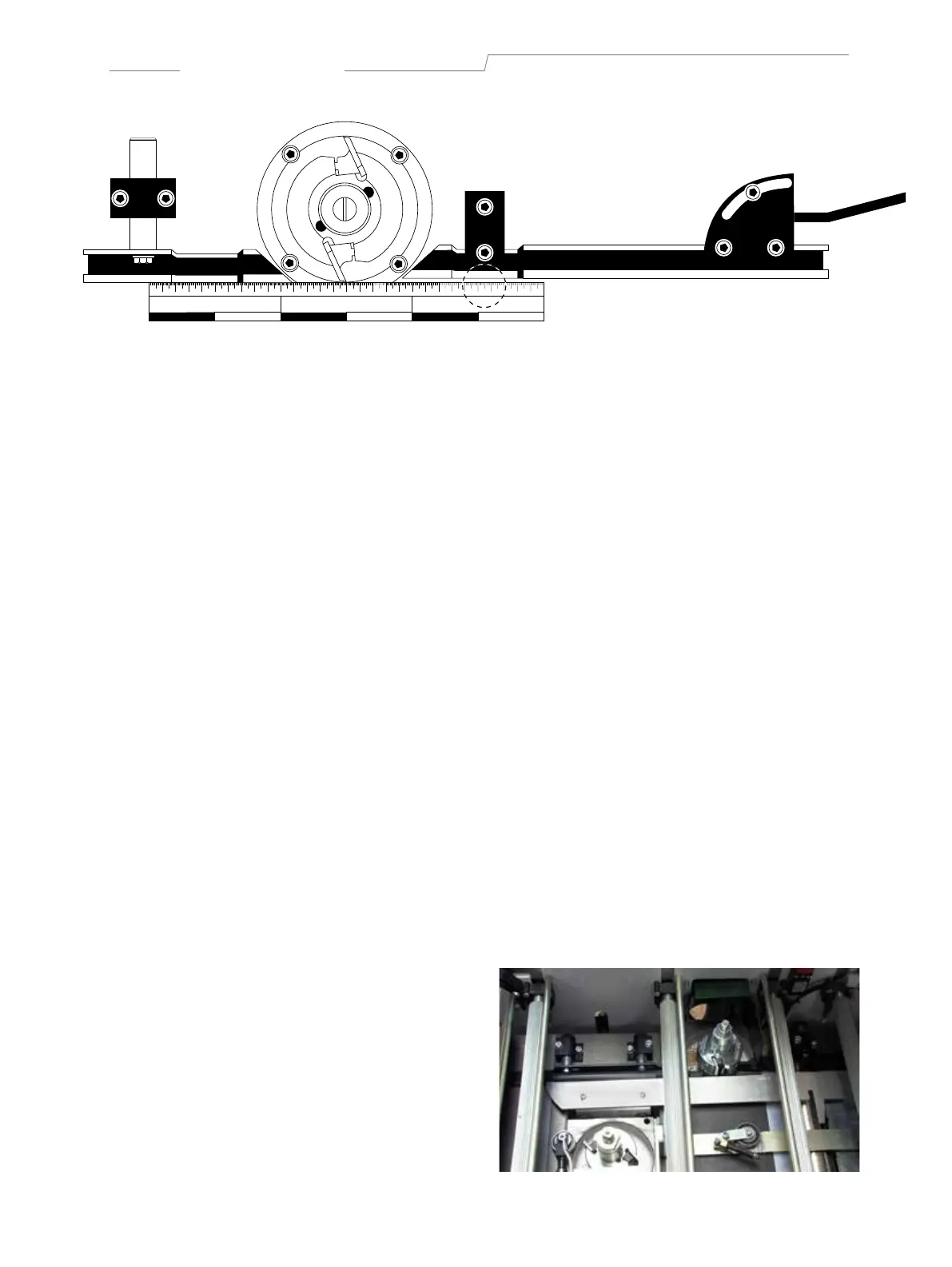
The fixed cutter has two fences, the front (62) and
the back fence (54). The front fence controls how
much the cutter cuts, and the back fence works as
a support for the workpiece when it has passed
cutter 2 and is ready to be worked by cutter 3.
Both fences must be in line with one another, but
offset in parallel so that the front fence is slightly
more to the right (see fig.). In this way, the back
fence will support the workpiece once it has been
cut by cutter 2 (the workpiece is slightly smaller
then).
The fence is fixed by socket head screws in the
fence holders (55) according to fig. The screws that
lock the fence in the horizontal direction are 13 mm
(5/10") hexagonal screws and sit in the fence's U
profile. In addition, there are micro adjustments on
the fence. When the hexagonal screws are
loosened slightly, the knob for micro-adjustments
can be turned. If the angle of the fence needs to be
adjusted, both the hexagonal and socket head
screws must be loosened.
INSTALLATION OF SIDE FENCES
Method 1:
• Insert the first fence inwards, for minimal cut-
ting. Add a straight aluminum fence rail tight
against the fence. Adjust the fence using
the lever until the loose fence rail touches
the cutter’s plane diameter (the outer
rotating line) as it lies against the first fence.
• The plane diameter that is inline with the back
fence is where you need to measure to, the
cutter’s plane diameter that is higher than 30
mm above the table height is unimportant
here.
•
Align the back fence along the guard rail, which
is still tight against the first fence and tighten it.
The cut is now 0 mm. The first fence, cutter and
back fence are fully inline, and the first fence
controls the angle through the machine.
• Remove the fence rail and all loose tools
from the machine.
• Move the first fence back to the required cut
and lock it using the tie-back knob. (Around
2 mm is usually a suitable cut for the first
cutter.)
Method 2:
• The back fence is pulled in so that it is not used,
and is fixed there. (Check that the cutter
can rotate freely.)
• Position the front fence so that the required
cut depth is obtained and the fence stands
straight. Tighten the screws that fix the fence.
• Close the safety doors and take the measures
required to start the planer/moulder.
•
Start the bottom cutter, both side cutters and the
feeder and feed in a test piece of approx. 1
meter (3 ft). Stop the planer/moulder just as the
board reaches the moveable cutter (cutter 3).
• Drive the back fence towards the planed part
of the board.
Installation jig for adjusting fences.
Wood-Mizer
®
from forest to final form


 To Next Page